Tag: learning

  • Playing with Minecraft

    Playing with Minecraft

    “Daddy, watch this,” my son said. We were sitting next to each other on the couch, and he turned his iPad to face me. I looked over and saw a house made from square blocks of wood, stone, and glass. He moved his equally blocky character closer to the door and taped the screen. I heard the chime of a doorbell, and my son smiled.

    The world of Minecraft.

    We introduced him to the game a few years ago. Between his love of Lego and other video games, I was sure it would stick, but it never did. He couldn’t articulate why, but I suspected it was because of the game’s open-ended nature. With Lego, there is a plan. With Fortnite or a sports game, there is a goal, and there are rules. With Minecraft, a player has to come up with rules and goals on their own, and I think that was challenging for him.

    Then, a few months ago, I noticed him watching YouTube videos about Minecraft. He would borrow my iPad to watch videos on it while he played the game on his device. He started to show me what he was building: hockey rinks, and skyscrapers, and elaborate homes with secret passages and trap doors. These creations would sometimes take hours to make, but he was into it.

    One day, we were figuring out how to connect to the same Minecraft world so that he could play online with friends. Once my character appeared in his world, he asked if he could show me around.

    “What’s that?” I asked.

    “That’s iron ore, ” he replied. Then he built a furnace, and he showed me how to melt the ore down into ingots. We used the ingots to craft other items like pickaxes and swords. It was very involved, but he knew the recipes. He knew the materials, the creatures, and the mechanics.

    I could see how proud of himself he was. He was the expert, and he was teaching me. So much of our life is the other way around. We have to remind him of basic things. Sequencing, processing, and retention continue to be a struggle. Even in Minecraft, he forgot some of the words. But it was reassuring to see that, with enough repetition, he could learn things well enough to be able to teach them to me.

    I didn’t realize how badly I needed to be reassured. Even though we’ve made positive changes in the last few months with the new house and the new school, the tests show regression. I can see other signs in him that some things are getting harder, too. I’m supposed to help him, but I feel helpless. I’m supposed to protect him, but I can’t protect him from this.

    But these moments we have where I see that look on his face fills my heart with joy. I know my love, my time, and my presence are what I can give him and what he needs from me. That is what will carry us through good times and bad. That is how I help, whether it is in person or in digital form in a world of his creation.

    “There, ” he said. My character stood in front of his, fully armored and with a sword and shield. “Now, we are ready for The Nether.”

    “What’s The Nether?” I asked nervously.

    He smiled. “Don’t be scared, daddy. I’ll protect you.”

  • Going Virtual

    Going Virtual

    The fourth grade started so well.

    It was the first year where my son had multiple teachers for different subjects, and each of them took a genuine interest in him. They asked how they could best support his learning. They brought us in to talk to the entire grade about epilepsy. We strengthened our relationship with his aide. The new special education teacher showed initiative and commitment by working with the other teachers and us to make sure my son’s IEP was current.

    My son seemed to be doing better than last year, too. Even though he had a modified schedule and didn’t need to, he would get up early and be ready for drop-off at the regular time with his friends. He was going to school every day of the week, and we had fewer absences than we’ve had in previous years, too.

    Of course, school was still difficult for him. The noise of the classroom and the building triggered his anxiety. The attention issues were still there. He was still drifting further behind academically and socially from the other children. He still worked with his nanny on homework and subjects he missed after he got home and rested. But we found a bit of a groove in fourth grade, more than we had before.

    And then the pandemic hit.

    For as well as the fourth grade was going in the classroom, it didn’t translate when they closed the schools and moved classes online. My son’s school was not equipped to do online schooling successfully, and they spent the rest of the school year just trying to get through it. There was a lot of homework, a few virtual class sessions, and a lot of busywork. But with the help of our nanny who also went virtual, we figured it out and made it work.

    As frustrated as my wife and I was (as were many other parents) with the quality of the “forced virtualization,” my son enjoyed the move to virtual classes. Of course, he missed seeing his friends, and the online sessions didn’t always offer a chance for the kids to interact. But he could take the lessons from the “office” we created in his room. He didn’t have the noise and anxiety that came from going into the physical school surrounded by other students.

    While we knew online schools were an option, we didn’t consider them because of my son’s age, and because one of the reasons we sent him to school was for the social aspect. But because of how well he responded to the move to virtual classes during the pandemic, my wife started looking into them as an option for fifth grade.

    Initially, I was worried about how they would deliver instruction to an 11-year-old. From what I saw of the virtual classes in his current school, I couldn’t imagine learning anything. But the first thing we picked up on talking to the online school was that it is very different when a school is set up to operate virtually versus a traditional school that is thrown into teaching online.

    The online school is also required to accommodate an IEP and might have more flexibility in accommodating my son’s schedule and his need to chunk activities during the day. They have programs in place to help students meet and connect in the real world, too. We’ll have to get creative to continue to develop his social skills, but the in-person meetings will help.

    The more we looked into it, the more that it seemed like a good thing to try for fifth grade. Forcing my son to go back to an environment that makes it more difficult for him to learn when there is another option is irresponsible. Besides, we can always go back to the traditional classroom if it doesn’t work out. But, especially with the state of the world and the uncertainty about the fall, all the signs point to trying something different.

    If you have any experience with online schooling, I would love to hear about your experiences, good and bad. Feel free to leave a comment or contact me directly.

  • Lessons From The Field

    Lessons From The Field

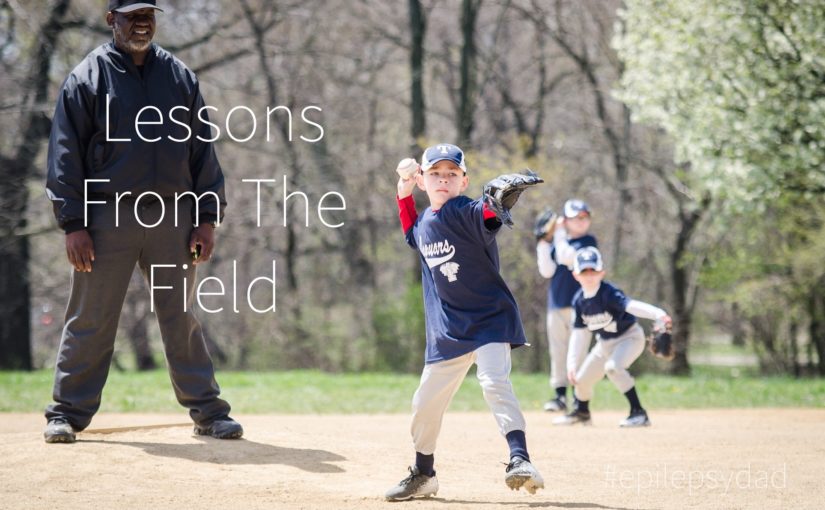
    The welcome arrival of Spring brings with it sunshine, warmer weather, and baseball. Last season was incredibly special for my son and our family because of the team we were on and the experiences that my son had. At a time when my son desperately needed something to hold on to and an outlet of his own, he found it in baseball.

    This season, we are on a new team but there is no reason to think his experience will be any different. We’re fortunate to be reunited with coaches who knew my son from when I coached him and the coaches’ daughter in tee-ball a few years ago. When we reached out to them to give them background on my son, they already knew about him and welcomed him wholly.

    Baseball has been good for my son. It provides him with an opportunity to be around other children, to have fun, and to get better at something that he enjoys. It has been good for me, too, by giving me opportunities to step back and let my son have his own experiences, his own successes and failures, and to let him figure out from those experiences who he is and who he wants to become.

    Last weekend, my son had a chance to pitch for the first time. He was excited. I was terrified. My brain immediately went to what could go wrong. His throwing accuracy is not the best. I was worried that he would be embarrassed. I was worried that he would walk everyone. I was worried that he would lose the lead and that his teammates and coaches would be disappointed. I was worried that he would like it but wouldn’t be asked to do it again.

    Before the inning started, I took him to the side to get him warmed up. He wasn’t great, but he wasn’t terrible. Then they called him up. As I walked him back to the field, I flooded him with instruction and advice. He threw a few more warm-up pitches with the coach and seemed to do ok, but I held my breath as the first batter came to the plate.

    The thing about my son is that he likes to play the part. He’ll see a movie of a baseball player and add the drama and flourishes to what he is doing, even if it’s not appropriate for his situation. On the pitcher’s mound, he looks towards first as if he is going to pick off the runner, not understanding that in his league, the players have to stay on the bag anyway. While he is on a base, he’ll crouch way down like the player did in the Jackie Robinson movie, even though it’s not practical to run from that position. I get frustrated because I think he could do a much better job if he could just focus on the task even though many times he simply can’t. But then he also might not have as much fun.

    On the mound, he threw a few strikes but a lot of balls. He walked a lot of batters and hit one. I could see him start acting instead of following his steps. I tried to get him to settle down before I realized I was likely making it worse. My frustration and anxiety were bubbling up as I watched our sizable lead shrink. The coach was finally able to put in a different pitcher and I started to think about the conversation I would have to have with my son. Should we talk about not playing the part and just focusing on doing his steps? Should we talk about how they may not ask him to pitch again? Should we talk about how he can do better?

    When the inning was over, my son ran off the field with a big smile on his face. “Did you have fun?”, I asked. “That was amazing,” he said.

    After the game, my son and I played catch. He threw the ball right to me every time. I asked him what was different between throwing the ball to me and pitching and he said that when he was pitching, he was nervous because everyone was watching him. I realized that I was so focused on the mechanics of pitching and trying to get him to stay out of his head that I didn’t think to check in with how he was feeling going up to the mound for the first time. I was so focused on my anxiety and my frustrations that I didn’t ask about and acknowledge his.

    It’s hard. It’s hard to step back and to not be the “helicopter dad” always trying to protect him or to keep him on task. I do it with the best intentions. I want to protect him. I want to help him with the challenges his condition and the side effects of his medicine bring to his life. I felt like he needed me to do those things to function in the world, but deep down I know that it’s holding him back. He needs to be able to figure it out without me because I won’t always be here. And he needs to feel like he can do it by himself and for himself so that he develops confidence and a sense of worth. He simply can’t do that if I’m always trying to do it for him.

    On the way home, I asked if he wanted to pitch again and he said “absolutely.” The coaches agreed. Because where I saw anxiety and fear and failure, they saw an amazing kid do something that he had never done before with joy in his heart and a smile on his face. They didn’t expect him to do it perfectly his first time because they know that he’ll get better with experience. They just wanted him to have fun doing it. Once I got through my own baggage, I figured out that so did I.

  • Nothing Can Prepare You

    Nothing Can Prepare You

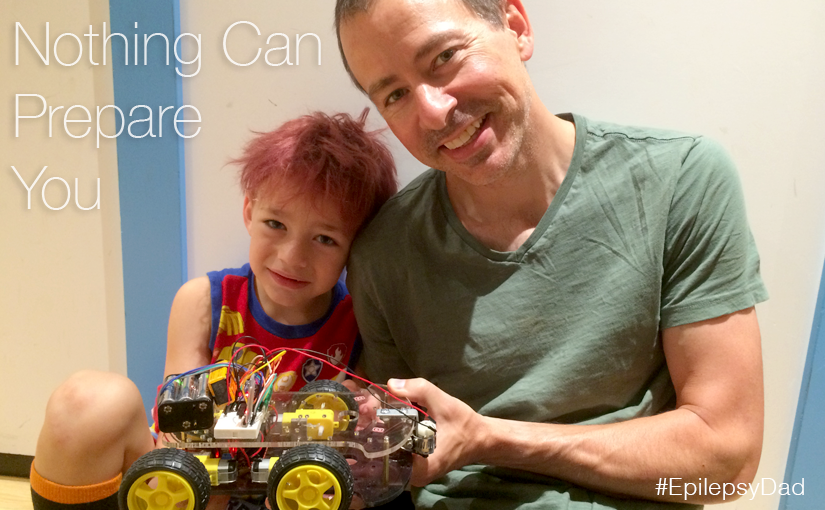
    When I was ten or eleven, my parents brought home our first computer. It was a Mattel Aquarius (yes, that Mattel) and it changed my life. I was fascinated by the games and the things I could do with a computer and I spent a lot of time figuring it out. My next computer was a Commodore 64, and that’s when I started programming. When I was fifteen, I got a job in a television repair shop where I spent part of my time on the work bench and part on the sales floor selling computers. In the Army, I was the resident computer expert and helped develop update archaic systems to bring them into the modern age.

    When I left the Army, I got a job as a computer programmer with a large financial firm. At the time, it was unheard of to get a job in a company like that without a college degree, but I already had much more hands-on, practical experience than most of my peers exiting college. The challenges I faced, the solutions I developed, and my understanding of the practical applications of technology started me on my path as a career technologist.

    When I look back, I’ve spent most of my life preparing myself for my life in technology. I read books and magazines and copied the code from their pages, inspected every line, and made improvements. I joined user groups and surrounded myself with people who understood computers and technology and absorbed everything I could. I build and repaired computers and honed my troubleshooting skills to a sharp point and thrust it into every problem that I could. I had fifteen years to prepare and acquire the skills that I needed to land that first job that eventually turned into a career in technology and a gift that I could share with my son.

    epilepsy dad technology parenting fatherhood

    I was less prepared to be a parent. I had a lot of negative lessons about what a parent should not be or do, but few role models or experiences for the type of father I wanted to be. Part of me hoped that the lack of guidance would present an amazing opportunity to be any type of father that I wanted to be but the darker part highlighted my own insecurities and made it difficult to believe that I could do the right thing. I read books and took the classes that the hospital offered, but the there wasn’t enough time to absorb everything there was to know about being a parent or to practice any of the skills that I would need to raise a child. Still, I was as prepared as I could be and made educated guesses as I tried to navigate the complexities of keeping this young life alive and teaching him about the world around him. Prepared, maybe. Proficient, not even close. But I held on to the belief that, even though I fumbled, that’s what parenting is, and as long as I love my son and show him and try to be a good role model, I’m ahead of the game.

    None of the parenting books or classes, though, prepared me for the path my son’s life took with epilepsy. At least when he was born, I had a nine-month lead time to start gathering some information and make an attempt at getting myself ready. The first seizure came out of nowhere. The second, a few months later, felt like someone pushed us down an infinitely deep, pitch black hole without warning. in the beginning, I felt desperate, out of control, and helpless. I couldn’t see and didn’t know what was happening around me. There was no preparation for the descent, and I was afraid of the dark, of falling, of not being able to right myself and save my wife and my son. It was terrifying. It is terrifying.

    Even though there wasn’t anything that could have prepared me for what is happening, there are resources available that give us back some control in an otherwise uncontrollable fall. In the years since his diagnosis, we are finding people and information that offer some light in the darkness, just enough light to see that we are not alone.

    Most importantly, my family is in this together and we’re finding each other, too. These lessons that I am learning and these feelings that some days overwhelm me have forced action on my part to face these fears, to find what is most important, and to open up to my wife and my son and to show them that I am here and I am present.

    Somewhere in that darkness, in the falling, in the fear, I felt a hand, so I reached out for it and I found my wife. I reached out again into the emptiness and I found my son. As I pulled them closer to me, I had one thought:

    “Don’t let go. Don’t ever let go.”

  • What Can’t Be Measured

    What Can’t Be Measured

    We sat in the windowless office of the neuropsychologist’s office waiting to hear the results of the daylong series of cognition tests that my son took a few weeks before.

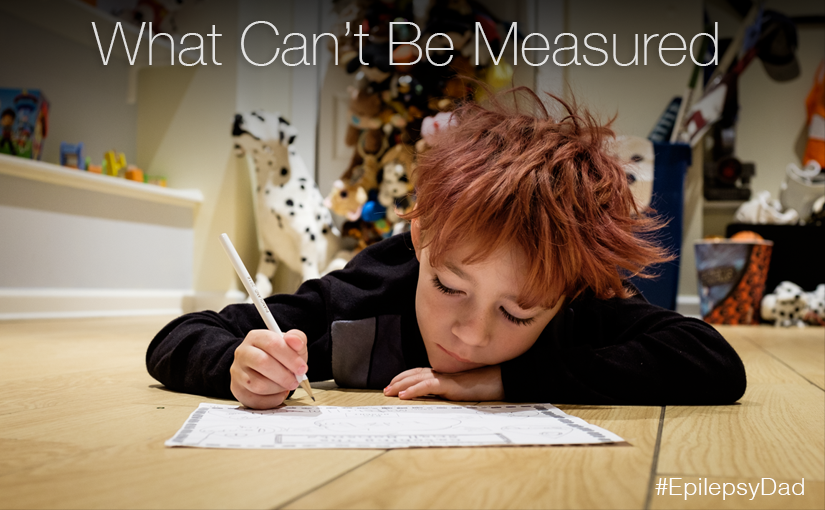
    Like most parents, I know my son is intellectually gifted. I can easily point to instances where he figured out a hard problem that he shouldn’t have or learned a new concept much more easily than I could have. Genius? I don’t like to use labels, but since you brought it up, let’s go with it.

    In the previous two years, however, my son’s brain had been through a lot. Seizures. Status epilepticus. Toxicity from an adverse reaction to medicine. For a few days, it forgot how to move my son’s body or form words for him to speak. In many ways, we had to start over, helping him form sentences and complex thoughts. Helping him put ideas together in the right order or to remember a simple sequence of steps. After everything he had been through, after having been picked up and spit out by a tornado, we sat in that office to find out where he landed.

    “Overall,” the doctor said, “your son is remarkably consistent.” It took me a few minutes to absorb the word and process its meaning. I had expected the results of the test to fall on either extreme of the spectrum. Either he was back to being a genius or his brain was irreparably damaged, but consistent?

    Sensing my confusion (probably aided by my snarky “Oh, my son is perfectly adequate, like buttered toast.” comment), the doctor went on to explain that the tests showed that, aside from a few areas that needed extra attention, my son was “about average.”

    The higher you climb, the further you have to fall. Selfishly, that was the first thought that came to my head. My genius son who was destined for the stars had been forced back down to earth with the rest of us by a cruel twist of genetic fate.

    It was only after a few minutes that I realized what a gift I had just been given. My son was “about average”. After two years of seizures, and status, and side effects. Two years without consistently going to school, of hard work at home teaching him to read and to write and count. After all of that, my son managed to come out “about average”.

    It was a miracle.

    As I thanked the doctor for her time, she added that she enjoyed spending time with my son. She commented about how hard he worked, even though she could tell that he was tired. Her mouth turned upward into a big smile as she told us how he made her laugh. Weeks removed from the time she spent with him and after seeing countless kids in between, that smile showed that my son had left her with something more than a score on a piece of paper.

    Our neurologist had also taken time out of her day to join us in the meeting. She has been an amazing ally and supportive influence who sees what is special about my son. That evening, we received an e-mail from her that said:

    I wanted to emphasize that this does not predict where he will go in the future, and there’s a lot of wonderful things about him that cannot be measured at this time given his young age and some of the best things in life just can’t be quantified.

    Exactly.