I came across a post on Instagram recently. It said something like: no one talks about the grief of giving medications to a child who can’t tell you how they feel.
I’ve been thinking about that. Not for the first time.
(more…)
I came across a post on Instagram recently. It said something like: no one talks about the grief of giving medications to a child who can’t tell you how they feel.
I’ve been thinking about that. Not for the first time.
(more…)
I’ve been listening to a book called Mattering. One of the early chapters is about the weight that comes from someone depending on you, and what happens when that weight disappears. The author tells the story of a woman who cared for her elderly mother for years. When her mother passed, she didn’t just grieve the loss. She grieved something more specific. The absence of being needed in that particular way, every day, by someone who depended on her for it.
I recognized something in that. Not the same loss, but the same shape.
(more…)
A few years ago, we did genetic testing for the first time. An exome sequencing — not the full genome, but a significant portion of it. They found a variation in the PRICKLE1 gene, which is associated with epilepsy. It looked like it might be something.
It wasn’t.
(more…)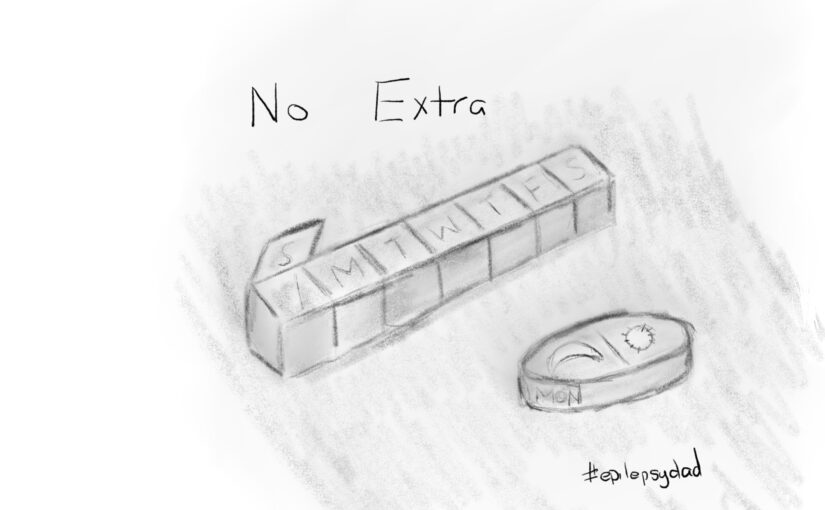
There’s no extra right now.
Not extra money. Not extra time. Not extra energy. The margins are narrow. The system runs because it has to.
Sunday mornings are for medication.
I make coffee. I put on a podcast or an audiobook. I stand at the kitchen island and start with mine. A few supplements come out first so they can go into my son’s pills later. Mine go straight into the organizer. His get laid out on a paper towel, seven days in a row, then transferred into the plastic containers. When they’re finished, Sunday goes on top.
I take my pills. I set both containers on top of the coffee machine for when he wakes up. The dogs are usually on the couch, half-watching. They know the routine.
Every morning I swap the containers. I take mine. I put them back. It’s mechanical. Quiet. Just part of the structure.
Everything goes in the calendar now. Appointments. School events. Guitar lessons. Therapy. Tennis. If it isn’t there, it doesn’t exist. The to-do list is long, but it turns over. Things come off. New things go on. Nothing flashy, but nothing slipping.
The house is tidy. The clothes are clean. The dogs get walked, even when it’s freezing. They get groomed. My son and I get haircuts regularly. It might look like a small luxury from the outside, but it feels more like maintenance. A way of saying we’re still taking care of what’s ours.
There’s no extra, but there’s enough.
We’re not adding new things. Guitar and tennis stay for now, but they’re the first to go if something else demands attention. I don’t feel deprived. What we have feels deliberate. Contained.
The debt is heavy. The future has large shapes in it. I want clarity. I want the numbers to go down. I want more margin. But the day-to-day isn’t falling apart.
That’s new.
Control feels quiet. It isn’t about power. It’s about not bracing. It’s about knowing that if something goes wrong, it’s a problem to solve.
I’ve been doing this job longer than the title suggests. Now there’s no one else to absorb it. Income. Meds. Schedules. Appointments. A cold this weekend. Likely more seizures. That’s just the math. I’ll adjust. I’ll keep going.
The system holds.
It isn’t elegant. It isn’t abundant. But it’s ordered. Maintained.
There’s no extra right now.
There’s what must get done. There’s what keeps us steady.
For now, that’s enough.
Last summer, I was at the pool with my son.
It wasn’t that long ago that he needed to stand on his tiptoes to keep his head above the water. Now, standing over six feet tall (the tallest in our family, as he likes to tell everyone), only his waist is submerged. His skinny torso sticks up like a twig in a pond.
His body carries many markers from his life. There are scars from his adventures and falls. There are stretch marks on his lower back from his growth spurt. And there are remnants from the incisions on his chest and neck from his surgeries that implanted the two devices and the leads to his brain.
It’s hard not to notice, prominently pushing against the skin on his chest, the two implants. Against that skinny frame, with no fat or muscle to buffer them, the devices look huge. They are a permanent alteration to the contours of his body, captured on his chest like a relief map, describing the differences in elevation and the way the land rises and falls. And similar to the permanence of mountains in our lifetime, they will remain a defining part of his body’s landscape.
Of all the recorded history on his body, the implants are the hardest for me to see. The scars, even those from his surgeries, can be rationalized away as everyday occurrences of a growing child. I’ve had a scar above my eye since I was five, when I chased my sister under a glass table and forgot to duck. I’ve had a scar under my chin from when I was ten and tried to jump over a softball on my bike. And I have scars on my hands and arms from the countless times that I clumsily pulled something from the oven without protection and burned myself.
But the implants can’t be explained away as normal consequences of living. They are more than just damaged or healing skin and tissue. They are unnatural, and there is no alternative explanation to the reality that they are devices inserted into his young body to help reduce his seizures. They are visible reminders of his challenges—challenges, like the devices themselves, that he will likely carry for the rest of his life.
Seeing them, it’s easy to fixate on the implications and miss out on the significance of the moments that they enable. He’s alive. He’s having fewer seizures and has stopped a few medications. He and I were in a pool playing basketball, spending time together, and laughing. The reason he has the devices may be overwhelming, but the life they allow him to live is a medical miracle.
I still see the devices when I look at him, but I’m learning to see them differently. They don’t just mark his struggle—they also mark his survival. They are symbols of how far medicine has come, of how far he has come, and of the moments we still get to share.