Nothing, Again

A few years ago, we did genetic testing for the first time. An exome sequencing — not the full genome, but a significant portion of it. They found a variation in the PRICKLE1 gene, which is associated with epilepsy. It looked like it might be something.

It wasn’t.

We were told the science was always advancing. New connections were being made between genetic variations and conditions like his. It would be worth revisiting in a few years.

So we did.

This time it was the whole genome. All three of us — my son, his mom, and me. The test looked for epilepsy markers, indicators connected to intellectual disability, and secondary findings in areas like heart and cancer risk. The technology had advanced. The dataset was larger. There was more to look at than there was last time.

I didn’t go in with much hope. Not because I’ve given up, but because I know where we are. My son is sixteen, and we’re twelve years into our epilepsy journey. We’ve tried most of what there is to try. We know his condition better than most people ever know anything. A clearly-named cause wouldn’t open new treatment doors at this point. It would just be a name.

What I was actually hoping for was not to hear something worse. There are types of epilepsy with harder trajectories than the one we’re already on. A result isn’t always good news. Sometimes it reframes everything you thought you understood.

I got a voicemail from the genetic team. I called back and left one of my own. A few days passed. Then they called me at work.

The call lasted for about five minutes.

The epilepsy markers and the intellectual disability indicators. Nothing found.

She asked if I had any questions. I didn’t.

The secondary findings came back clear for all three of us. No elevated markers for heart conditions. No increased cancer risk. That was genuinely good news. It landed as good news. I noticed that it did.

At the end of the call, she said that science is always advancing. New connections are being made. She said we should revisit in two years.

I recognized the closing. It was the same one from last time, when the PRICKLE1 variation turned out to be nothing. We’ll keep looking. Check back when the data has caught up.

I said thank you. I hung up. I went back to work.

That’s the part I keep coming back to. Not the results. It’s how quickly I moved on. There was a time when a call like that would have carried weight for days. The waiting, the callback, the five minutes of someone telling me we still don’t know. That used to be an event.

Now it’s just a Wednesday.

I don’t know if that’s peace or just distance. I don’t know if I’ve made my peace with the uncertainty or if I’ve just stopped expecting it to resolve. Those aren’t the same thing, even if they look similar from the outside.

What I know is this. He is who he is, named or unnamed. The cause doesn’t change the kid. It doesn’t change what we do tomorrow, or next week, or when the next appointment comes.

In two years, we’ll do it again. We’ll see what the science has found by then.

Until then, we’ll keep doing what we’re doing. Living our lives. Hoping the science advances. Hoping for new medications, new treatment options. Hoping his DBS continues to provide more benefit. Doing what we’ve been doing since the last time we sat down for this test.

Living, and waiting.

In that order.

When He Looks at Me

I’ve noticed it for a few years now.

He’ll say something, or try out a joke, or make an observation about something we’re watching, and then he’ll look at me. Not a glance. A look. He holds it for a beat longer than most people would, waiting for something to come back.

I noticed it gradually, the way you notice most things about your kids. Not a single moment but a pattern that eventually became impossible to miss.

I tested it once or twice. Not in a mean way. There were moments where I could smile without making eye contact, could let the beat pass without responding, and I’d feel him still looking. Holding. Waiting. A few seconds longer than felt accidental.

I asked him about it once. Why do you do that?

He didn’t know. That’s true for a lot of things he does when you ask him why. The awareness required to answer that kind of question hasn’t fully arrived yet, and may take time, and may look different when it does.

So I’ve been left to wonder on my own.

Part of it is probably simple. He wants to see if he made me laugh. He wants to know what I think about what he just said. That’s not unusual for a teenager, or for anyone. We look at the people who matter to us to see how we’re landing.

But I carry my own history into everything I observe, and I can’t always separate what I’m seeing from what I’m afraid of seeing.

I was made to feel small. Not by one thing, but by enough things over enough years that I spent a long time wondering if I mattered. If I was visible. If anyone was actually registering that I was in the room. I know what it feels like to look for confirmation that you exist, and I know how much energy that takes, and I know what it costs over time.

When I see my son hold that look, I feel two things at once.

I want him to feel seen by me. That part is easy. I am always looking. I notice everything. He does not have to wonder whether I’m paying attention, whether his jokes land with me, whether I think what he said was interesting or funny or true. I am here. I see him.

But I also want more than that for him.

The world was not built for him. That’s something I’ve written about before and something I think about constantly. People with his needs are often invisible in the systems and spaces they move through. He has to work harder to be noticed, harder to be understood, harder to be taken at full value rather than reduced to what he struggles with.

He is so much more than what he struggles with.

He is kind and funny and specific and stubborn in the best way. He has opinions about hockey teams and strong feelings about Fortnite and he named our dog after a winning moment in a video game. He looks at his father to see if a joke landed, and when it does, the satisfaction on his face is complete.

I don’t want that looking to come from the same place mine did. I don’t want him scanning faces for proof that he’s real. I want him to know, without having to check, that he is seen.

Not for what he carries. For who he is.

Maybe that’s all he’s doing when he looks at me. Maybe he just wants to see me laugh. Maybe it’s nothing more than that, and I’m the one making it heavy.

I hope so.

But I keep looking back.

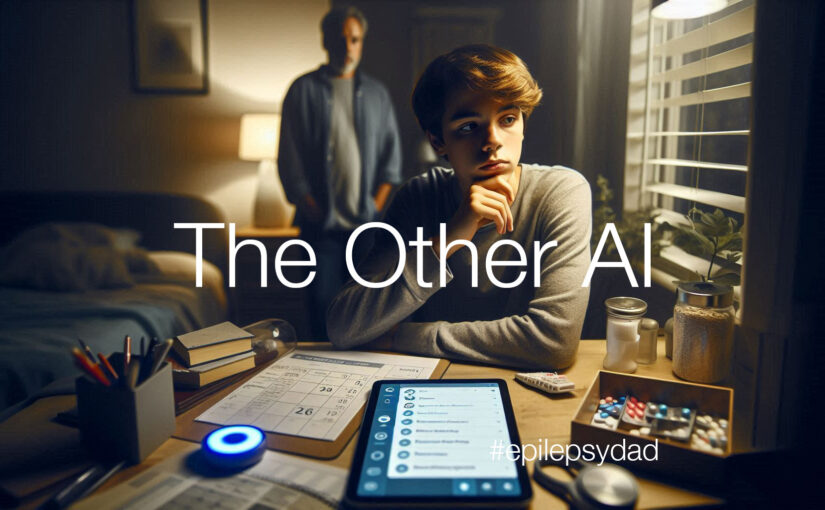
The Water Level: Disability and Technology

When driving comes up, I tense.

It doesn’t happen every time, but when we’re with other families and someone mentions permits or practice drives or the freedom of having a new driver in the house, something tightens in me. I watch my son. He doesn’t say anything. He just goes quiet and waits for the conversation to move somewhere else. I usually help it along.

I don’t know exactly what he’s thinking in those moments. I don’t ask. Maybe it’s nothing. Maybe it’s everything. But I was in that exam room when his neurologist answered his question about driving, and I know what “probably not” sounds like when it lands.

His friends are getting permits. He’s watching that happen from the outside, the way he watches a lot of things.

I think about his future more than I let on to him. I think about medications they haven’t discovered yet. Therapies. Devices. I think about his independence — what it might look like, what it might require. Autonomous vehicles have been part of that thought for a while. Not as a certainty, just as a possibility worth holding onto. So when I came across a podcast recently about autonomous vehicles and what they might mean for people who can’t drive, I expected something that confirmed what I’d been quietly hoping. Instead it pulled in two directions at once.

The first part was about job displacement — the ways AI is already eliminating work, particularly at the lower end. Automation moving through the kinds of jobs that don’t require a degree or specialized training. The ones with structure and repetition. Then the second half shifted to autonomous vehicles and the disabled community. The argument was straightforward: people who can’t drive because of a medical condition, a physical limitation, age — autonomous vehicles could give them something they don’t currently have. Independence. The ability to get somewhere on their own.

And then someone in the episode pointed out that the disabled community was being used to make the case for technology that primarily serves other interests. That the promise of accessibility was real but also convenient. I don’t know where the truth lands on that. Probably somewhere uncomfortable.

My son is sixteen. He wants to be a hockey player or a streamer. Neither is straightforward. Hockey as a player isn’t realistic, though being involved in the sport in some other way might be possible someday. Streaming is something he genuinely enjoys, but it requires consistency, memory, sequencing — things that are hard for him right now, harder than they look from the outside. He has dreams the way any teenager has dreams. He just has more walls. And the jobs most likely to be within reach for him — the ones with structure, repetition, and the right support in place — are the same ones that automation is already eliminating.

I’ve worked in AI for more than a decade. I use it every day. The work it’s making easier is white collar work — the kind that requires education, executive function, the ability to synthesize and decide. The jobs it’s eliminating are the ones that could work for him.

The water level keeps rising. He’s already underwater.

That’s the part I can’t think my way out of. Autonomous vehicles might eventually give him a way to get to a job on his own. That would matter. That would be real. But if the job itself has been replaced by the time the technology arrives, the independence doesn’t have anywhere to go.

I don’t know how to hold both of those things. I’m not sure I’m supposed to yet.

What I keep coming back to is that exam room. His neurologist exhaled before she answered. My son sat there and took it without flinching. Part of him probably already knew. Part of him was hoping for a different answer.

He’s been doing that his whole life — absorbing the gap between what other kids have and what’s available to him. Sitting quietly while the conversation moves on. Waiting.

I don’t know what the world looks like when he’s thirty. I don’t know which promises will have been kept and which ones will have turned out to be convenient. I don’t know if the door that technology seems to be opening will still be open, or what will be on the other side of it if it is.

I just know he’s sitting with questions he shouldn’t have to sit with at sixteen.

And I know what it looks like when he goes quiet.


I also wrote about this topic from a different angle on davidmonnerat.com, where I explore the structural side of the question — who technology is built for, who it displaces, and why those two groups are often the same people. You can read that piece here: The Other Hand: AI, Disability, and the Cost of Progress.