Where Are My Boys

Poodles have hair, not fur. Like most hair, it grows in a certain direction. Dogs generally like to be pet in the direction their coat grows, not against it.

My son didn’t notice for a long time.

When Emmet first came home, my son was eleven. Emmet is a service dog, trained specifically for children with epilepsy. He was a year and a half, already trained, already knowing his job. He knew how to lay across a person’s lap with his full weight, the way a weighted blanket settles. He knew “over” and “lap” and how to read a room. He was ready.

My son wasn’t sure what to do with him.

The petting was the first sign. He would reach for whatever part of Emmet happened to be closest and move his hand in a way that looked like petting without quite being it. He wasn’t feeling Emmet. He was mimicking the shape of what petting looks like. And he’d go against the grain without noticing, his hand moving in whatever direction felt natural rather than the direction Emmet’s hair ran.

They would be in the same space, close enough to touch. But there was something between them. An invisible distance that kept the contact from becoming connection.

Emmet is trained to comfort. His weight across your lap is supposed to mean something, to regulate, to settle. But when he’d do “over” and lay across my son, I don’t think my son felt it. The command worked. The dog complied. The comfort didn’t arrive.

We kept at it. We practiced in the kitchen, the three of us, Emmet running through his commands while my son learned to offer the right reward. A treat, and then his hand in the places Emmet actually likes. Under his chin. Along his neck. Near his ears. The top of his back.

And then one day Emmet leaned in.

My son was petting him the right way, in the right place, and Emmet pressed into his hand the way dogs do when they want more of something.

“See how he’s leaning in to you? That means he likes it.”

My son noticed. I could see him register it. The idea that the dog had a response, that something he was doing was causing something in return. It was a small thing. But it was the first time the contact went both ways.

Viktor joined the family a few years ago, ten weeks old and completely feral. My son helped name him. We asked for ideas and he said “Victory Royale,” the winning moment in Fortnite, which is how we landed on Viktor. The name fit. He has been chaos ever since.

He’d rocket into whatever room my son was in and be immediately in his face, all energy and no concept of personal space. My son didn’t know how to play with dogs yet, not really. He’d try to do what he’d seen me do, but the timing was off and Viktor was relentless. It was too much.

Viktor also, on more than one occasion, relieved himself on my son’s bed. This did not help.

But time passed. Viktor calmed down, somewhat. My son got older. And slowly, something started to change.

He started throwing the ball for Viktor. He learned that Emmet likes it when someone holds a nylabone while he chews, and he started doing that. Small things. Quiet things. Things I noticed without saying anything.

Then the dogs started showing up in his room. I’d go check on my goddaughter across the hall and hear him from his doorway, pleased about something. The dogs had migrated to his bed. He’d send me pictures from the couch, one or both of them pressed against him, settled, staying.

Now when he comes home, he wants what I get.

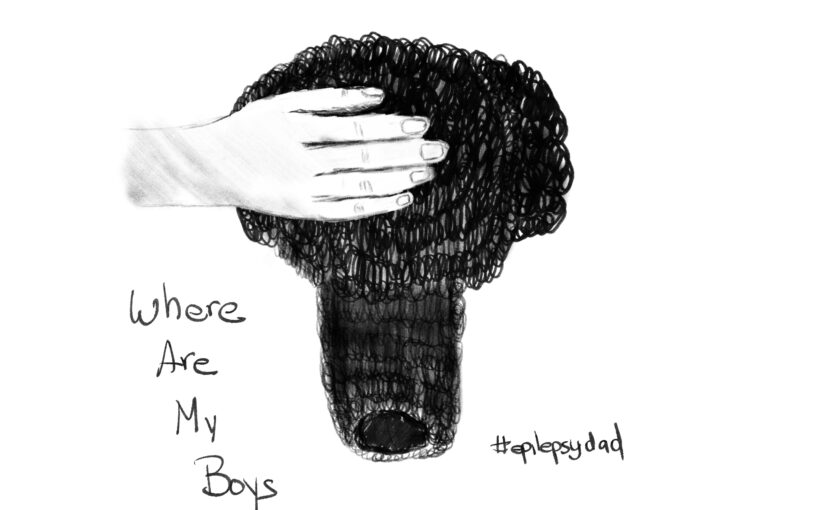
He comes through the door and looks around. “Where are my puppies? Where are my boys?”

The dogs come to me first. They usually do. But I redirect them, and eventually they split. One finds him, one stays with me. He bends down toward whichever one comes his way. He doesn’t get on the floor the way I do, not yet. But he bends. He reaches. He waits for them to come to him.

And they do.

It took four years. It didn’t look like bonding for most of them. It looked like proximity without connection, effort without payoff, a boy and a dog in the same room who hadn’t figured out what they were to each other yet.

But they got there.

Invisible In Plain Sight

I stepped on to the street on my way to work. As I joined the flow of foot traffic, I saw a young man walking quickly ahead of me. I say “walking”, but he was bouncing more than he was walking. I didn’t see any of the earphones that I and most of my fellow pedestrians were wearing, but he was moving as if he had a soundtrack playing in his head that lightened his steps.

I noticed him because he was so different from everyone else on the street. He was a tall, young African American teen wearing a bright blue t-shirt surrounded by an army of mostly white business people dressed in muted black, brown, or blue. He head was up as he looked at the world around him while that world was looking down at their feet or at their phones.

When he stopped at a crosswalk, I got close enough to see that he would sometimes raise his hands and sign to no one in particular. It was as if he was signing the lyrics to the song in his head. Like when the chorus of a really good song comes on and you find yourself singing along, even if only in your head. From half a block away, this young man looked like joy personified walking up the street.

The light turned green before I could catch up to him. He danced through the intersection and on his way. As he did, I saw that he would occasionally wave to people passing in the opposite direction. Even from my distance, I could see a big smile on his face. But no one that he waved to reacted. They kept their head down. They looked at their phones. They looked the other way.

Maybe they didn’t see him. Maybe they were busy. Maybe they were really interested in whatever was on their screen. Maybe they were scared. Or maybe they just couldn’t be bothered. We live in a big city and I see people ignoring the world around them and everyone in it all the time.

I thought that maybe the young man had a disability because he was signing. Or maybe he was just different than, in color and age and general attitude, the other people on the street. But watching how the young man was being ignored made me think of my son.

Epilepsy is often called an “invisible” condition because it lacks physical markers, but there can be signs. We’ve had more than a few people ask us politely “Is there something wrong with him?” after they spend time with our son. He’s noticeably different in a self-centered world that doesn’t seem to have a place for people that are different. We talk about diversity and inclusion but we look the other way when it is our turn to act…when it is our turn to accept someone who is different from us.

I watched the world look away from that young man on the street. I saw the world unwilling to acknowledge another human being. I don’t want that for my son but I don’t know what to do about it. I wish I could change the world. I wish I could make it more accepting, more forgiving, more tolerant, more open, more aware. But we’re heading in the wrong direction. I fear that the only thing that I can do is prepare my son for the road ahead.

But then I turned my attention back to the young man. I could see, as he waved to the next person, that he was smiling. Even with the world ignoring him, he was walking with a bounce in his step and smiling. He would wave at another person. And then another. And he would keep smiling. I watched him not slow down, not shy away, and keep moving forward. I thought of my son then, too, because he has that same persistence, the same drive to bring joy to the world. And for a brief moment, I felt hope.

I never caught up to him, but I wish I could tell that young man that he brightened at least one person’s morning that day.

What Can’t Be Seen

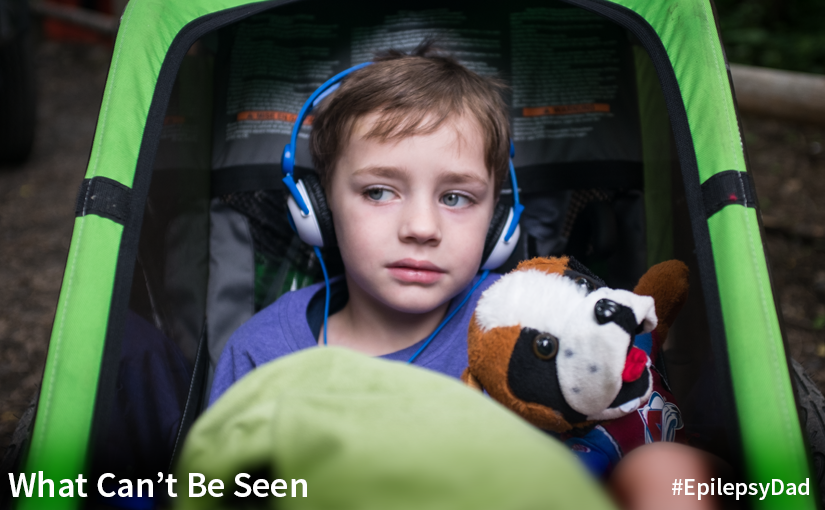
Earlier this year, we bought a stroller for our 5-year-old son. After his condition deteriorated in the hospital, he came home with very little physical or mental stamina. Every exhaustive mental activity drained him, and ever labored step sapped his energy. Since we live in the city, getting anywhere involves walking, so we found ourselves isolated in our apartment. With no social interaction, no friends, and no sunshine, our confinement raised the tension in an already strained situation, which was not good for our family or for his recovery. The stroller gave us a way of getting out of the house without having to carry him so that we could rejoin the world outside.

Our son is tall and weighs 45 pounds, so we bought the biggest, most durable stroller we could find. Even so, he barely fits inside with a small bend of the knees and his head is a bit taller than the top of the canopy, but he is comfortable and the stroller lets us get to where we need to go without completely exhausting him.

what cant be seen epilepsy

One day, we headed across town to the market. As we turned up a street, I saw a woman sitting on a bench on the sidewalk. She was looking at us as we approached. It’s the city, so of course I know not to make eye contact. But as we passed, she pointed to the stroller and blurted out “Why is that boy in a stroller? Is there something wrong with him?”

We didn’t respond and continued past her as she raised her voice. My son didn’t hear her, or he didn’t understand what she was asking.  Her question didn’t sound curious. It came across as accusatory, a reaction to seeing a big kid being pushed around in a stroller that was almost too small for him. It was the tone that is used to admonish a parent that is spoiling their child, not one of compassion for a difficult situation or even an innocent inquiry in to a situation that she didn’t understand.

I read a related story a few weeks ago about the family of a disabled girl having a note left on their car for parking in the handicapped spot because “they didn’t look handicapped”. The girl actually has a brittle bone condition, invisible to anyone that doesn’t know her story, hidden on the inside, behind a curtain of skin.

My son doesn’t look disabled, either. Unless you know him, you might not notice his drooping eyes that reveal his exhaustion. You might not know that his exhaustion comes from seizing all night long or that, in an unforgiving cycle, the exhaustion also leads to an increase in seizures. You might not see his behavior or psychological issues that come from an uncontrollable seizure cluster or the side effect of a medicine that he is taking to keep his seizures just barely on the side of control. You wouldn’t know about the nights that he has been so overtired that it took us hours to calm him down so that he would sleep.  You wouldn’t know that the dark circles under our eyes are from the endless watching of the baby monitor and waking on every sound that comes from his room.

As I was writing this post, I shared it with my wife. I was struggling to find its meaning and the lesson that I hoped to share. In response, she posed a number of questions. Do I wish people wouldn’t judge my son for what they cannot see? Do I wish my son would learn to accept this judgement and not let it bother him? Do I want my son to learn from their mistakes and not do the same to other people?

Of course, I want all those things. I want my son to not be made to feel different, even though he is. I want him to understand that the world is filled with ignorant and callous people who will judge him for being different, and I want for their comments to bounce off him, even though I know that they will always hurt.

I want him to remember what it feels like to be made to feel different by people who don’t know him or his situation. Even if he can’t change the people around him, he can remember that feeling and can choose to be a person that leads with compassion instead of an ignorant judgement.

I’m just as guilty of rushing to judgement as the woman on the street. I make assumptions and use my own biases lunging in to situations without stopping to consider the entire story. Maybe the person that is angry on the other side of the phone just lost a loved one or is having a problem at home. Maybe the dad that snapped at his kid isn’t a bad father but is frustrated with something going on at work or is trying to deal with behavior issues stemming from side effects of an epilepsy medication.  Having gone through those situations, I know how much a little empathy would have meant to me. Maybe the lesson is that if my son can lead with compassion and understanding, then so can I.

On second thought, maybe the lesson is that if he is going to do it, then so should I.