Tag: grateful

  • When Help Isn’t Helping

    When Help Isn’t Helping

    It’s great to have people in your life who want to help. I know how lucky I am to have friends and family who care, who check in, who ask what they can do. I am very fortunate.

    But when you’re already overwhelmed, even the offer of help can add to the weight. Suddenly, instead of just managing my own list, I’m trying to come up with something for someone else to do so they feel helpful, because they genuinely want to be helpful. And that becomes one more responsibility, one more set of feelings to consider.

    The other day, my mom offered to help. I told her I’d let her know if something came up. She gently pushed back and said I needed to find something for her to do—some way for her to contribute—because she needed to feel like she was helping.

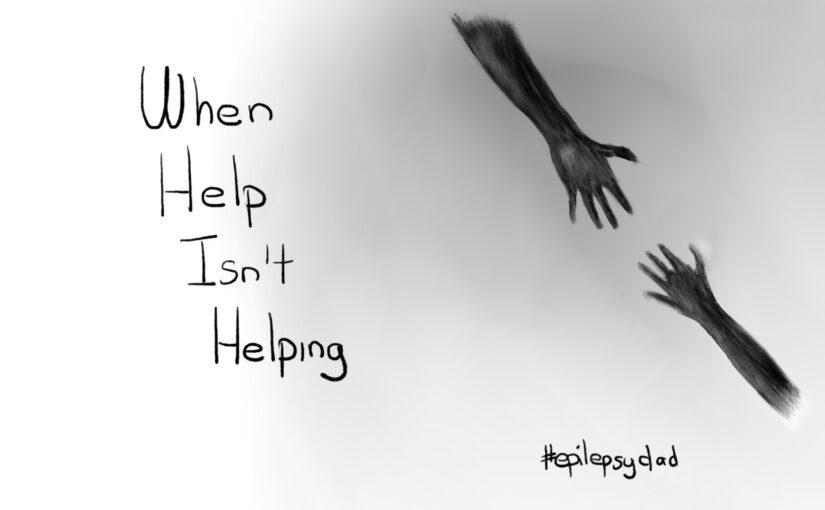
    And in that moment, my stress level doubled. What was meant as support felt like another to-do. Another thing to figure out. Another emotional dynamic to manage. The offer wasn’t helping; it was giving me more to carry.

    I know some of this is me. I’ve never been good at asking for or accepting help. Maybe it’s because I don’t want to put anyone out. Maybe it’s because I feel like I should be able to handle it on my own. Maybe it’s because I don’t always feel worthy of the help being offered. Or maybe it’s that the help being offered doesn’t match the help I need in that moment, and then I feel guilty for not having a task ready.

    There are so many obstacles in my way—my sense of responsibility, my discomfort, my self-doubt. I don’t want people to think I’m ungrateful. I don’t want them to think I don’t need them. I don’t want them to stop offering.

    And sometimes, the truth is that what helps isn’t a task at all. Sometimes it’s just knowing someone is thinking of us. Sometimes it’s an invitation to grab a coffee or play tennis or step away from everything for an hour. Sometimes the help is simply the reminder that we’re not doing this alone.

    But so often, help doesn’t feel like help. It feels complicated.

    Maybe that’s because I don’t yet have a healthy relationship with accepting help. Maybe there’s something I need to learn about receiving care instead of only giving it.

    Because the reality is: my son will likely always need support. I want him to grow up knowing he can ask for help without shame. I want him to feel worthy of help. I want him to see that needing support doesn’t mean he’s a burden.

    I want to model that for him.

    But I’m still figuring out how to do that while shielding him from the stress and overwhelm that comes with being the one who needs help. I’m still learning how to receive help without turning it into another source of pressure.

    Maybe the lesson starts with accepting that I can’t do everything alone. And maybe the next step is allowing others—genuinely, openly, imperfectly—to help lighten the load in the ways they can.

    Even if that means learning how to let help actually help.

  • Thankful and Grateful

    Thankful and Grateful

    Today is Thanksgiving in the United States.

    While we aren’t the only country that celebrates Thanksgiving, the holiday is widely celebrated in the United States as a time of gratitude and togetherness.

    In our household, we have a nightly routine that has evolved over the years. It includes reflecting on something we are grateful for. Even if we are too tired to do the full routine, we never skip our “grateful for.”

    That led me to wonder about Thanksgiving being a day about gratitude and the difference between being thankful and grateful. According to the vast library of truth that is the internet, gratitude encompasses both being thankful and being grateful, but even though the terms thankful and grateful are often used interchangeably, they have subtle differences in meaning and emotional nuance:

    Thankful

    Definition: Being aware of and expressing appreciation for something good that has happened or for a specific benefit received. Thankful is usually tied to a specific moment or event (short-term and outward-focused).
    Focus: Often more situational and reactive; tied to specific actions, events, or gestures.
    Example:
    “I’m thankful for the gift you gave me.”
    “She felt thankful for the sunny weather during her picnic.”

    Grateful

    Definition: A deeper sense of appreciation and acknowledgment, often tied to an enduring or broader sense of thankfulness. Grateful reflects a more profound, ongoing state of appreciation (long-term and inward-focused).
    Focus: Goes beyond immediate circumstances and often reflects a heartfelt acknowledgment of a relationship, life situation, or intrinsic value.
    Example:
    “I’m grateful for having a supportive family.”
    “He felt grateful for the lessons he learned from his challenges.”

    With my newfound knowledge of the nuances of gratitude, I think about how it applies to the language I use in the context of my son’s epilepsy.

    I am thankful that our son has access to medicine that helps reduce his seizures. I am thankful for the doctors and nurses who cared for him during his surgery. And I am thankful he has a friend who helped him catch up when our son returned to school.

    I am grateful for the support of his friends and his school. I am grateful to live where he can access specialists and get the care he needs. I am grateful for the lessons I have learned from our son’s challenges.

    I’m not sure it’s perfect, but in the end, regardless of the words we use, it’s the feeling that matters. Gratitude improves our overall well-being and strengthens relationships by fostering positive emotions, encouraging mutual appreciation, deepening connections, and helping us focus on the good in ourselves, others, and the world around us.

    On a day intended to celebrate gratitude and togetherness, I think that’s what matters, whatever language we use.

    Because this post mentions Thanksgiving, it’s also important to be mindful that its origins are tied to events that some Native Americans associate with colonization and the loss of land, culture, and lives. If you’d like to learn more, please read about the National Day of Morning, which is observed by many Native Americans on Thanksgiving and is a time to honor their ancestors and reflect on the historical and ongoing injustices faced by Indigenous peoples due to colonization.

  • Then Things Changed

    Then Things Changed

    This is the first time in months where I have sat down to write.

    Before I did, I skimmed my posts from earlier this year. I wanted to be reminded of where we were. Our family felt isolated and trapped in the city, and there was no hope of moving. My son was struggling with his virtual school, and there was no hope of finding a way of learning that would work for him.

    I wrote those posts as a way to process my thoughts. I wrote those posts as a way to ask the universe for help. I wrote those posts because I had to get those feelings out. They were real. They are real. Putting them down in writing felt like the last act of acceptance that nothing was going to change.

    But then things did change.

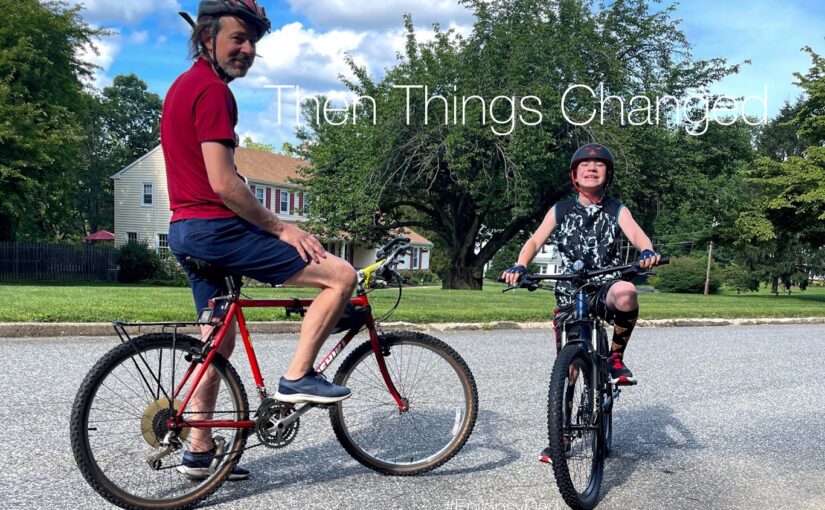
    I’m writing this post in our new house. I’m writing this post early in the morning before my son wakes up and gets ready to go to his new school that is only a few miles away with kids that have challenges just like him. I’m writing this post the day after my son spent hours in the yard playing with other kids from the neighborhood who didn’t treat him like he was different at all.

    The contrast between where we were and where we are is surreal, but I know things won’t always feel this way. My son is still seizing every day. The cognitive, social, and emotional gap between him and his peers is obvious, and it is growing. And the one constant thing in our epilepsy journey, for better and for worse, has been change.

    At this moment, though, I am immeasurably grateful to have landed where we did, when we did. Because we needed it. Because we are together. Because we can breathe. And because for the first time in a long time and despite the struggles he faces every day, my son is happy.

  • Poopsicle, Popsicle, Dreamsicle

    Poopsicle, Popsicle, Dreamsicle

    Since my son was little, we have had a tradition of ending our nights by talking about our days. It started as “poopsicle, popsicle, dreamsicle” but it has evolved over the years to include a few additional reflections:

    Poopsicle – Something bad that happened today

    Popsicle – Something good that happened today

    Dreamsicle – Something you want to happen

    Grateful For – Something you are grateful for

    God Bless – Someone you are thinking about that could use your thoughts or prayers

    Mistake – A mistake you made today (because mistakes are opportunities to learn)

    Proud Of – Something you did today that you are proud of yourself for

    Each night, we would take turns going through the list. But for the past few months, I haven’t been participating. My wife has been reading with our son before bed and the reflections became part of their routine. Instead of joining them, I busied myself by cleaning the kitchen or working on the computer.

    I don’t remember exactly when I stopped. It could have been near the end of my last job when I was so unhappy and stressed and just wanted to get out. It could have been after I started my new job because I was so exhausted trying to prove myself to my new team. It could have been any number of times when life got hard and complicated and fast.

    Ironically, it was probably when I needed to reflect the most that I stopped doing it. I didn’t just stop reflecting with my family, I stopped reflecting at all. I didn’t notice the day, I survived it. I spent all my energy moving things forward without appreciating where I’ve been or what I’ve done. Instead of acknowledging the really hard things and being proud of myself for having done them, I moved on to the next thing on my endless list of things to do.

    This Father’s Day, my wife surprised me with a special Japanese tea ceremony. It was a beautiful ceremony in which a teacher described each step as it was demonstrated by his students. He described the ritual of serving the tea, but also introduced a mindfulness aspect from the perspective of the guest. During the ceremony, the guest would inspect the different things in front of her. She would lift the bowl and examine every side of it. Because this moment may never happen again. She may never see the bowl again. She may never see the host again. So she was appreciating this moment and these objects and being mindful and present in the moment.

    Three minutes into the ceremony, I caught myself wondering how long we had been there and how long we had to go. But after awhile, I settled in on the experience. I settled into the space. I noticed the way the host and assistant walked in and out of the room. I noticed how they folded the silk cloths they used to wipe down the bowl. I noticed the way the guest turned the bowl to examine it. I noticed my son watching the ceremony.

    Drink your tea slowly and reverently, as if it is the axis on which the world earth revolves – slowly, evenly, without rushing toward the future. ~Thich Nhat Hahn

    It was as if the world slowed down enough for me to see what was happening. Instead of moving on to the next thing, I was seeing the things that were in front of me. I wasn’t thinking about my to-do list. I wasn’t thinking about work. I was there. I was present. I hadn’t felt that way in a long time. It felt good. I missed feeling that way.

    I have gotten into the habit of doing instead of experiencing. It’s easy to measure a day by how much gets done because there is no end to the list of things to do. But that keeps my eyes focused on the horizon instead of the ground beneath my feet, or noticing the footprints I left behind me, or being aware of who is at my side.

    My son has a serious medical condition that can change our lives or take away his without warning. We are not guaranteed any moments beyond the one we are in. I want to be better and being present in it with my family. I want to share these moments with the people around me. And I want to reflect on them and acknowledge what they mean to me. Because I want life to be about more than checking things off an endless list of things to do.

    That night, I laid next to my wife and son as we put him to bed. “What’s your poopsicle?”, I asked him. Then, we took turns reflecting on our day.

  • Wherever We Go, There They Are

    Wherever We Go, There They Are

    Whenever we go to a new place, in the back of my mind I want that place to change my life. It seems like a tall order, which may be why it hasn’t happened yet. I want to go to a place and be so inspired that I start writing that book that I’ve been thinking about. I want to leave a place a better person, having a better relationship with the people in my life. But mostly, I want to go to a place where my son doesn’t have any seizures.

    My son didn’t show any signs of having epilepsy until we moved to Philadelphia. I was only partially joking with the doctors when I asked them if it could be Philly causing his seizures. The first time we went back to Colorado, I was ready to move back if he was seizure-free during the trip. But he wasn’t. I had the same thought when we visited Florida. Maybe Colorado was at too high of an elevation and he needed an ocean breeze. But he had seizures in Florida, too. And in New York. And in California. Wherever we went, there they were.

    Even so, when I stepped off the plane in Hawaii, I had that same thought. That maybe this was going to be the place where my son would be seizure-free. If it was going to be any place, Hawaii wouldn’t be terrible. Before we even picked up our bags, I convinced myself we could make it work. I could find a job, even if it meant working remotely. I was sure the children’s hospitals would be fine, and we could make regular trips back to the mainland for care. But we wouldn’t need to, because he wouldn’t be having seizures. It was the perfect plan. Until it wasn’t.

    In our first early morning in paradise, the sound worse than every other sound filled the hotel room. His seizures had found us. Across the continent, across the ocean, to an island in the middle of the Pacific. In a place we’ve never been before, hidden from the world. Wherever we go, there they are.

    In a way, I was grateful that the seizure came quickly because it lifted the pressure that I had put on our vacation. The longer I carry that pressure, the less present I am and the more I miss of our life. But instead of worrying about that seizure around the corner, it had already come.

    It was freeing.

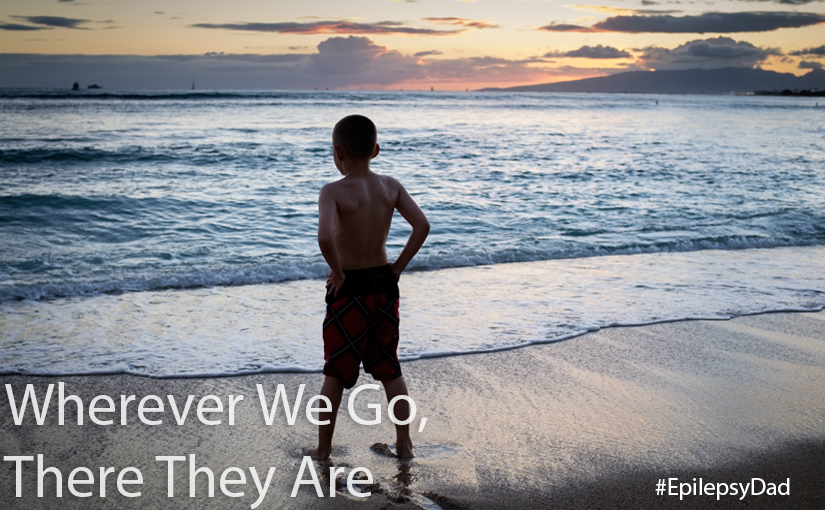
    It allowed me to focus on having an amazing vacation with my family in spite of our stowaway. It allowed me to be present and to be grateful for the moments that we have. I saw the beauty of the island. I saw the smile on my son’s face. It reminded me that it’s not a destination that is going to change my life. It’s that feeling that I get when I see his smile that makes my life better every day.

    epilepsy dad wherever we go