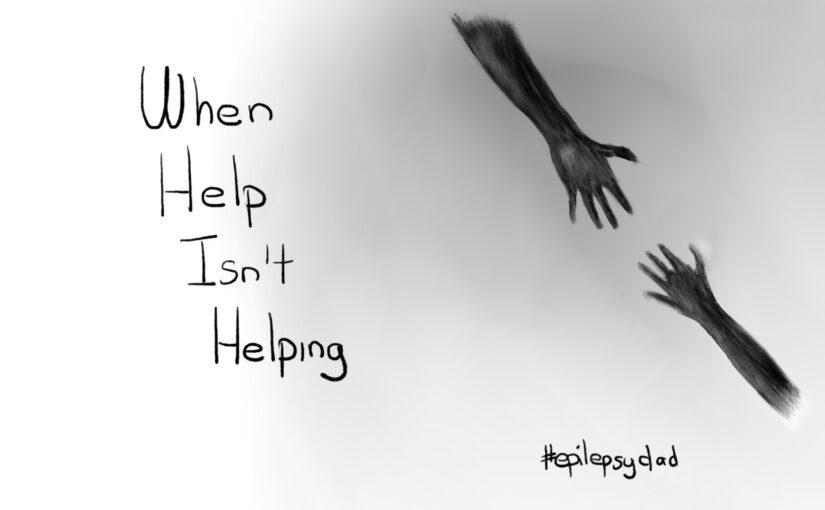
When Help Isn’t Helping

It’s great to have people in your life who want to help. I know how lucky I am to have friends and family who care, who check in, who ask what they can do. I am very fortunate.

But when you’re already overwhelmed, even the offer of help can add to the weight. Suddenly, instead of just managing my own list, I’m trying to come up with something for someone else to do so they feel helpful, because they genuinely want to be helpful. And that becomes one more responsibility, one more set of feelings to consider.

The other day, my mom offered to help. I told her I’d let her know if something came up. She gently pushed back and said I needed to find something for her to do—some way for her to contribute—because she needed to feel like she was helping.

And in that moment, my stress level doubled. What was meant as support felt like another to-do. Another thing to figure out. Another emotional dynamic to manage. The offer wasn’t helping; it was giving me more to carry.

I know some of this is me. I’ve never been good at asking for or accepting help. Maybe it’s because I don’t want to put anyone out. Maybe it’s because I feel like I should be able to handle it on my own. Maybe it’s because I don’t always feel worthy of the help being offered. Or maybe it’s that the help being offered doesn’t match the help I need in that moment, and then I feel guilty for not having a task ready.

There are so many obstacles in my way—my sense of responsibility, my discomfort, my self-doubt. I don’t want people to think I’m ungrateful. I don’t want them to think I don’t need them. I don’t want them to stop offering.

And sometimes, the truth is that what helps isn’t a task at all. Sometimes it’s just knowing someone is thinking of us. Sometimes it’s an invitation to grab a coffee or play tennis or step away from everything for an hour. Sometimes the help is simply the reminder that we’re not doing this alone.

But so often, help doesn’t feel like help. It feels complicated.

Maybe that’s because I don’t yet have a healthy relationship with accepting help. Maybe there’s something I need to learn about receiving care instead of only giving it.

Because the reality is: my son will likely always need support. I want him to grow up knowing he can ask for help without shame. I want him to feel worthy of help. I want him to see that needing support doesn’t mean he’s a burden.

I want to model that for him.

But I’m still figuring out how to do that while shielding him from the stress and overwhelm that comes with being the one who needs help. I’m still learning how to receive help without turning it into another source of pressure.

Maybe the lesson starts with accepting that I can’t do everything alone. And maybe the next step is allowing others—genuinely, openly, imperfectly—to help lighten the load in the ways they can.

Even if that means learning how to let help actually help.

Thankful and Grateful

Today is Thanksgiving in the United States.

While we aren’t the only country that celebrates Thanksgiving, the holiday is widely celebrated in the United States as a time of gratitude and togetherness.

In our household, we have a nightly routine that has evolved over the years. It includes reflecting on something we are grateful for. Even if we are too tired to do the full routine, we never skip our “grateful for.”

That led me to wonder about Thanksgiving being a day about gratitude and the difference between being thankful and grateful. According to the vast library of truth that is the internet, gratitude encompasses both being thankful and being grateful, but even though the terms thankful and grateful are often used interchangeably, they have subtle differences in meaning and emotional nuance:

Thankful

Definition: Being aware of and expressing appreciation for something good that has happened or for a specific benefit received. Thankful is usually tied to a specific moment or event (short-term and outward-focused).
Focus: Often more situational and reactive; tied to specific actions, events, or gestures.
Example:
“I’m thankful for the gift you gave me.”
“She felt thankful for the sunny weather during her picnic.”

Grateful

Definition: A deeper sense of appreciation and acknowledgment, often tied to an enduring or broader sense of thankfulness. Grateful reflects a more profound, ongoing state of appreciation (long-term and inward-focused).
Focus: Goes beyond immediate circumstances and often reflects a heartfelt acknowledgment of a relationship, life situation, or intrinsic value.
Example:
“I’m grateful for having a supportive family.”
“He felt grateful for the lessons he learned from his challenges.”

With my newfound knowledge of the nuances of gratitude, I think about how it applies to the language I use in the context of my son’s epilepsy.

I am thankful that our son has access to medicine that helps reduce his seizures. I am thankful for the doctors and nurses who cared for him during his surgery. And I am thankful he has a friend who helped him catch up when our son returned to school.

I am grateful for the support of his friends and his school. I am grateful to live where he can access specialists and get the care he needs. I am grateful for the lessons I have learned from our son’s challenges.

I’m not sure it’s perfect, but in the end, regardless of the words we use, it’s the feeling that matters. Gratitude improves our overall well-being and strengthens relationships by fostering positive emotions, encouraging mutual appreciation, deepening connections, and helping us focus on the good in ourselves, others, and the world around us.

On a day intended to celebrate gratitude and togetherness, I think that’s what matters, whatever language we use.

Because this post mentions Thanksgiving, it’s also important to be mindful that its origins are tied to events that some Native Americans associate with colonization and the loss of land, culture, and lives. If you’d like to learn more, please read about the National Day of Morning, which is observed by many Native Americans on Thanksgiving and is a time to honor their ancestors and reflect on the historical and ongoing injustices faced by Indigenous peoples due to colonization.

Then Things Changed

This is the first time in months where I have sat down to write.

Before I did, I skimmed my posts from earlier this year. I wanted to be reminded of where we were. Our family felt isolated and trapped in the city, and there was no hope of moving. My son was struggling with his virtual school, and there was no hope of finding a way of learning that would work for him.

I wrote those posts as a way to process my thoughts. I wrote those posts as a way to ask the universe for help. I wrote those posts because I had to get those feelings out. They were real. They are real. Putting them down in writing felt like the last act of acceptance that nothing was going to change.

But then things did change.

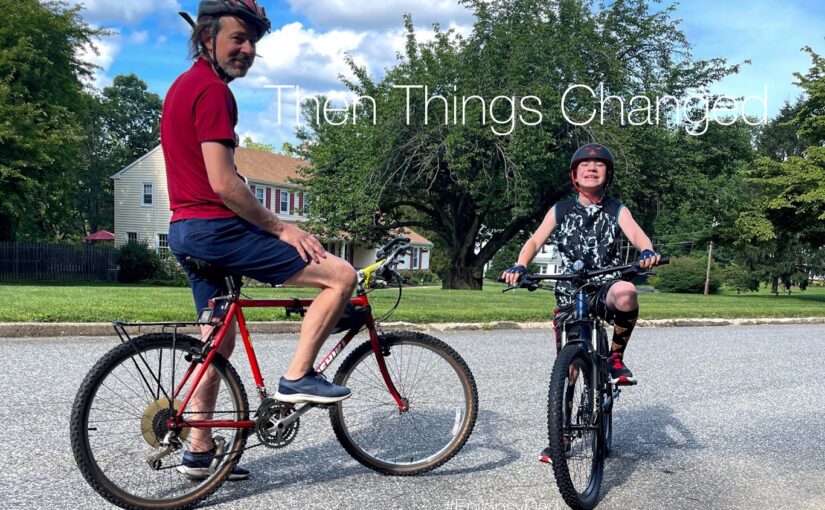
I’m writing this post in our new house. I’m writing this post early in the morning before my son wakes up and gets ready to go to his new school that is only a few miles away with kids that have challenges just like him. I’m writing this post the day after my son spent hours in the yard playing with other kids from the neighborhood who didn’t treat him like he was different at all.

The contrast between where we were and where we are is surreal, but I know things won’t always feel this way. My son is still seizing every day. The cognitive, social, and emotional gap between him and his peers is obvious, and it is growing. And the one constant thing in our epilepsy journey, for better and for worse, has been change.

At this moment, though, I am immeasurably grateful to have landed where we did, when we did. Because we needed it. Because we are together. Because we can breathe. And because for the first time in a long time and despite the struggles he faces every day, my son is happy.