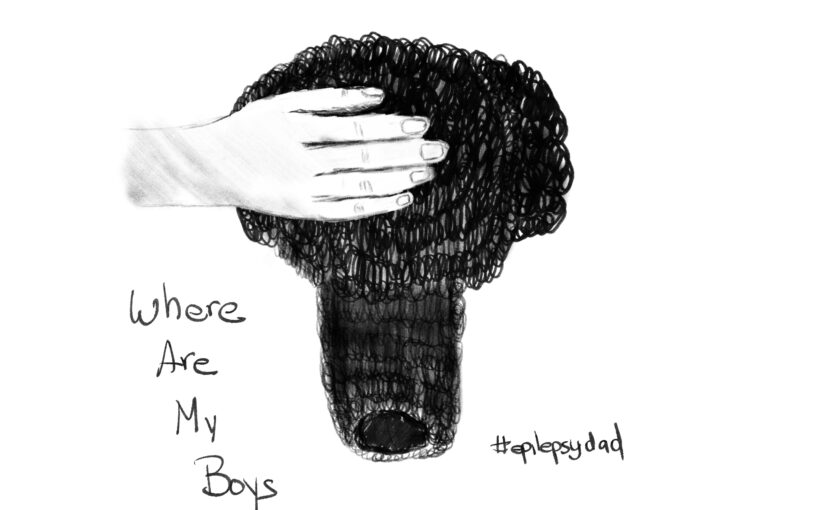
Poodles have hair, not fur. Like most hair, it grows in a certain direction. Dogs generally like to be pet in the direction their coat grows, not against it.
My son didn’t notice for a long time.
When Emmet first came home, my son was eleven. Emmet is a service dog, trained specifically for children with epilepsy. He was a year and a half, already trained, already knowing his job. He knew how to lay across a person’s lap with his full weight, the way a weighted blanket settles. He knew “over” and “lap” and how to read a room. He was ready.
My son wasn’t sure what to do with him.
The petting was the first sign. He would reach for whatever part of Emmet happened to be closest and move his hand in a way that looked like petting without quite being it. He wasn’t feeling Emmet. He was mimicking the shape of what petting looks like. And he’d go against the grain without noticing, his hand moving in whatever direction felt natural rather than the direction Emmet’s hair ran.
They would be in the same space, close enough to touch. But there was something between them. An invisible distance that kept the contact from becoming connection.
Emmet is trained to comfort. His weight across your lap is supposed to mean something, to regulate, to settle. But when he’d do “over” and lay across my son, I don’t think my son felt it. The command worked. The dog complied. The comfort didn’t arrive.
We kept at it. We practiced in the kitchen, the three of us, Emmet running through his commands while my son learned to offer the right reward. A treat, and then his hand in the places Emmet actually likes. Under his chin. Along his neck. Near his ears. The top of his back.
And then one day Emmet leaned in.
My son was petting him the right way, in the right place, and Emmet pressed into his hand the way dogs do when they want more of something.
“See how he’s leaning in to you? That means he likes it.”
My son noticed. I could see him register it. The idea that the dog had a response, that something he was doing was causing something in return. It was a small thing. But it was the first time the contact went both ways.
Viktor joined the family a few years ago, ten weeks old and completely feral. My son helped name him. We asked for ideas and he said “Victory Royale,” the winning moment in Fortnite, which is how we landed on Viktor. The name fit. He has been chaos ever since.
He’d rocket into whatever room my son was in and be immediately in his face, all energy and no concept of personal space. My son didn’t know how to play with dogs yet, not really. He’d try to do what he’d seen me do, but the timing was off and Viktor was relentless. It was too much.
Viktor also, on more than one occasion, relieved himself on my son’s bed. This did not help.
But time passed. Viktor calmed down, somewhat. My son got older. And slowly, something started to change.
He started throwing the ball for Viktor. He learned that Emmet likes it when someone holds a nylabone while he chews, and he started doing that. Small things. Quiet things. Things I noticed without saying anything.
Then the dogs started showing up in his room. I’d go check on my goddaughter across the hall and hear him from his doorway, pleased about something. The dogs had migrated to his bed. He’d send me pictures from the couch, one or both of them pressed against him, settled, staying.
Now when he comes home, he wants what I get.
He comes through the door and looks around. “Where are my puppies? Where are my boys?”
The dogs come to me first. They usually do. But I redirect them, and eventually they split. One finds him, one stays with me. He bends down toward whichever one comes his way. He doesn’t get on the floor the way I do, not yet. But he bends. He reaches. He waits for them to come to him.
And they do.
It took four years. It didn’t look like bonding for most of them. It looked like proximity without connection, effort without payoff, a boy and a dog in the same room who hadn’t figured out what they were to each other yet.
But they got there.