Where Are My Boys

Poodles have hair, not fur. Like most hair, it grows in a certain direction. Dogs generally like to be pet in the direction their coat grows, not against it.

My son didn’t notice for a long time.

When Emmet first came home, my son was eleven. Emmet is a service dog, trained specifically for children with epilepsy. He was a year and a half, already trained, already knowing his job. He knew how to lay across a person’s lap with his full weight, the way a weighted blanket settles. He knew “over” and “lap” and how to read a room. He was ready.

My son wasn’t sure what to do with him.

The petting was the first sign. He would reach for whatever part of Emmet happened to be closest and move his hand in a way that looked like petting without quite being it. He wasn’t feeling Emmet. He was mimicking the shape of what petting looks like. And he’d go against the grain without noticing, his hand moving in whatever direction felt natural rather than the direction Emmet’s hair ran.

They would be in the same space, close enough to touch. But there was something between them. An invisible distance that kept the contact from becoming connection.

Emmet is trained to comfort. His weight across your lap is supposed to mean something, to regulate, to settle. But when he’d do “over” and lay across my son, I don’t think my son felt it. The command worked. The dog complied. The comfort didn’t arrive.

We kept at it. We practiced in the kitchen, the three of us, Emmet running through his commands while my son learned to offer the right reward. A treat, and then his hand in the places Emmet actually likes. Under his chin. Along his neck. Near his ears. The top of his back.

And then one day Emmet leaned in.

My son was petting him the right way, in the right place, and Emmet pressed into his hand the way dogs do when they want more of something.

“See how he’s leaning in to you? That means he likes it.”

My son noticed. I could see him register it. The idea that the dog had a response, that something he was doing was causing something in return. It was a small thing. But it was the first time the contact went both ways.

Viktor joined the family a few years ago, ten weeks old and completely feral. My son helped name him. We asked for ideas and he said “Victory Royale,” the winning moment in Fortnite, which is how we landed on Viktor. The name fit. He has been chaos ever since.

He’d rocket into whatever room my son was in and be immediately in his face, all energy and no concept of personal space. My son didn’t know how to play with dogs yet, not really. He’d try to do what he’d seen me do, but the timing was off and Viktor was relentless. It was too much.

Viktor also, on more than one occasion, relieved himself on my son’s bed. This did not help.

But time passed. Viktor calmed down, somewhat. My son got older. And slowly, something started to change.

He started throwing the ball for Viktor. He learned that Emmet likes it when someone holds a nylabone while he chews, and he started doing that. Small things. Quiet things. Things I noticed without saying anything.

Then the dogs started showing up in his room. I’d go check on my goddaughter across the hall and hear him from his doorway, pleased about something. The dogs had migrated to his bed. He’d send me pictures from the couch, one or both of them pressed against him, settled, staying.

Now when he comes home, he wants what I get.

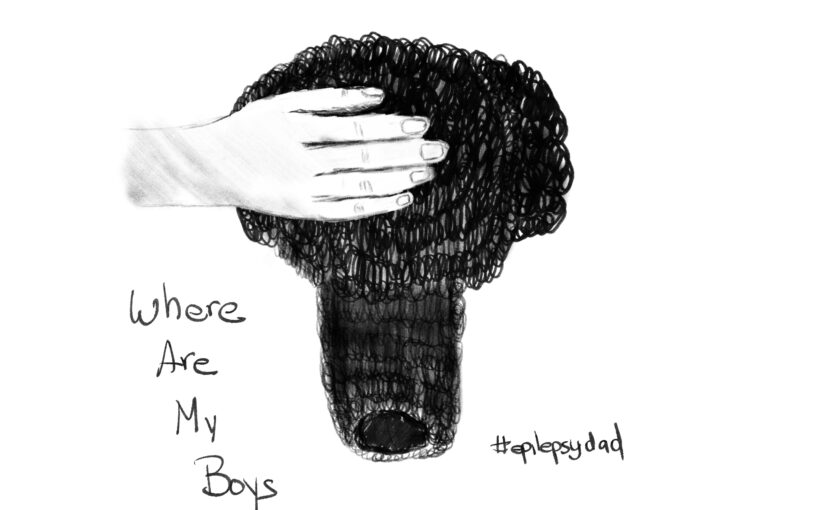
He comes through the door and looks around. “Where are my puppies? Where are my boys?”

The dogs come to me first. They usually do. But I redirect them, and eventually they split. One finds him, one stays with me. He bends down toward whichever one comes his way. He doesn’t get on the floor the way I do, not yet. But he bends. He reaches. He waits for them to come to him.

And they do.

It took four years. It didn’t look like bonding for most of them. It looked like proximity without connection, effort without payoff, a boy and a dog in the same room who hadn’t figured out what they were to each other yet.

But they got there.
Breaking the Survival Loop

There’s a theme in my last few posts. Survival.

Survival is the most primitive, instinctive reaction. It’s the “keep myself safe” and “keep this child alive” mode. It’s adrenaline, reflex, and emergency decision-making. No long-term view. No nuance. It’s the hospital room at 3 AM when you’re just trying to make it to the next hour.

Survival is the body and brain trying to stay alive.

I’m good at survival. I’ve had a lot of practice.

Coping is the layer just above survival. It’s how you function after the emergency — when the crisis becomes chronic. It’s the routines, the systems, the compartmentalization we use to manage stress, danger, or uncertainty. It’s “I can’t live in panic all the time, so how do I manage this?”

Coping is the mind trying to live with what survival couldn’t fix.

I’m not as good at coping. There’s still a lot of pretending I’m fine. Emotional numbing. Overfunctioning. Avoidance. Self-blame and shame.

This is where I get stuck. Not always, and not as much as I used to, but I still see it happening. Avoiding the hard conversation or phone call. Sticking to the lists and logistics because feeling anything is too much. Blaming myself because it’s easier than accepting that some things are simply out of my control.

Without healthy coping, it’s hard to reach the next level: connection — where healing, relationship, and meaning can actually emerge.

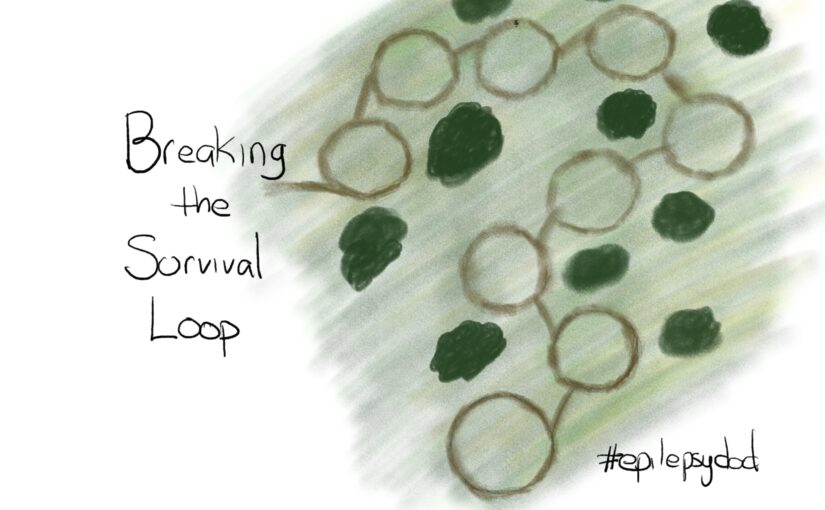
It’s like I’ve been walking on a path, and I see a place where it branches off. For years, I didn’t take it. I stayed on the familiar loop, not realizing it was holding me back. Sometimes I’d look back and wonder if I should have taken the other path. But eventually, I’d face forward and keep moving, step by step.

In the last few years, I’ve started stepping onto that new path. I’ve opened up to other people. I’ve accepted help. I’ve stopped automatically blaming myself — or at least, when I do, I pause and question whether it’s really true.

In moments when everything feels overwhelming, leaving the old loop feels different. My old behaviors, patterns, and habits still tug at me, trying to pull me back to the familiar path. But now I see more branches, more opportunities to connect. I don’t always take them — but sometimes I do. And when I do, it brings gratitude, support, and the sense that I’m not so alone.

Survival keeps the body alive.

Coping keeps life moving.

Connection makes life worth living.

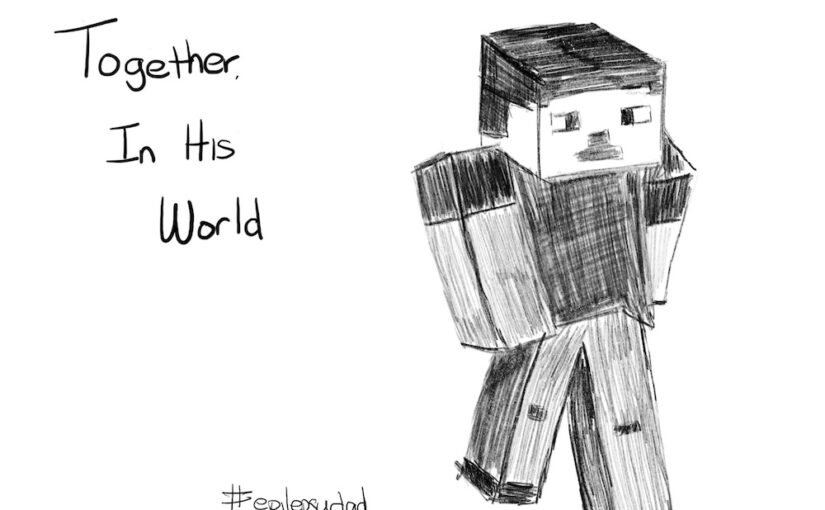
Together, in His World

I stood behind my son in a deep cave. A torch on the wall behind us was the only light, casting our long shadows down the tunnel ahead.

“What are we looking for?” I asked.

“Diamonds,” he said.

We continued forward, using our pickaxes to clear the stone blocks in our path. The deeper we went, the darker it became. Occasionally, we’d hit pockets of lava or veins of redstone. I mostly followed his lead—he knew where to dig, where to place torches, when to mine, and when to run.

Then I saw movement ahead. I hung a torch on the wall and, when it ignited, I saw a very large spider walking toward us.

“I hate spiders,” I sighed.

My son didn’t hesitate. He didn’t flinch. While I stayed back, cautious and reluctant, he moved forward.

That’s how it’s always been. In these games, in these worlds, he becomes someone else—bold, decisive, brave. He leads with purpose, unburdened by the hesitation that sometimes follows him in the real world.

I raised my head to see him at his computer, locked in, defeating the red-eyed monster. With the path clear, I looked back down at my iPad, and we pressed on in our quest.

It had been a while since we had played in the same physical space. Lately, he’s been focusing on his streaming “career,” diligently trying to build an audience on Twitch. He’ll come home from school, finish his homework and chores, head to his room, and close the door.

I’ll watch his stream. Sometimes he plays with friends. Sometimes alone. Sometimes we play together—but two floors apart, connected only by FaceTime or in-game audio. It’s something, but it’s not the same.

Today was different.

Minecraft is one of the few games where he takes the lead. He’s the expert—he builds the world, sets the rules, and guides the mission. He lights up when he shows me what he’s made—a house with hidden doors, a rollercoaster that goes through a mountain, or a massive Captain America shield reaching impossibly high into the sky.

In the real world, everything takes extra energy. Every day is a challenge that he doesn’t always show. The constant pressure to keep up, to interpret unwritten rules, to manage the invisible toll of his condition—most people wouldn’t notice it, but it’s there. And it wears on him. But in these digital spaces, he’s free. Confident. In control.

Sitting beside him, I kept glancing up from my screen. I saw how invested he was in keeping me alive, on task, and included. He was unusually chatty, explaining our next steps. His voice was proud. His posture relaxed. He was happy.

And I was, too.

We’ve been in a bit of a rut lately—living in separate spaces, our lives occasionally overlapping. I’ve caught myself worrying that the distance is permanent. That the doors he closes might stay that way. It’s easy to panic when that happens. To think it’ll take something big to bring us back together.

And maybe that fear comes from knowing what distance can become.

Because that’s what happened to me. I hid in my room, hands on a keyboard, eyes on a screen, building worlds in code. I created that distance—between me and my parents, who didn’t understand me, and my sister, who didn’t want to be around me. In my room, and in that world, it was easier. I was safe. And no one did anything to change it. So the distance became permanent.

But today reminded me: sometimes it only takes a moment. A small step into his world. A little curiosity. A shared screen. A diamond hunt.

Not to fix everything, but to find each other again.