Tag: exhaustion

  • Fine.

    Fine.

    On days when I work from home, I like to pick my son up from school. I sit in the line of cars slowly making their way to the exit and wait for the teacher to send him out.

    As he walks toward the car, he looks exhausted most days. School asks more of him each year—more performance, more endurance, more emotional regulation, and more social navigation.

    He throws his backpack into the back of the car and plops down in the front passenger seat.

    “Hi, pal. How was school?” I ask.

    “Fine.”

    That’s it.

    Fine. One word. One syllable. Full stop.

    “Well, what did you do in…” and I’ll rotate through his subjects.

    Sometimes I get a short answer, but most of the time he says he doesn’t remember.

    As a parent, it’s frustrating. I can see that he’s tired, but I don’t want him to think that—by not asking how his day went—I don’t care. I genuinely want to know how his day was, what he did, and what he learned. I’m curious about his experiences and want to understand more about what he does and how he sees the world.

    Additionally, my son struggles with his memory, so I feel pressure to ask the question right away—for a chance to hear any details before they fade. If I don’t get an answer, it feels like I’ve lost the opportunity to connect with him. It becomes an unmet need when his answer feels like it shuts the door.

    But that’s my need.

    His need, after working so hard all day just to get through it, is not to engage in that moment.

    I recently read an article about how school is harder for kids today, and something clicked.

    It may seem simple, but a genuine answer to the “how was school today” question requires considerable effort and decision making to synthesize information from a busy day.

    When my son gets in the car, he’s not just carrying books in his backpack. He’s carrying the weight of every demand he had to meet. He’s carrying the exhaustion from seizure-disrupted sleep. He’s carrying the side effects of his medication. He’s used up every bit of energy just to make it through the day.

    “Fine” isn’t a brush-off. It’s an exhausted plea for peace.

    The article offered a simple but powerful suggestion:

    Consider the purpose. Ask yourself whether you want to gather information or simply connect with your child.

    As much as it feels urgent to gather information about his day—as a way to connect—it often does the opposite. It leaves me frustrated and leaves him more drained, trying to process my question, reach into his memory, and find the right words. Instead of connecting, in those moments, we drift farther apart.

    My goal, always, is to connect with him.

    I want him to know I’m happy to see him. I want him to know that I feel lucky to be able to pick him up. I want him to know that I see him. I want him to know that I appreciate how hard he worked to make it through the day and that I hope he’s proud of himself, because I am.

    Instead of starting with a question that requires him to do more work, maybe I will start with a statement. Maybe one of those.

    Or maybe I’ll just tell him how lucky I am to be his dad.

  • Tapped

    Tapped

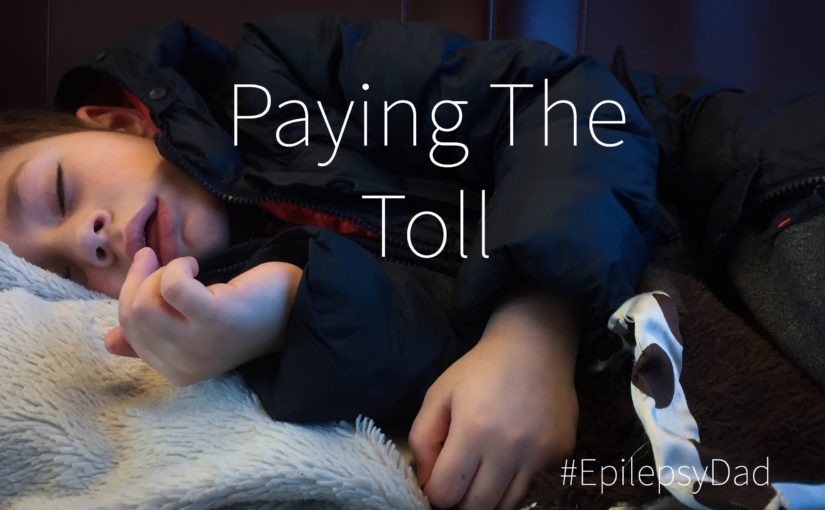
    My son does this thing where the muscles in his face loosen. His cheeks look chubbier as they drape softly down to his jaw. His mouth separates a little, and I can see the tip of his tongue pushing through. Sometimes he’ll swallow slowly, which at the same time seems automatic but also like it takes all of his concentration and energy.

    That is one of the signs we see that lets us know when he is tapped.

    There are other signs, too. He has an even harder time with his executive functioning and memory than he normally does. It’s more difficult for him to regulate his emotions. He gets angry and frustrated. But that look on his face is the look of someone who has given everything they can for the day. It’s how we know he’s done.

    This isn’t something that only happens occasionally.

    It happens every day.

    There are days when it happens sooner, usually around this point of the school year or when we did such things after a baseball game. There are days when it happens later, like on a lazy weekend. And there are days when it happens more than once, usually once before and then later on after a nap. But it always happens. Every day. Every day, my son gives everything to get through the day.

    Every day, my son gets tapped.

    The other day, I sat on the edge of the bed with my son and studied his face as he leaned against his pillow, watching his iPad. I tried to be present with him. I asked him what it felt like and if there was anything I could do for him, but even asking a question forces him to try to muster enough energy to think and respond. He’s such a good kid that, even tapped, he tried to find enough energy to process my question and think of an answer. It felt cruel. I felt terrible. And so I didn’t ask any more questions, and I sat with him and rubbed his head and let him tune out.

    Unless you knew him, you wouldn’t know that anything was going on. He might just look like a tired kid. Its invisible nature is one of the many curses of epilepsy. His doctors, who have seen the same in other patients as they see in my son, understand it. But it’s harder to convey to others because they don’t know him and because they don’t have a reference for that level of exhaustion.

    “Imagine climbing a mountain. Now, imagine if everything you did felt like climbing a mountain. Now, imagine if that is what you felt like every day. “

    Every day, my son climbs that mountain. Every night, he falls asleep only to find himself back at the base of the mountain when he wakes up. Then he starts to climb again. He pushes, he grinds, he stumbles, he gives everything he can until his body, and his brain can’t do anymore.

    Every. Day.

    He’s eleven years old.

  • Wall Of Limitations

    Wall Of Limitations

    This summer, my son participated in a week-long baseball camp. We knew it would be physically demanding so we spoke with the coaches before we registered him to make sure that he could rest and leave early if he needed it. It’s a phone call we have made before and will likely make many times in the future that serves two purposes. First, it helps us make sure that our son will be safe. And second, it identifies any places not willing to make accommodations for people who need them, which is not a place we want to be.

    My son’s nanny took him on the first day and the coaches welcomed him to the camp. He managed to stay for half the day but then took a three-hour nap when he got home. But he had fun and he made friends. The second day was much the same with a long nap after a shortened day.

    By the third day, he didn’t want to go. He was noticeably tired but he managed to make it out the door. His nanny coaxed him on to the field and, after almost thirty minutes, one of the coaches managed to finally get my son to participate. He left early again that day.

    On the last day of camp, we planned to let him stay all day because they were going to play a game. His nanny made sure he took frequent breaks and he made it through the day and finished the camp with a smile.

    The end of the camp coincided with the Little League World Series. I watched the grueling tournament and wondered, given how the camp went, whether my son could do anything like that. By now, I don’t have any grand vision of him playing in the major leagues, but I do want him to continue to play something that gives him joy and that makes him feel like a part of a team.

    It made me think that someday we’re going to run into a wall of limitations. We’ve faced small ones before, but we’ve managed to pass them mostly by watching our son climb over them. We’ve managed to keep our distance from larger walls by adjusting our path. We swapped hockey for baseball. We learned to work around his physical and endurance issues. But we haven’t been faced with consciously confronting the difference between possibility and probability. Potential versus practical. Fantasy versus reality. We haven’t faced the wall that was once on the horizon but is now uncomfortably close.

    And every day we are moving closer. It’s starting to block our view to the world behind it. I’m beginning to wonder what we will do when we reach it. Will it be too big and stop us in our tracks? Will it be too overwhelming and send us back the way we came? Or will we do what we have always done and follow our son as he finds a way to climb it, even though we know there will be an even bigger wall behind this one?

  • Paying The Toll

    Paying The Toll

    We were coming off a good weekend. We celebrated my wife’s birthday on Saturday, and we ended Memorial Day visiting friends, having a swim lesson, and staying up a little later to see part of the first game of the hockey finals. We put my son to bed tired but happy.

    Just after midnight, the first seizure came. I heard the sound come from my son’s room a second or two before the sound came through the speaker of his monitor. By the time I got to him, it had passed. He was sitting up in his bed disoriented, so I helped him lay back down and waited for him to fall back to sleep.

    The next seizure came a few hours later. The next one an hour after that. And the next one an hour after that. It was like aftershocks after an earthquake, except each of them was just as intense as the one before it. He had at least four that I saw, but we learned during the overnight EEGs that we don’t see them all.

    When he does anything that exerts an effort mentally or physically, a nap-time seizure or a collection of seizures during the night is likely to follow. We bowled for an hour and he had a seizure during his nap. After a morning baseball game, a seizure. Even though he only goes to school for a few hours, he’ll often have a seizure during his nap.

    We tried to explain it to his school. It’s not just about what he can handle in the moment. The exertion carries beyond the activity itself. It show’s up as more seizures, which set him up to be more tired the next day. That lowers his seizure threshold for the next day, too, making him more likely to have seizures or requiring him to spend more energy regulating his emotions or attention. It’s downward spiral that ends with the husk of a boy too tired to function.

    It feels like the universe collects a toll from my son based on how much he gets to actually live his life. It imposes a penalty to knock him back down and remind him of his limitations when he tries to exceed them. Someone with uncontrolled seizures shouldn’t play baseball. Seizures. Someone with uncontrolled seizures shouldn’t be progressing in school. Seizures. Someone with uncontrolled seizures shouldn’t be going to the skate park, or an amusement park, or a hockey game. Seizures.

    Every time it happens, I question whether we did too much. But I gave up wondering if we should be doing anything at all, because that’s having no life. That’s letting epilepsy win. That’s not giving my son the life and the world that he deserves. So we’re careful and we’re calculated in deciding what to do and how much to do. We do our best to protect our son but let him be part of the world. We introduce as much downtime as possible so that we can distrupt his pattern of exhaustion and let him do the things he loves.

    The universe seems committed to collecting its toll, but we’re doing everything we can to minimize how much my son has to pay. Because we’re going to keep on living.

  • One Thing

    One Thing

    Lately, my wife and I have started a new routine. We sit next to each other on the couch, flip open our computers, pull up our calendars, and look at the week ahead. Even though it’s all digital and we share our calendars, it gives us a chance to get on the same page. We can add any events that we miss or decide who is picking up dessert for dinner at a friend’s house later in the week. But it also gives us a chance to create a manageable week for our son.

    Fatigue plays a big part in the frequency and severity of my son’s seizures. If he gets too mentally or physically taxed, they break free from their confinement. Instead of happening only in the morning, he’ll have them during his nap or after he goes to bed at night. The more seizures he has, the less rested he is, which causes more seizures. It’s a cycle that we work very hard to avoid.

    In most cases, that means we only plan one activity a day. While other kids his age go between team practices, play dates, and birthday parties, he’ll do one thing. Instead of “and”, our lives involve a lot of “or”. A birthday party or a movie. The museum or the park. A play date or a baseball game.

    Some days, that one thing is school. Other days, that one thing is therapy. Those activities are so draining to him that, if he goes in already tired, he can barely function. We see that, too, when he leaves school early to go to one of his appointments. But on those days, we don’t have a choice. He wills himself through it but then he stays exhausted through the next day. If that happens, we adjust his schedule to try to prevent those demanding days from adding up. If we can’t, or if we miss the signals that he’s running on fumes, we lie next to him in bed, watching him pay the price.

    We had a few of those nights in early summer. School was ending and we tried to juggle therapy and baseball practice. He loved baseball, but it broke my heart to see what the physical exhaustion did to him at the end of the night. It was all too much, but deciding what to cut and when was impossible. School is important and provides social opportunities. Therapy helps rebuild those skills that he lost and reinforce those that he will need. And baseball…baseball made him feel like he was part of a team. And that he was a normal kid.

    I wanted to take this post in a positive direction. I wanted to say that “in lives packed with activities and distractions, having to choose what to do helps clarify what is important.” I do believe that, but I also hate having to decide what to take out of my child’s life. I hate having to limit him in any way. To have to pick one thing. For every day. Every week. Every month. With no end in sight. There is no positivity in that.

    But as conflicted as I am, it has inspired me to try to make that one thing amazing and special. And I try to be mindful, present, and grateful for that one thing. Because I know that, no matter how much it hurts, one thing is better than nothing.