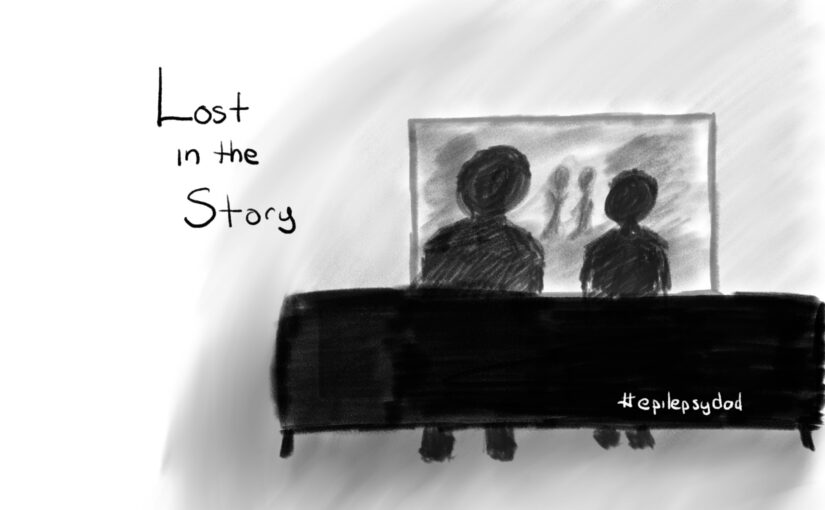
Recently, we started watching Stranger Things.
For most families, that means settling into the couch, grabbing snacks, and diving into the next episode. For us, it means something different.
In between episodes, I have to remind him of what happened last time—who the characters are, what they’re trying to do, how the story left off. Even when we watched it the day before. Sometimes the same day.
And when the new episode starts, I keep the remote close.
Not to skip the scary parts.
Not to turn up the volume.
But to pause.
To explain.
To anchor him to what’s happening on the screen and how it connects to what came before.
Sometimes it’s a quick reminder. Other times it’s a full recap: “That’s Will’s mom. Remember, she’s the one who put up all the Christmas lights. And these guys are going into the Upside Down. It’s like that dark world we saw last episode.”
Sometimes he nods.
Sometimes he asks more questions.
Sometimes the explanation drifts away as quickly as it landed.
It’s like this with every show. Every movie. A remote in one hand, a thread of the story in the other, trying to keep him connected to something that keeps slipping through his fingers.
A few weeks ago, I read Still Alice, the book about a woman losing pieces of herself to Alzheimer’s. There’s a moment where her husband brings home movies because books have become too hard—too much to hold onto, too much to follow. Movies were supposed to be easier. But even those became confusing when scenes blurred together and storylines couldn’t be kept straight.
She could no longer follow the thread of the plot or the significance of characters who weren’t in every scene. She could appreciate small moments but retained only a general sense of the film after the credits rolled.
She wouldn’t understand why her family reacted the way they did to something on the screen, so she matched their expressions and faked the same reaction to protect them from how lost she was.
Watching movies made her keenly aware of how lost she was.
That part stopped me because it felt uncomfortably familiar.
My son is not losing memories the way Alice was. His brain works differently for different reasons. But the impact is similar. He can’t follow all the threads. He struggles to remember the significance of characters who aren’t in every scene.
And yet, he wants to watch these shows. He wants to enjoy them. He loves the characters, the action, the mystery. He wants to be part of the story.
This is where the questions start to land heavy for me. I wonder if he is aware of how lost he is. I don’t know if he knows any different. But he probably sees that not everyone is lost. He knows that I am not lost.
Does he think this is a common thing for kids his age? Does he believe you need to be a grown-up to follow the threads? Or does he know, somewhere inside, that this confusion is something uniquely his?
I don’t have those answers. But I do know that every time I reach for the remote, I am not just pausing a show. I am trying to make sure he never feels like he has to fake understanding to keep up. I am trying to meet him where he is, in the spaces between the story he wants to follow and the story he is able to hold.
I’ve followed your impactful and generous sharing of your journey for years . We are all on different arcs while dealing with epilepsy and other co morbid conditions where we have to often make hard choices for our children while hoping as their advocate we are choosing what they would wish . My mechanism for dealing with memory loss , was to take a billion photographs . I use them as site joggers . I wonder if having a pic of the main characters in a notebook with a grief explanation may help ? That way he has something he can touch while asking questions to try and stimulate a memory on a static paper , instead of a paused screen? I’m sure you have so many brilliant hacks , but I just thought I’d try and offer an extra one , reading your journey has made a huge difference to me over the years , it would be nice to be able to offer the smallest tip back . Thank you for your insight and vulnerability
Oh my gosh this reply is so impactful to me thank you! I wish I had read it prior to my reply. It reminds me to focus on the strategies and remedies or coping skills and compensatory strategies. I have also benefited from Dave’s blog. I am so grateful for his insight and for yours! Blessing to you both and to our children.
Thank you so much for the ideas, Danielle. I really appreciate it. I love that idea. And, honestly, it would be great for real-life people, too, whom he doesn’t see very often.
Pictures have historically been tricky for my son. We have photos from before he should remember anything, and newer pictures where he says he remembers, but it always seems like he thinks he should, or he remembers me retelling the story about the picture. Memory is such a tricky thing.
But in the context of a story, that could work. And it can be an exercise we do together, too, to add notes on the different characters as the story progresses, helping capture those critical points of the journey (coincidentally, he just started learning about the Hero’s Journey in school).
I really like the idea. We’ll see if it helps!
~Dave
Hi Dave
You are a wonderful father and I know it’s been hard. I wish you contentment this holiday season and a focus on gratefulness even though it is hard. My son had a seizure this morning after going 5 months which has been a record. I’ve gotten better at taking each day one at a time but I’ve never quite fully gotten beyond “ waiting for the other shoe to drop”. I don’t worry ALL the time anymore but I still inevitably get to days in which thoughts drift and out like “ could he keep this seizure freedom up … could he be cured … or simply feeling the creeping thought of expecting him to have a seizure any day”. Sometimes I even think my thoughts are an aura. I haven’t cried yet today until I responded to your post and a thought hit me about the long arc in parenting a child with refractory epilepsy and even coping with epilepsy in general. I believe that all of the work you have done and are doing now is incredibly meaningful and I doubt you will ever regret it.
The image of you holding the remote and the thread of the story at the same time is such a precise description of caregiving when cognition is delayed, diminished or however it is labeled but desire is intact.
My son is 22 now and has refractory epilepsy, and while the setting looks different than a couch and Stranger Things, the experience feels very familiar. The pauses can be about daily life, routines, expectations, and things other young adults move through without realizing how many threads they’re holding at once.
What you wrote about “not wanting your son to fake understanding” really struck me. I think that instinct doesn’t go away as they get older. If anything, it becomes harder, because the world expects them to “just get it” by a certain age. Even family member don’t really understand. It’s an hard ask though as it can be very confusing to me. As parents, we’re left trying to decide when pausing is support and when it’s interference. Sometimes I even wonder about my role in enabling. Because I don’t know, I error on the support side never wanting anything but love to win the day. But am I right? Is there a right or wrong ? I am very conflicted at times. I just keep telling myself “ everything will work lot for the greatest good”. I’ve not been able to think
My way out of this one.
I also find myself wondering—like you do—how much awareness or attention my son has of what could be slipping away. He knows other people don’t have his same challenges , but I don’t know how he interprets that gap. Is it invisible to him? Is it quietly painful? Or is it simply the water he’s always swum in? He is very positive and I wouldn’t want him to be any other way. He is strong and courageous and tries to love his life best he can. As any parent however we see areas where our children can grow or make choices that benefit them and it’s hard to accept when they don’t.
One thing your post helped me identify is that these pauses aren’t or maybe shouldn’t be about lowering expectations or shielding them from reality. They’re about dignity. About making sure our kids don’t feel stupid, lazy, or defective for brains that work under very different conditions—whether from seizures, medication, or both. I never know if we’ve inadvertently lowered expectations and have harmed him in this way. That question really runs deep in me and hurts.
As our son has grown, the pauses look different. Sometimes they’re reminders. Sometimes systems. Sometimes uncomfortable and redundant conversations about responsibility and safety. But the heart of it feels the same as what you described: trying to stay close enough that they don’t have to pretend, while still letting them be who they are.
Thank you for putting language to something many of us live but struggle to explain.
You’re not alone in this, even when the pauses change shape.
Thank you so much, as always, Kris, and I’m grateful the post resonated. I struggle with the lowered expectations every day, and finding that line between support and enabling. I think it’s something we’ll always have to navigate without a map, but if our direction is, as you said, always towards dignity and letting them be who they are, I am hopeful we will find our way. ~Dave
I appreciate your responses and am grateful for the nudge to give the idea of dignity more weight in my thinking
My daughter has memory impairment, but it is not significant. However, there are other significant challenges that accompany her epilepsy journey. Sometimes I simply have to pray to God to show me how to find joy in the moment and to focus on what this day has for us because that is all we have. Today. You described an event. It was simple, yet profound. You and your son having time together and enjoying each other’s company and you being a great dad. That’s what I took away from your post.