The D Word

At a recent appointment, my son brought up the topic of driving. Even though we had talked about how he wouldn’t be able to get a license while he was still having seizures, I knew that, once he turned 16, we would have to revisit the conversation.

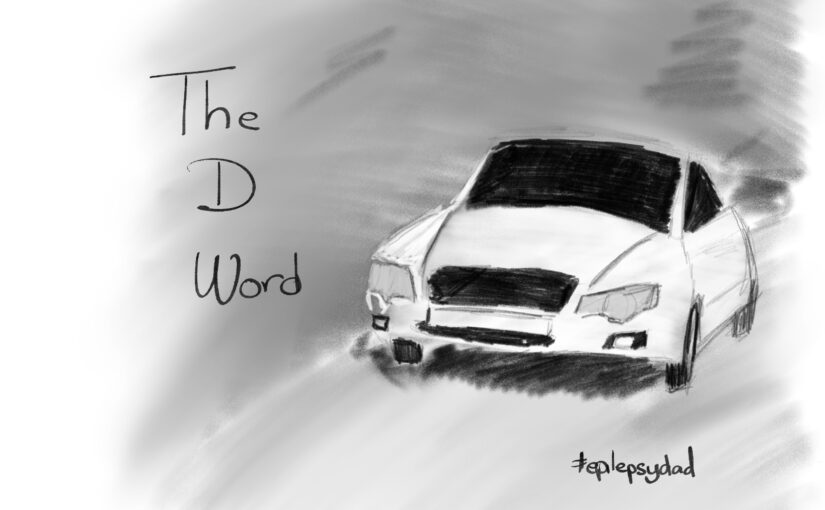
I remember getting my driver’s license shortly after my 16th birthday. I had been working since I was 14 and saved up enough money to buy a car. It was a white Hyundai Excel with a manual transmission, air conditioning, and a sunroof. It wasn’t the flashiest car, but it was mine, and it gave me freedom to go where I wanted when I wanted. I started driving to school instead of taking the bus. I drove to work instead of riding my bike. I could go where I wanted and get there faster. The car gave me more range, speed, and independence.

I know that feeling is something my son wants, especially as some of his friends will soon be getting their learner’s permits or licenses. In all likelihood, though, he won’t be able to drive. Even if we manage to keep him seizure-free for six months, despite never going more than a day without a seizure since they started, the responsibility of having a license and driving isn’t something he’s ready for today.

His challenges with executive functioning and slower processing are a dangerous combination behind the wheel of a two-ton moving rocket. The coordination required to operate a vehicle physically and the focus needed to mentally navigate safely on the streets and around obstacles are both areas where he struggles every day.

He needs reminders to stay on task, whether it’s chores or homework. He has learned to make a few basic microwave meals, but even then, we’ve learned first-hand what happens to the mac and cheese in the microwave when you forget to add water.

When he brings up driving, I can feel the weight of what he’s really asking — not just Can I drive?, but Will I ever be able to? Will I ever be like everyone else?

That’s the part that breaks me.

Driving represents so much more than transportation. It’s independence, choice, and self-direction. It’s being able to decide where to go and when. And for him, it’s a symbol of everything that still feels out of reach.

Because the truth is, driving isn’t just about safety. It’s about trust — trust in his body, his brain, and the world. And right now, none of those things is reliable enough to hand him the keys.

When I think about him behind the wheel, I imagine all the things that could go wrong. The seizures, the split-second decisions, the distractions. The danger is obvious. But underneath that fear is a quieter one — that he’ll never have the kind of independence that comes so easily to other kids his age. That he’ll always need someone — me, or someone after me — to help him navigate the world.

That thought terrifies me more than anything else. Because as much as I want to keep him safe, I also want him to have a life that’s his. I want him to feel capable, to feel like he belongs in the world, not just protected from it.

So for now, we’ll keep talking about driving — what it means, what it represents. Maybe someday he’ll be able to drive, maybe not. But my hope is that he still finds his own kind of freedom, one that doesn’t depend on a license or a steering wheel. One that lets him move through the world in his own way, with confidence and joy.

Even if he’ll always need help getting there.

Scars and Survival

Last summer, I was at the pool with my son.

It wasn’t that long ago that he needed to stand on his tiptoes to keep his head above the water. Now, standing over six feet tall (the tallest in our family, as he likes to tell everyone), only his waist is submerged. His skinny torso sticks up like a twig in a pond.

His body carries many markers from his life. There are scars from his adventures and falls. There are stretch marks on his lower back from his growth spurt. And there are remnants from the incisions on his chest and neck from his surgeries that implanted the two devices and the leads to his brain.

It’s hard not to notice, prominently pushing against the skin on his chest, the two implants. Against that skinny frame, with no fat or muscle to buffer them, the devices look huge. They are a permanent alteration to the contours of his body, captured on his chest like a relief map, describing the differences in elevation and the way the land rises and falls. And similar to the permanence of mountains in our lifetime, they will remain a defining part of his body’s landscape.

Of all the recorded history on his body, the implants are the hardest for me to see. The scars, even those from his surgeries, can be rationalized away as everyday occurrences of a growing child. I’ve had a scar above my eye since I was five, when I chased my sister under a glass table and forgot to duck. I’ve had a scar under my chin from when I was ten and tried to jump over a softball on my bike. And I have scars on my hands and arms from the countless times that I clumsily pulled something from the oven without protection and burned myself.

But the implants can’t be explained away as normal consequences of living. They are more than just damaged or healing skin and tissue. They are unnatural, and there is no alternative explanation to the reality that they are devices inserted into his young body to help reduce his seizures. They are visible reminders of his challenges—challenges, like the devices themselves, that he will likely carry for the rest of his life.

Seeing them, it’s easy to fixate on the implications and miss out on the significance of the moments that they enable. He’s alive. He’s having fewer seizures and has stopped a few medications. He and I were in a pool playing basketball, spending time together, and laughing. The reason he has the devices may be overwhelming, but the life they allow him to live is a medical miracle.

I still see the devices when I look at him, but I’m learning to see them differently. They don’t just mark his struggle—they also mark his survival. They are symbols of how far medicine has come, of how far he has come, and of the moments we still get to share.

Bit of Both

There’s this great line from the Marvel Guardians of the Galaxy movie where one of the characters asks his team what they should do next.

 Peter Quill: What should we do next? Something good? Something bad? A bit of both?

Gamora: We’ll follow your lead, Star-Lord.

Peter Quill: Bit of both.

At a recent appointment with our neurologist, we were giving her an update on our son’s quality of life. As I listed the highs and lows, that line from the movie popped into my head because it perfectly captures where we are on our journey with epilepsy.

For so long, it felt like we were chasing a single definition of “better.” Fewer seizures. Better focus. More sleep. But over time, I’ve learned that progress rarely shows up in a straight line. It comes in fragments stitched between setbacks.

Even with the medication changes, VNS, and DBS, our son still has seizures most days. But they’re mostly when he sleeps and hasn’t had a daytime seizure in a long time. The seizures affect his sleep and rest, and he’s tired a lot. But we’ve been able to manage his exhaustion and prevent it from escalating and increasing his seizures.

Because of his morning seizures, he often goes to school later, but he makes it through the day. He still struggles with his memory and executive functioning, but he is able to complete tasks and problem-solve. He’s behind socially, but he has a best friend. When we thought we should only expect regression in his cognitive abilities, we saw progress in math and other subjects.

When the neurologist did the “finger-to-nose” test to assess his upper body movement and coordination, she observed some tremors and dysmetria. But he also plays baseball and can hit a fastball and throw a pitch. His reaction time is slow, but his coaches adapt their style to help him contribute. The team consists mainly of neurotypical teens who go to school together and socialize outside of baseball, but they treat my son kindly. This season, the coach even drafted his best friend onto the team.

Last week, I wrote about embracing the bittersweet. Moments are never just one thing, and I sometimes struggle to find the good in bad ones, but I look for the bad when the moment is good.

In the middle of sadness, there is love. In struggle, there is strength. In the hardest days, there is light.

Life isn’t one thing, either. It’s a collection of moments and experiences stitched together over time. It’s natural to apply the same pessimistic lens to the collection as to each individual moment and get stuck in the pattern of only seeing the negative. But in life, just as it is with each moment, it’s important to see both.

Maybe I won’t always find it right away. Maybe some days the sorrow will feel heavier than the joy. But if I can hold space for both, if I can remember that they live side by side, then maybe I can stay a little closer to hope.

Maybe I won’t always recognize it immediately. Some days, the bad will feel bigger than the good. But if I can step back, hold space for both, and remember that neither tells the whole story on its own, I can keep moving forward.

Holding space might mean celebrating a hit in baseball even if the rest of the day was hard, or letting my son’s laugh take up the room without immediately wondering how long it will last. It’s giving each part its due without rushing past the good or getting swallowed by the bad.

That’s not just something to look forward to — it’s something to hold onto.

So, what comes next? Something good? Something bad?

Bit of both.