Getting Used to It

I’ve been on this epilepsy journey with my son for more than ten years. Ten years of seizures, medications, side effects, appointments, therapies, surgeries, sleepless nights, and the fear and instability that come with having uncontrolled seizures.

After ten years of anything, most people assume you’d eventually get used to it. Like living next to a railroad track long enough that the passing trains become background noise, or becoming so accustomed to planes overhead that you stop noticing them entirely. They imagine that after a decade of this life, the shock would soften, the fear would fade, and that somehow repetition would dull the edges.

But it never does.

Each seizure still stops the room, stops my thoughts, and stops whatever sense of normalcy I’ve managed to build. You don’t get used to it. You just get better at pretending you’re not breaking inside while you find a way to keep going on the outside.

That ability so many of us develop — to keep going, to go to work, the grocery store, the pharmacy, to keep the house clean, to pay the bills — can create the illusion that we’ve somehow normalized it all simply because it’s familiar. It can make it look easy from the outside, as if what we live with has become background noise to an otherwise ordinary life.

But it’s not background noise. It’s deafening. It drowns out everything else, and it takes effort — real, constant effort — to strain past that noise and hear the rest of the world. It takes effort to juggle routine tasks with the medical needs that keep my son going. It takes effort to reorganize an entire day of obligations when he has more or longer seizures that require rescue medication.

The reality is that there is no getting used to it. And that truth reveals itself over and over again.

Not after ten years, not after a thousand seizures, not after all the appointments, therapies, and sleepless nights. I’ve been walking this epilepsy path with my son for more than a decade, and still, every seizure cuts through whatever calm I’ve managed to create.

Time doesn’t dull the impact; it just teaches you how to carry it.
Slow Down

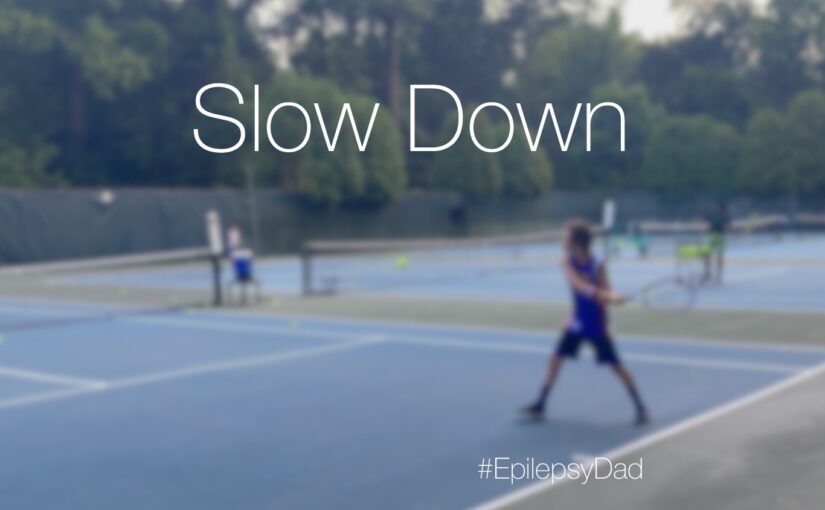
I’m standing with my left foot on the edge of the baseline. I bounce the bright yellow tennis ball a few times with my left hand while my right hand dips low, holding my racquet. I’m ready, so I steady the tennis ball before tossing it high into the air slightly in front of me. I rock backward on my heel, then forward, lifting my racquet to meet the ball’s descent. Contact.

“No, no, no,” my instructor says through his thick French accent. He points upward at the ball that has soared high enough to qualify as a space flight, and that still hasn’t completed reentry.

“Too fast. Watch.”

He takes my place on the baseline and tosses a ball into the air. His movement is controlled and intentional. The racquet methodically completes its arc and makes contact with the ball, sending it across the net where it lands in front of the service line.

“This is you.”

Again, he tosses a ball into the air. But instead of the slow, intentional movement, the racquet disappears into a blur of speed and sends the ball crashing into the fence on the far side of the court.

“When you go slow, you are present…you can control. When you go fast, you can’t.”

“Story of my life, ” I think to myself.

I’ve never been good at slowing down. I’m nervous and anxious and always feel like there is something I should be doing. I’ve created lists upon unending lists of the things that I need to do. Not “want” to do. Need. Must. Obligated to. Compelled to.

But there is only so much time, so I race from one thing to the next. Sometimes, I don’t quite complete the task that I’m doing or do it as well as I could have, but, usually, I don’t look back to check. Checking slows me down. And there is still so much to do.

Often, I don’t remember details because, as it turns out, I’m not there at all. And that, I realize, is part of the problem, especially when there are other people involved. What is the point of doing something with my wife and my son if the goal is to do it so that I can move on to the next thing? I’m not there with them if I can’t slow down enough to be present with them.

None of us knows how much time we have in this world. With my son’s condition, that is a fact of which I am too well aware. It should serve as a reminder that it is the quality of the time we spend together that matters more than the quantity of the things we do. But, as my wife has pointed out too many times lately, I haven’t always been showing up that way. I know she’s right.

Awareness is the first step of change. Acceptance is the second. I’m working on that part. I know it’s time to slow down.

The instructor backs away, and I retake my place on the baseline. I bounce the ball a few times before tossing it into the air. I raise my racket slowly towards the ball. Deliberately. Intentionally. I can feel that my arm is extended. I can feel it when the racquet makes contact with the ball. I watch as the ball flies over the net and lands in the box. It’s a different experience. And it’s the same type of experience I want more of with the people around me, too.

Inconsiderate Epilepsy

It was a few days before a big meeting that I was organizing at work. I was pulling together the leadership teams involved with a project that I am working on to talk about our progress. It was a big deal and I wore my anxiety like a jacket. Even if I wasn’t preparing for the meeting, I was thinking about it. I was stressing about it.

The meeting was on Tuesday. On the Sunday before, we were having a good day. We saw a movie. My son went to the park with a friend and I worked on my slides for the meeting. That night, though, my son started to act strangely. He was skirting boundaries. He played with an outdoor ball in the house. He started to play a little too dangerously with his foam baseball bat. I asked if he was okay and which way his brain was going and he said he was fine and that his brain was going forward, but I sensed something was off.

When it was bedtime, my wife started to get him ready and I fired up the laptop to work on my presentation. But when she asked him to clean up his toys, he started to throw a fit. It escalated quickly and before I knew it, I was sitting on the ground holding him. We tried to work on his breathing exercises and his coping skills but he was past the point of listening.

He was trying to hit us, spit on us, and calling us by our first names and saying mean things. For more than thirty minutes, I sat on the floor, holding my son, trying to comfort him. A few months ago, these episodes were happening all the time. Now, they are rare. But whether they are constant or rare, the impact of seeing your son struggle with his emotional regulation and become someone else is painful. After he finally came out of it and we put him to bed, I tried to work on my presentation, but I couldn’t. I was so shaken up.

The next day, I went to work thinking about the night before and also stressing about the meeting that was now only a day away. It’s not easy to go in the next day and tune out the night before. It’s the same when he has more seizures during the night than he normally does. I show up to work stressed and tired but try to focus on my work. I just hope it doesn’t happen on a day where I have to be “on.”

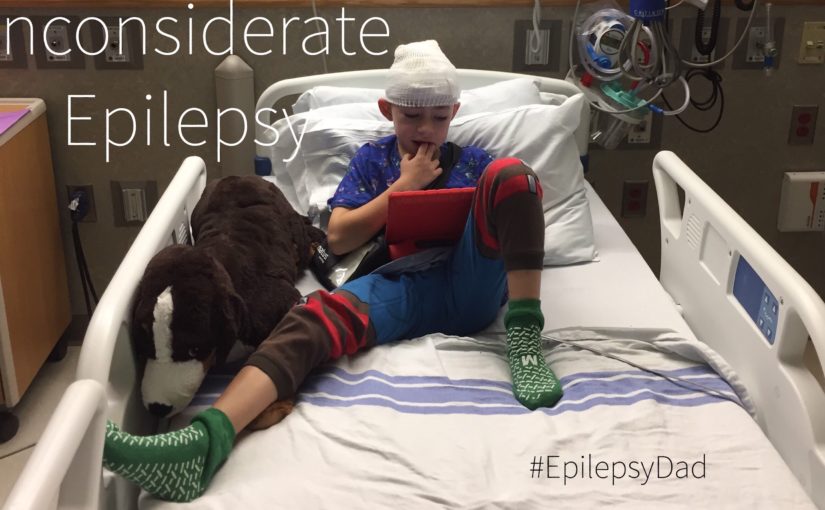
Epilepsy doesn’t care what else you have going on. Epilepsy didn’t care about my big meeting. It doesn’t care that we’re on vacation. It doesn’t care that we have plans.

My son had seizures on the baseball field. Seizures in Hawaii. At Disney world. A seizure in the pool. At school. But it’s not just seizures, it’s the overmedicated, the behavioral issues, the fatigue. Epilepsy and its entourage can show up anywhere, anytime.

When it does, you can’t send it away. Everything else gets pushed down the priority list. You have to deal with it right now.

And then, after you are done dealing with it, you figure out how to transition out of crisis mode. You go to work or you go to school and figure out how to go back to normal.

“Normal”, as if it’s a different place. But it isn’t. This is our normal.