Category: seizures

  • A Year With The VNS

    A Year With The VNS

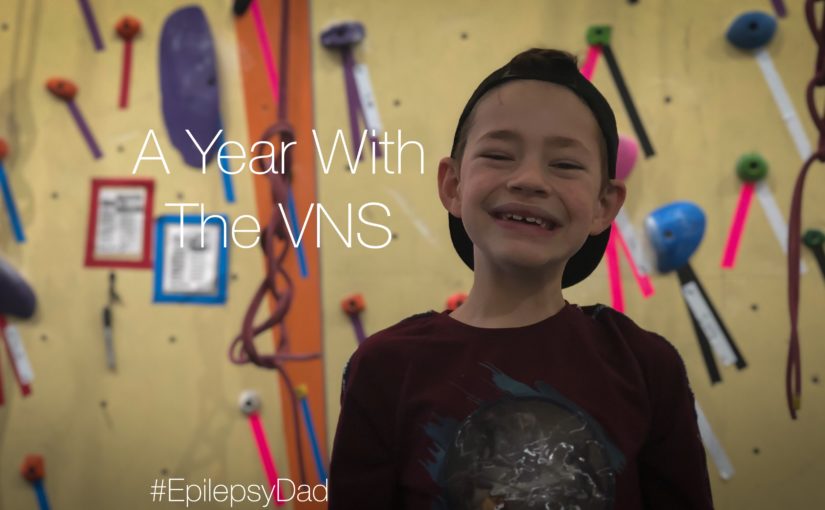
    Last December marked the one-year anniversary of my son’s VNS surgery.

    Leading up to the surgery, I was a wreck. The week before, I had to give a preview of a presentation to one of our executives. I was not present and I stumbled through, relying heavily on the notes that I threw together on a handful of index cards. A few weeks later, my boss commented that she noticed how off I was. “You’re normally so put together. I don’t know what happened.” I did, I thought. My son was about to have surgery.

    As I wrote about when we were contemplating the VNS, there is something about a surgery that is so daunting. With medications or the ketogenic diet, we can stop them if they aren’t working and the side effects eventually go away. But you can’t “uncut” my child. Once the scalpel breaks the skin, that’s it. It’s done. Even if the VNS is turned off or if the leads are removed, there is no going back. That thought weighed heavily on my mind right up to when they wheeled him back to the operating room.

    Thankfully, we are near one of the best children’s hospitals in the country, and the surgery went smoothly. The device was turned on a few weeks later, and the waiting game began.

    For the first six months, I didn’t expect much of anything to happen, which was great because not much of anything happened. Except for the vibration in his voice from the tingle of the VNS and the two visible scars, there was no change.  We didn’t see any reduction in seizures, even as the doctors adjusted the intensity and frequency of the pulses.

    At nine months, there was more of the same. His vocal cords seemed to adjust and his vibrato was less pronounced, but I could still hear it. Again, though, there was no seizure reduction.

    A year after his VNS surgery, I would love to write that it took a year for the VNS to really start helping my son. I would love to write that he is seizure-free and that we were able to wean him off the ketogenic diet or remove a few pills from the handfuls of pills he takes every day. I would love to write that I sleep any better knowing that the VNS will protect my son from a catastrophic seizure and that I sleep much better at night.

    But I can’t.

    The obvious question is, knowing what I know now, would I have still gone through with the surgery?

    The short answer is yes. The VNS helps a lot of people. At the time, we didn’t know whether it would work and I was and still am willing to try anything to reduce or prevent my son’s seizures. I’m disappointed that it didn’t do more for him, but it was worth trying.

    Maybe someday it will help. Maybe it is already helping with seizures that we can’t see, or maybe it will someday prevent a really bad seizure.
  • On The Surface

    On The Surface

    Recently, on the way to school, my son told my wife that he wasn’t feeling good. She turned around and took him home where he slept for three hours.

    Usually, he will try to push through. I don’t know if he doesn’t recognize what is happening in his body or if he is too stubborn or eager to please, but he goes dangerously beyond his limits until he crashes. We have spent so much time picking up the pieces and putting him back together after he does.

    My son started having seizures before he developed a reference or the vocabulary to describe what he was feeling. He only knows seizures, and medications, and side effects, and fatigue. There was never an absence of these things that he can recall and contrast when it happens to him today. For him, that is normal.

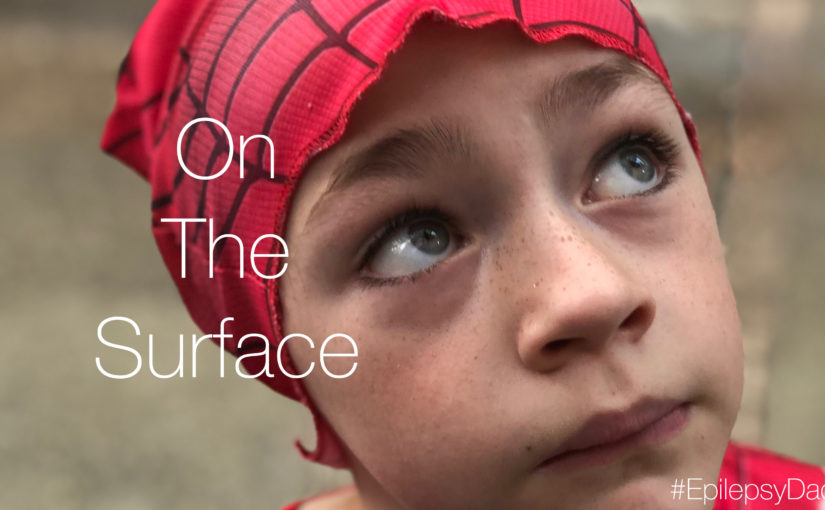
    We have spent years watching him closely and trying to be the external monitor of his condition. We ask probing questions when we suspect that he is off, but he often answers “yes” as if he assumes we know what he is feeling or can describe what he can’t. But we only see the external signs. We can only see what is on the surface. And our vocabulary and ability to describe what is happening to him is as limited as his.

    Me: “Do you have a headache?”
    My son: Yes.”
    Me: “Do you know what a headache is or feels like?”
    My son: “No.”

    I write every day. At work, I use words to describe complex systems. But the words that I know seem inadequate to describe what I can only imagine he is feeling. It’s words and concepts in another language that I am just beginning to understand after five years. We’re trying to use that language to communicate but too often things are lost in translation.

    It’s another one of the many frustrating things about being the parent of a young child with epilepsy. I want to make the seizures go away, but I can’t. I want to eliminate the side effects of his medication, but I can’t. At a minimum, I want to understand what he is going through so that I can help him but there is so much about his condition that is invisible to us. It’s a terrible feeling of helplessness.

    I’m hopeful that, as he did on the way to school, he’s starting to build awareness of what is happening inside his body and vocalizing it. Becoming an advocate for himself and expressing his needs will be critical for him to be able to navigate a world that is not always kind or forgiving or tolerant of people who are different.

    For the past five years, we have been the monitors of his condition and the ones expressing his voice. As much as I felt ill-equipped for the role, it was necessary because my son was not able to do it himself. It made me feel needed and useful instead of focusing on my inability to find a way to make the seizures stop. I am comfortable filling that role but I can only account for what is on the surface. There is so much more to him and his condition than what I can see.

    The reality is that the more I take on that responsibility, the longer it will take my son to learn to do it himself. It will take longer for those symptoms and feelings that exist below the surface to reveal themselves. And it will take longer for him to get what he needs because he won’t learn to put his needs out there. At some point, the help I am trying to give him becomes the thing holding him back.

    Reality and I don’t always agree, but it is usually right.

  • The Night Watch

    The Night Watch

    Every night before he goes to bed, my son takes a handful of pills.

    The pills are the last line of defense that my son has against the unrelenting seizures that constantly lurk on the horizon. Especially at night, when his brain slows down to recuperate from the day, my son’s brain isn’t strong enough to defend itself against attack.

    His medication is meant to strengthen his defenses so that his brain can rest. They are the guards on the parapet defending the residents inside the walls throughout the night. But the gaps in my son’s wall are too wide for the guards to cover. It’s not a question of whether a seizure will break through; it’s how many. It’s how much damage will the attackers do before the sun rises.

    We’ve tried to boost his defenses. New medications. The ketogenic diet. VNS surgery. But none of them have prevented the nightly raids from exacting their toll on his developing brain. Even combined, they are no match for the electrical storm the flows wildly across the neurons and floods the cells.

    It could be worse. It has been worse. Before we knew what this was, the flood nearly took my son. The uncontrolled pulses flowed through the gaps in his natural defenses and eventually breached them entirely, leaving his body frozen and his mind disconnected. We managed to beat back the invader and rebuild. We strengthened the walls. We bolstered the night watch. But our seizure calendar records the history of attacks, painting cells with yellow markers revealing every defeat in long ribbons of sequentially colored squares.

    Every night before he goes to bed, my son takes a handful of pills because there is nothing else to do. We stick to our routine because it is better than the alternative. His pills, his diet, and his VNS play their part. But as he drifts off to sleep, I turn on the monitor and take my post watching over him, too. Because it’s my job on the night watch to be there when his defenses ultimately fail, to comfort him after the attack, and to help him rebuild the next day before we do it all over again.


  • Ignoring The Warnings

    This post is part of the Epilepsy Blog Relay™ which will run from March 1 through March 31. Follow along!

    When I was younger, my vision of my future included many things. It included a cabin in Maine where I would write and take my sea kayak out to harvest lobsters from my traps. It included a job where I made a lot of money doing something that I loved. It included traveling around the world, soaking up the sights and flavors of every culture on the planet. And it included a family that would share in these experiences and would enrich my life with their own experiences and dreams.

    Man plans, God laughs. ~Yiddish proverb

    That vision for my future didn’t include a lot of things. It didn’t include the pressure and demands of a job later in my career. It didn’t include the realities that come with having parents who are aging. And it didn’t include the curveball we were thrown when our son was diagnosed with epilepsy.

    The combination of these factors created an environment that tests us every day. The relentless seizures. The widening gap between our son and his peers. The insecurity of our lives. The distance that the exhaustion and pressure create between us.

    There was a movie called “The Perfect Storm” that detailed the account of the Andrea Gail caught at sea during the 1991 “Perfect Storm”, where multiple storms merged to create a super-storm. The crew ignored the warnings about the storm and made choices that took them further from safety. Eventually, underestimating the power of the storm, they turn back into it and the ship is lost.

    Lately, I’ve been feeling like we’re caught in our own storm. I’ve been ignoring the signs and now we’re trapped in the middle of it and the waves are getting bigger. Occasionally, one of us will get thrown overboard but the others pull them back to safety. But there is only so long we can hold out. Eventually, we will get tired. Eventually, the ship will be lost.

    I underestimated the strength of this storm. I thought we were lucky. I thought the seas would calm. I thought we had been through enough. But the storm is not done with us yet.

    The warnings are in front of us.

    It’s time to steer our ship to safety before it’s too late.

    NEXT UP: Be sure to check out the next post by Elaine at livingwellwithepilepsy.com for more on epilepsy awareness. You can check out any of the Epilepsy Blog Relay posts you may have missed.

  • Some Other Beginning’s End

    Some Other Beginning’s End

    It’s already February.

    It feels like we skipped January, which I wouldn’t have minded.

    January sets the tone for the year. We treat it as a fresh start. We make resolutions to change things about ourselves that we want to improve. And then we endeavor to build up enough momentum to carry those changes through the year and through our lives.

    If we’re still exercising in February, or eating better, or not drinking, then there is a better chance that we’ll be doing the same in March and in December. But, inevitably, by the second month of the year, the gym is starting to thin out. There is a pint or two of ice cream in the freezer and a box of wine on the counter.

    I was hoping for a better January. My son had VNS surgery in December. While I knew it would take months or a year to see if it would work, January felt so much worse. We often counted the time between seizures in hours, not days. We were reminded every five minutes when the VNS went off and tickled my son’s throat and changed his voice that we were still at war with a relentless enemy that takes and takes from him, leaving him tired and insecure and behind.

    January didn’t even give us that first, hopeful week. It strapped us to the couch, shoved a ladle full of ice cream into our mouth and poured the box of wine down our throat on the first day. “Just so you don’t get any ideas that this year is going to be different or better, ” January said, smoking a cigarette with its foot on my chest.

    Seneca said, “every new beginning comes from some other beginning’s end.” I’m trying to find a new beginning in all of this. But to do that, I need to find an end, but there never seems to be one. We turn the page of the month, but it’s the same calendar with the same theme that has been hanging on the wall for the last five years.

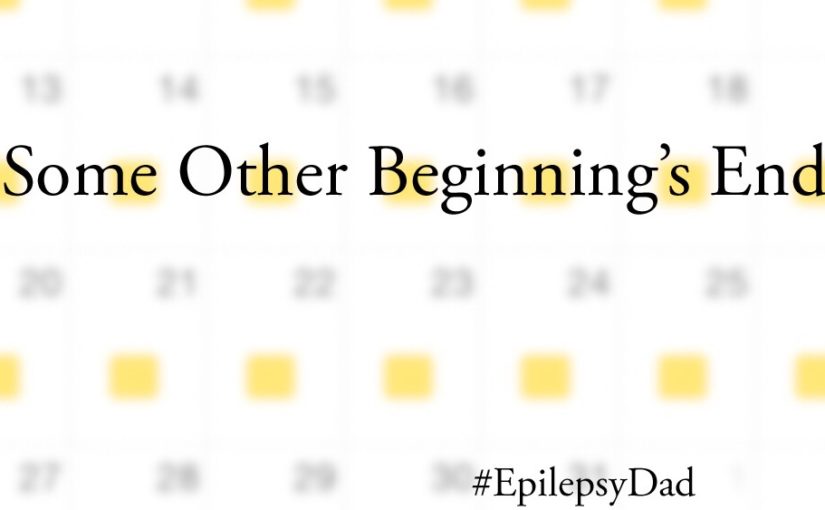
    The days of the month are color-coded to capture those when my son had a seizure. January is covered with the little yellow squares of activity. February isn’t starting out any better. It’s hard to look at the calendar and imagine that it is ever going to end or that we’re going to get that new beginning we’ve been hoping for.

    But Seneca also said, “Begin at once to live, and count each separate day as a separate life.” Maybe I’m thinking too “big picture”. I’m trying to apply “before” and “after” to months and years instead of to each day. Each day when my son has a seizure ends and a new day begins without one. Each day has the potential to be the day that he doesn’t have a seizure. Each day has the potential to be the one when things begin to get better.

    If it turns out to not be that day, I’ll try to remember that that day will end, too. And when it does, a new one will begin. I’ll try, but it won’t be easy. Because even though I’m trying to be grateful for each day and to see its potential, I’m still longing for the day when things finally get better for my son. Because even if it’s not possible, that’s the new beginning I still really want. But for that to happen, these relentless seizures and side effects need to end.