Category: parenting

  • A Year With The VNS

    A Year With The VNS

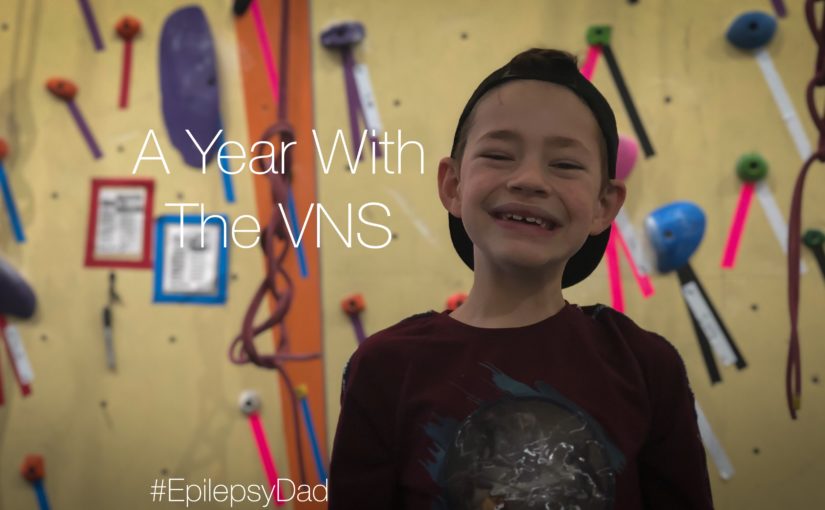
    Last December marked the one-year anniversary of my son’s VNS surgery.

    Leading up to the surgery, I was a wreck. The week before, I had to give a preview of a presentation to one of our executives. I was not present and I stumbled through, relying heavily on the notes that I threw together on a handful of index cards. A few weeks later, my boss commented that she noticed how off I was. “You’re normally so put together. I don’t know what happened.” I did, I thought. My son was about to have surgery.

    As I wrote about when we were contemplating the VNS, there is something about a surgery that is so daunting. With medications or the ketogenic diet, we can stop them if they aren’t working and the side effects eventually go away. But you can’t “uncut” my child. Once the scalpel breaks the skin, that’s it. It’s done. Even if the VNS is turned off or if the leads are removed, there is no going back. That thought weighed heavily on my mind right up to when they wheeled him back to the operating room.

    Thankfully, we are near one of the best children’s hospitals in the country, and the surgery went smoothly. The device was turned on a few weeks later, and the waiting game began.

    For the first six months, I didn’t expect much of anything to happen, which was great because not much of anything happened. Except for the vibration in his voice from the tingle of the VNS and the two visible scars, there was no change.  We didn’t see any reduction in seizures, even as the doctors adjusted the intensity and frequency of the pulses.

    At nine months, there was more of the same. His vocal cords seemed to adjust and his vibrato was less pronounced, but I could still hear it. Again, though, there was no seizure reduction.

    A year after his VNS surgery, I would love to write that it took a year for the VNS to really start helping my son. I would love to write that he is seizure-free and that we were able to wean him off the ketogenic diet or remove a few pills from the handfuls of pills he takes every day. I would love to write that I sleep any better knowing that the VNS will protect my son from a catastrophic seizure and that I sleep much better at night.

    But I can’t.

    The obvious question is, knowing what I know now, would I have still gone through with the surgery?

    The short answer is yes. The VNS helps a lot of people. At the time, we didn’t know whether it would work and I was and still am willing to try anything to reduce or prevent my son’s seizures. I’m disappointed that it didn’t do more for him, but it was worth trying.

    Maybe someday it will help. Maybe it is already helping with seizures that we can’t see, or maybe it will someday prevent a really bad seizure.

  • On The Surface

    On The Surface

    Recently, on the way to school, my son told my wife that he wasn’t feeling good. She turned around and took him home where he slept for three hours.

    Usually, he will try to push through. I don’t know if he doesn’t recognize what is happening in his body or if he is too stubborn or eager to please, but he goes dangerously beyond his limits until he crashes. We have spent so much time picking up the pieces and putting him back together after he does.

    My son started having seizures before he developed a reference or the vocabulary to describe what he was feeling. He only knows seizures, and medications, and side effects, and fatigue. There was never an absence of these things that he can recall and contrast when it happens to him today. For him, that is normal.

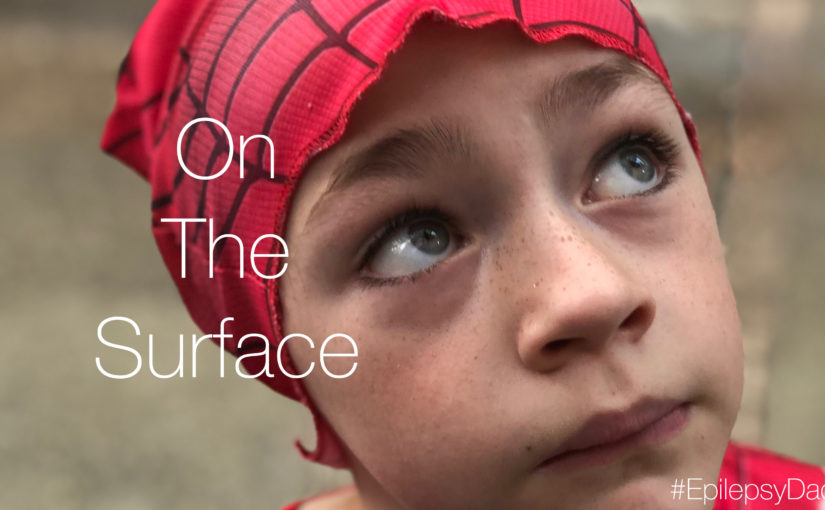
    We have spent years watching him closely and trying to be the external monitor of his condition. We ask probing questions when we suspect that he is off, but he often answers “yes” as if he assumes we know what he is feeling or can describe what he can’t. But we only see the external signs. We can only see what is on the surface. And our vocabulary and ability to describe what is happening to him is as limited as his.

    Me: “Do you have a headache?”
    My son: Yes.”
    Me: “Do you know what a headache is or feels like?”
    My son: “No.”

    I write every day. At work, I use words to describe complex systems. But the words that I know seem inadequate to describe what I can only imagine he is feeling. It’s words and concepts in another language that I am just beginning to understand after five years. We’re trying to use that language to communicate but too often things are lost in translation.

    It’s another one of the many frustrating things about being the parent of a young child with epilepsy. I want to make the seizures go away, but I can’t. I want to eliminate the side effects of his medication, but I can’t. At a minimum, I want to understand what he is going through so that I can help him but there is so much about his condition that is invisible to us. It’s a terrible feeling of helplessness.

    I’m hopeful that, as he did on the way to school, he’s starting to build awareness of what is happening inside his body and vocalizing it. Becoming an advocate for himself and expressing his needs will be critical for him to be able to navigate a world that is not always kind or forgiving or tolerant of people who are different.

    For the past five years, we have been the monitors of his condition and the ones expressing his voice. As much as I felt ill-equipped for the role, it was necessary because my son was not able to do it himself. It made me feel needed and useful instead of focusing on my inability to find a way to make the seizures stop. I am comfortable filling that role but I can only account for what is on the surface. There is so much more to him and his condition than what I can see.

    The reality is that the more I take on that responsibility, the longer it will take my son to learn to do it himself. It will take longer for those symptoms and feelings that exist below the surface to reveal themselves. And it will take longer for him to get what he needs because he won’t learn to put his needs out there. At some point, the help I am trying to give him becomes the thing holding him back.

    Reality and I don’t always agree, but it is usually right.

  • The Night Watch

    The Night Watch

    Every night before he goes to bed, my son takes a handful of pills.

    The pills are the last line of defense that my son has against the unrelenting seizures that constantly lurk on the horizon. Especially at night, when his brain slows down to recuperate from the day, my son’s brain isn’t strong enough to defend itself against attack.

    His medication is meant to strengthen his defenses so that his brain can rest. They are the guards on the parapet defending the residents inside the walls throughout the night. But the gaps in my son’s wall are too wide for the guards to cover. It’s not a question of whether a seizure will break through; it’s how many. It’s how much damage will the attackers do before the sun rises.

    We’ve tried to boost his defenses. New medications. The ketogenic diet. VNS surgery. But none of them have prevented the nightly raids from exacting their toll on his developing brain. Even combined, they are no match for the electrical storm the flows wildly across the neurons and floods the cells.

    It could be worse. It has been worse. Before we knew what this was, the flood nearly took my son. The uncontrolled pulses flowed through the gaps in his natural defenses and eventually breached them entirely, leaving his body frozen and his mind disconnected. We managed to beat back the invader and rebuild. We strengthened the walls. We bolstered the night watch. But our seizure calendar records the history of attacks, painting cells with yellow markers revealing every defeat in long ribbons of sequentially colored squares.

    Every night before he goes to bed, my son takes a handful of pills because there is nothing else to do. We stick to our routine because it is better than the alternative. His pills, his diet, and his VNS play their part. But as he drifts off to sleep, I turn on the monitor and take my post watching over him, too. Because it’s my job on the night watch to be there when his defenses ultimately fail, to comfort him after the attack, and to help him rebuild the next day before we do it all over again.


  • The In-Between

    The In-Between

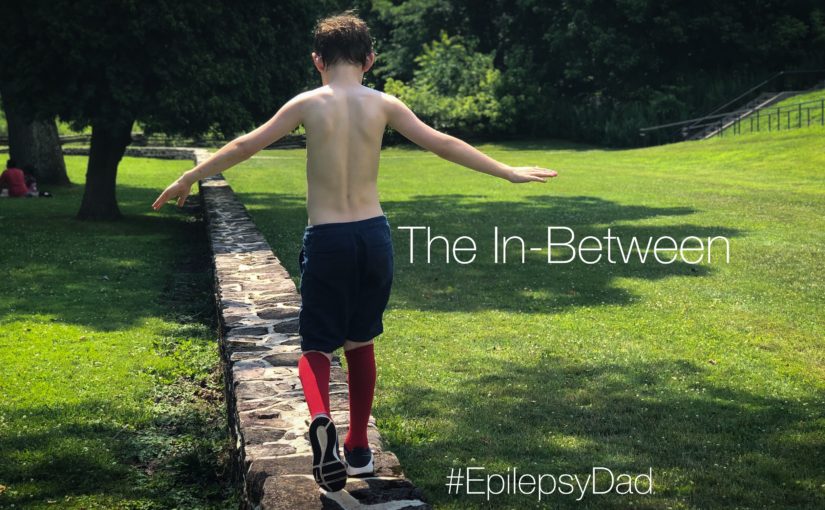
    We were in Colorado recently and saw some friends we haven’t seen in over a year. The school year has also started, and we’re seeing parents and children that we haven’t seen all summer. In both cases, people are seeing our lives at specific points in time. They’re seeing us then and now, but they don’t see us in the in-between.

    The in-between is where the highs and the lows are. It’s where the daily struggles of living with epilepsy are visible. It’s where the seizures feel like they never end. It’s where there are long stretches of days that seem impossible and where sometimes hope is lost.

    The in-between is also where small accomplishments seem enormous and where incremental progress seems like leaps and bounds. It’s where not going backward is sometimes as good as moving forward. It’s where a baseball game feels like the World Series and where climbing a rock wall feels like summiting Everest.

    The in-between is where every challenge and victory brings us closer together as a family. It’s where we shape our perspective. And it’s where our actions and how we approach the world shows how far we’ve come.

    The in-between is where we live. The in-between is our every day.


  • A Really Big Week

    A Really Big Week

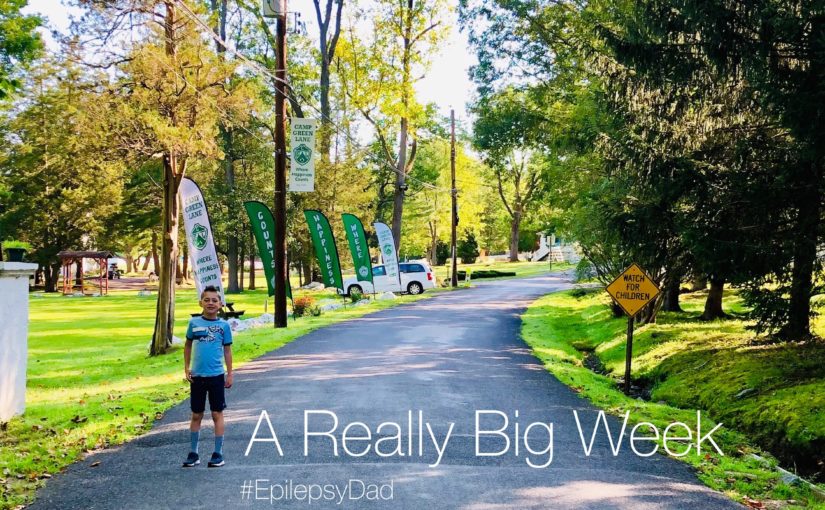
    Over the summer, two huge things happened during the same week.

    Professionally, I delivered a keynote speech at a conference. I’ve given many presentations before, and public speaking is something I want to do more. But this was much bigger than any talk that I had given previously.

    I started to prepare for my talk weeks in advance, but, at the same time, another important event was looming on the horizon. The same week as the conference, we would be dropping our son off at sleepover camp for the first time.

    Our son has rarely spent a night without either my wife or me there. And, when I say rarely, I mean once. No sleepovers with friends. No nights with the grandparents. One night in his entire life he spent with our nanny so my wife and I could go on an extended date night in the city and stay in a hotel, three blocks from our home. And now, we were going to send him away for a week.

    Our local Epilepsy Foundation affiliate runs a program called Camp Achieve that is tailored to the needs of kids with epilepsy. It’s a week-long summer camp where the kids do proper summer camp activities. They swim and play tennis and have water balloon fights. They’re surrounded by other kids that are like them. Many of the counselors are former campers, and they are rounded out with volunteer doctors and nurses and other medical professionals. We knew and trusted so many of the volunteers because they were our nurses and friends we met through the Epilepsy Foundation.

    Even so, the idea of leaving him for a week tore at my soul. I was worried about him, not just medically, but emotionally. I wondered how he would do away from us. I was worried about my wife. I was trying to be strong but leaving him was one of the hardest things I’ve ever done…right up there with giving a keynote speech.

    When I was still weeks away from the overlapping events, working on my speech provided a distraction. But as we got closer to camp week, I was having difficulty focusing. I didn’t work on my speech as much as I wanted to. I also wasn’t dealing with the impending separation from my son. Before I knew it, it was time to drop him off.

    In life, there are easy days, and there are hard days. The day we dropped our son off to camp was a tough day. I was so focused on the process of checking him in that I was unprepared for when it was done, and we were shown to our car. The rest of drop-off day was a waste, as was the next day as my wife and I checked Facebook every two seconds to see if the camp had posted any pictures of our son.

    But the conference was still happening, and it was only a few days away. I needed to focus and, thankfully, my wife helped, and her performance background proved instrumental. We spent the next few days shifting our attention away from Facebook (it helped that we started seeing pictures) and towards my talk. But each of those days was an exhausting marathon trying to keep my attention where it needed to be. Every night, I felt like I had given everything and crashed hard, only to repeat it the next day. Eventually, there were no more days.

    The day of the conference was the day before we would pick up our son. It felt like I just needed to get through this one, really big, last thing. Even though that morning, I couldn’t remember any of what I was going to talk about, I somehow managed to calm my nerves enough to deliver what I was told was a solid talk. The euphoria after the conference was a mix of relief and excitement. My wife and I celebrated making it through the week with an intense ping pong competition, then went to bed knowing we’d see our boy in the morning.

    We made it.

    Pickup day was an orchestrated event, so even though we saw him outside his cabin, we resisted the urge to run over to him and hold him. But my heart felt so full when he signed “I love you” to us with a tired smile. When the ceremony was over, I held him so tight, and it felt like the perfect reward for making it through the week.

    My son had a great time and wants to go back. Next year, though, I won’t sign up for anything the week of the camp. Maybe my wife and I can even go away together.

    Just not too far away.