Category: seizures

  • Opening Up About My Son’s Hidden Epilepsy

    Opening Up About My Son’s Hidden Epilepsy

    This post is part of the Epilepsy Blog Relay™ which will run from March 1 through March 31. Follow along and add comments to posts that inspire you!

    If you saw my son on the playground, you might not notice anything wrong with him. He’d be running, playing, and laughing alongside the other children. Epilepsy is a “hidden disability”. It can remain invisible, hiding its nature until a seizure reveals the cruel truth. For my son, his seizures occur in the early morning hours outside the view of the rest of the world. While there are traces of other symptoms of his condition, they, too, often go unnoticed. As a result, we control whether to expose his condition to the people around us.

    There are times when it is easy to know that we should disclose his condition. At school, he is on a 504 plan so his epilepsy is well documented, and he has special accommodations during the day. His aide and his teacher have both come to understand him and are able to better adapt to his needs. While many of his classmates can’t grasp what they cannot see, we are as honest with them as we can be. It’s hard to not notice the aide, the breaks and the absences. Ignoring the reason for them would confuse his young class more.

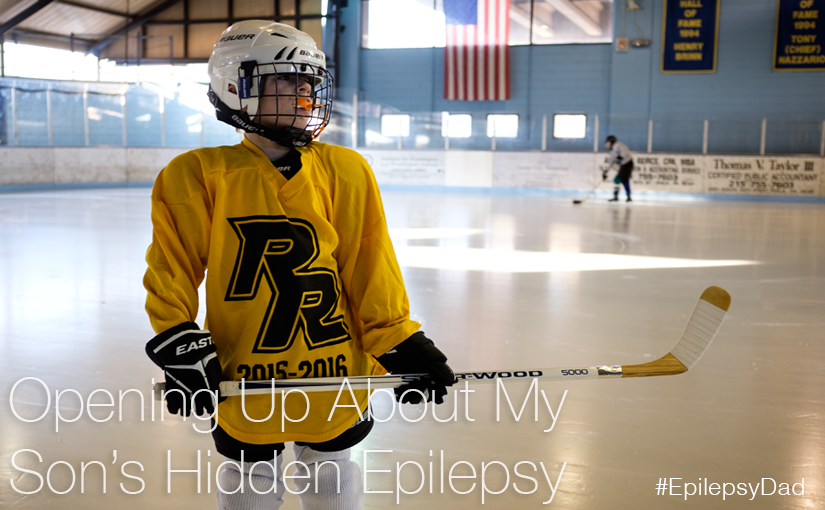
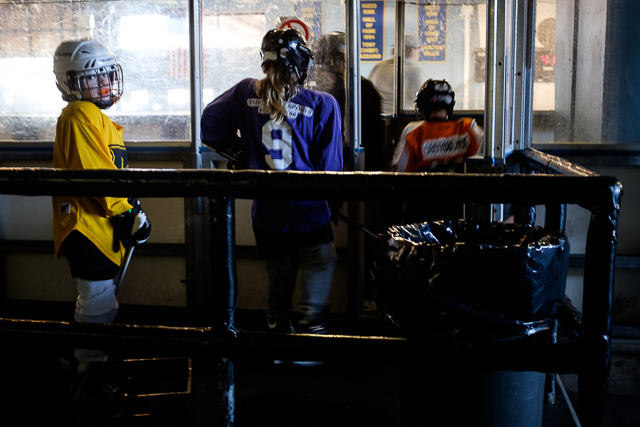
    Sometimes disclosing his epilepsy is a matter of safety. Before we signed him up for hockey, we asked if they were comfortable with a student that had epilepsy. On the first day of practice, we talked to the coach to remind him. When my son had a seizure on the ice, the coach was prepared and we spoke with him afterward, as well. It would have been unfair and irresponsible to hide my son’s epilepsy, even if he hadn’t had that seizure. It also could have easily traumatized his coaches. It’s bad enough seeing a seizure when you know one is possible. It’s another thing to be caught off guard.
    As his father, I worry what the stigma of epilepsy will do to my son. Classmates made him feel different because his ketogenic lunch was strange. They weren’t trying to be mean, but it caused my son to hide his lunch for weeks. As he gets older, the comments may not be as innocent. My wife and I work hard to give him a good foundation of strong values and a deep sense of self-worth. I don’t want him to feel shame because he has epilepsy. But he’s my little boy, and knowing that he’ll face challenges because of his condition is hard. The idea that he’ll be stigmatized by others because of it is unbearable. That alone makes me want to protect him and never tell anyone about his epilepsy.

    So I hide his struggle (and ours) from those around us. I don’t talk about his condition or volunteer any information for fear of judgment or pity. To the parents from his school and his hockey class, he’s another normal kid. To the people passing on the street and the people that see him on the playground, he blends in with everyone else. Some days, those moments feel like a gift that I don’t want to let go of.

    It’s tempting to take the same approach in every situation. But epilepsy is such a big part of his life that people won’t know the real him with that piece missing. They won’t know how hard he works to function on a bad seizure day or to navigate the fog caused by his medicine. They won’t know that he has different limitations and abilities. They’ll never understand him without that piece of the puzzle and I want him to be understood. He is worth understanding.

    Is it better to feel like everyone else when you know that you aren’t? Or is it better to always feel different but to always be yourself? Should the answer I’d give for myself be the same that I’d give for my 7-year-old son? These are the questions that I found myself asking as I tried to wrap up this post for epilepsy awareness. I struggled for a long time trying to come up with a concise answer, but I couldn’t. Because there is no answer. There is just doing the best that I can with what I am capable of doing and with my son always first on my mind.

    NEXT UP: Be sure to check out the next post tomorrow from Audra Sisak at www.hislifewithautism.com for more on epilepsy awareness. For the full schedule of bloggers visit livingwellwithepilepsy.com. And don’t miss your chance to connect with bloggers on the #LivingWellChat on March 31 at 7PM ET.
  • By His Side

    By His Side

    A noise stirred me from my sleep. Instinctively, I rolled to face the monitor. Even though it was on the dimmest setting, my eyes struggled to focus against the light of the screen. I closed one eye completely and squinted the other until I could make out the image. Then, another sound. That sound. The sound that still breaks the silence of the early morning. The sound that wakes me from my sleep and tells me that my son’s brain has lost control.

    Some mornings, I watch the screen to see if my son can put himself back to sleep. But this morning, I could tell by the way the sound echoed through the halls that it was a bad seizure. I slid my body off the bed and felt the cold floor beneath my feet. Keeping one eye closed did little to help readjust to the darkness. I navigated my way through the kitchen on instinct until I reached his door. I felt for the handrail and made my way down the stairs. Halfway down, my eyes finally caught up to the rest of my body and I could make out the bottom of the stairs. I swung myself around the banister and landed at the foot of my son’s bed as he sat upright and started to cry.

    I write a lot about these early morning hours. These are the hours when our unwelcome visitor makes its presence known. These are the hours of sounds, and seizures, and tears. Of scrambling down stairs and early morning comfort. The hours without sleep, when there is nothing to do but think about our lives…my son’s life.

    I wonder if these trips to his room will ever end. I wonder if our house will ever be quiet again in the early morning, or if I will ever be able to let my guard down. I wonder if this is his life, destined to call out into the night for the rest of his days. I try not to think about who will answer that call when I am gone. On that night, I was there, like I was on countless other nights. I did answer the call, like I will for as long as I am able.

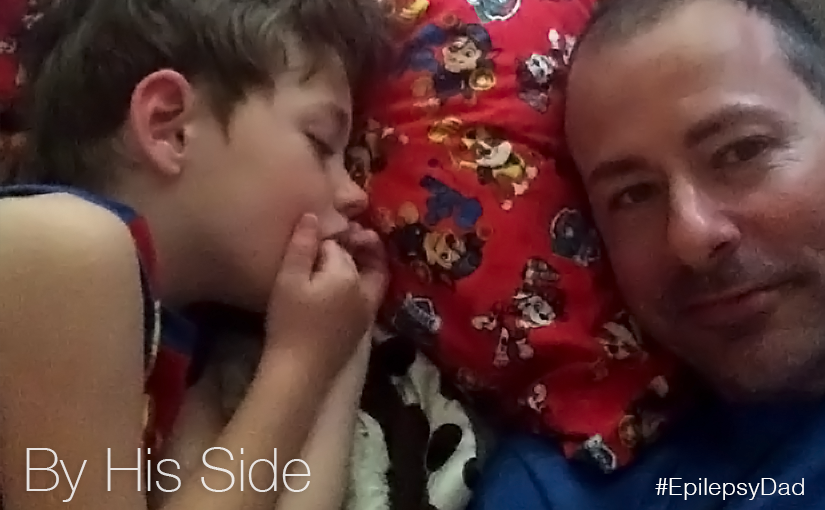
    I crawled into bed with him and sat next to him. I rubbed his back and told him that he was okay, that everything was going to be okay. It didn’t feel like a lie when I said it, but it didn’t quite feel like the truth, either. After a few minutes, he started to calm down. I helped him lay back down and covered him with his favorite green blanket. He stuck his fingers in his mouth as he closed his eyes. I laid next to him until his breathing slowed and the sound of him sucking on his fingers faded to silence. Then I stayed a little longer, letting my own eyes grow heavy, and fell asleep by his side.

  • Throwing It Back

    Throwing It Back

    We walked along the shore of Atlantic City. The beach was quiet with only a few other souls in view. The sun warmed the winter air to a comfortable temperature and cast stark shadows of the shells on the sand. The seagulls circled silently around us riding the current in the air. The waves rhythmically pushed themselves ashore. They darkened the sand to an almost black and erased the footprints that my son had left moments before.

    epilepsy dad feature throwing it back

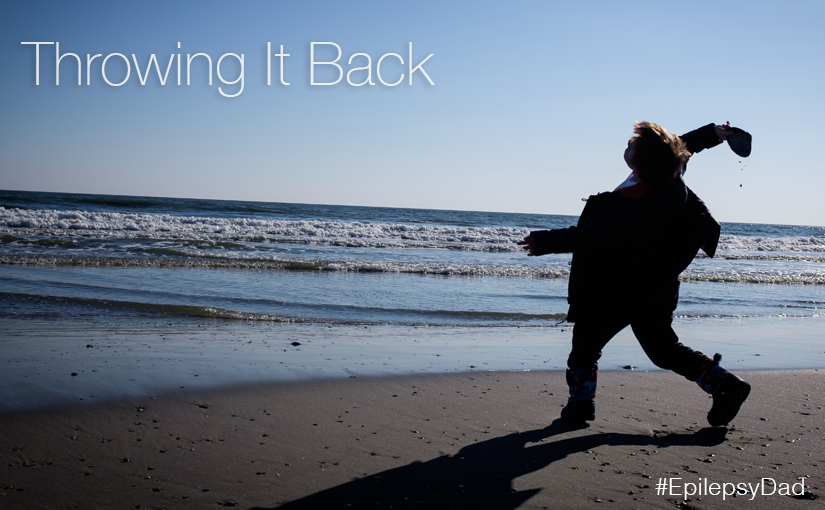
    That morning along the beach, my son took to launching enormous clam shells back into the sea. The inhabitants had been the unwilling dinner guests of another sea creature or one of those circling seagulls. Now, their empty shells laid scattered along the shore. I watched as my son scurried along the sand, finding the biggest ones, and brought them up to the water’s edge. The ocean had given up the shells to the land and now my son was sending them back.

    epilepsy dad awareness seizure medicine throwing

    Since my son was young, he has always liked to throw things in the water. He liked to see how far he can throw something against the limitless backdrop of the ocean. There were no walls to bounce off, no cars to avoid, only infinity against which to test his strength. After he hurled an object into the sky, he would track it through the air until it reached its destination. Would it skip or would it splash? Either was acceptable, as long as it was far. On the really good ones, he’d turn to me and ask if I saw how far it went. Of course I was watching, I told him, but he was already looking for his next projectile.

    As I watched him throw shell after shell, I thought about the things I’d like to throw into the sea. I’d start by taking his seizures from him. Like a piece of paper, I’d crumble them up into a ball until they held their shape. I’d grip it like a fastball and wind up with enough torque that, when I let go, the seizures would disappear over the horizon. I’d do the same with his medicine and their side effects. His learning and attention issues would be the next to go, followed by his fatigue and ataxia. Over and over, I’d crush these afflictions into dense spheres and throw them with all my strength. Whether they skipped or splashed, I only want them far away from my son, somewhere at the bottom of the sea.

    epilepsy dad feature throwing it back

  • Getting Unused To The Sound

    Getting Unused To The Sound

    We’ve lived almost every day of the last two and half years with the sound of my son having a seizure. Usually, in the early morning, the distinctive sound my son creates as his body tenses and contorts echoes through the halls until it reaches my ears and stirs me from my sleep. For two and a half years I have been on guard, listening for that sound that served as an alarm calling in the dark. I’ve spent most nights periodically waking to watch and listen to the video monitor. This has been our routine. This has been our life.
     
    When his seizures started, I would rush to his room with every seizure and lay with him until he fell back to sleep. Sometimes I would catch another seizure when it started. It was somehow comforting being there with him when they happened, from beginning to end. To hold him, to rub his head, and to let him know that I was there and that it would be over soon and that he would be okay.
     
    As time went on, my son started putting himself back to sleep before I could reach him. I started watching the monitor as he came out of a seizure to see if he needed me. More and more, he would simply turn over, pull the blankets back up to cover his body and fall back to sleep. As much as I liked being there with him during a seizure, the new arrangement gave me a few extra minutes of sleep.
     
    In the last month, we’ve also been able to string together (we think) a few seizure-free days in a row. I say “we think” because some of his are so short that they are easy to miss, especially in the middle of the night. But on a few of those nights, he was with us and he did not seize. He even had his first seizure-free week since they began.
     
    I felt like we turned a corner. We made the most recent change to his medications a few weeks before those seizure-free days and I almost let myself believe we had solved the riddle. But then my son got sick and we were again visited by our most unwelcome guest. He rides such a fine line between seizing and not that even a common cold can undo a streak.
     
    Hearing seizures in the middle of the night had become such a part of our routine that, when they stopped, it was easy to fall into the trap of thinking that they were gone. I stopped thinking that a life without seizures was possible, but when we had a week without them, I was too quick to assume that they wouldn’t come back. I felt as if we had been lifted from this unforgiving place. When they did come back, I fell from such a great height that the impact nearly crushed my spirit.
     
    As grateful as I was for those days without seizures, they tugged at my desperation. They opened me up at my seams and stuffed me with false hope before closing me off. Now I’m pulling at the stitches trying to free myself from unrealistic expectations.
     
    The reality is that the sound of a seizure will be a part of our acoustic landscape as long as our son is living with us. Even if we see another stretch of seizure-free days, the threat of another will always be there. There is no escaping its reach, no getting unused to the sound. The only thing I can do is respond when the alarm sounds, which I will do whenever I am called.
     
  • To CBD Or Not To CBD

    To CBD Or Not To CBD

    There is no shortage in the news of sensational headlines highlighting the miracles of CBD and medical marijuana as a treatment for epilepsy.

    The articles write about children who tried any number of medications that failed to control their hundreds of seizures a day but were all but cured by CBD.

    After two years of uncontrolled seizures, we were so desperate for something that could help our son so we brought CBD up with our doctors. At the time, it was illegal in Pennsylvania and our doctors weren’t comfortable talking about it because they had no experience with it. We were unable to get into the CBD trial happening at our hospital so we discussed moving back to Colorado. Our doctors said there was only limited testing on the drug and that it was focused on specific syndromes associated with epilepsy. There was little research on its long-term effects or its interactions with the antiepileptic medications. Another concern we shared with the doctors was the inconsistent quality coming out of many CBD providers. At the time, we made the decision to not try CBD because it wasn’t worth the risk of introducing a drug with so many unknowns.  We had seen what a bad reaction to a medicine looks like for our son and we weren’t willing to risk the progress that we had made.

    My son was still having seizures every day so we started to make plans for a VNS surgery. I struggled for weeks with the decision and, even after it was made, I agonized over the thought of surgery for my son. Then, in April of 2016, medical marijuana was legalized in Pennsylvania. We again brought up CBD as something to try before we pursued the surgery and we were referred to doctors in Colorado. The waiting list to get an appointment was so long. Even after a trip to Colorado, we were not able to get an appointment. We spoke to one of the doctors from our neurology department that was familiar with CBD and decided to give it a try.

    When the bottle of oil arrived, I tried to temper my expectations. We’ve tried and been disappointed by too many medications already and, regardless of the press clippings, I knew that, for every sensational success story, there were countless stories with less than miraculous results. It may not work at all, or my son may have a negative reaction, as he has had from many other treatments.

    The dosing to introduce CBD is slow and we were told it could take months before we saw the full effects. As the parent of a child with epilepsy, I’m no stranger to hearing about patience. That practice doesn’t make it any easier, especially watching my son continue to have seizures. But we started the treatment with a hopeful, open mind and as much patience as we could muster.

    After a few weeks, we were up to a functional dose but we didn’t notice any difference in my son’s seizure burden. We increased the dosage again and continued to wait. By the third month, we did see a slight decrease in seizures but nothing like the stories in the news and nothing we could directly attribute to the CBD. With the advice of our doctors, we decided to stay at the dose we were on and adjusted one of my son’s other medications. The result was our first few small stretches of seizure-free days.

    I was grateful for those days but I was also disappointed. I had hoped that the CBD would be the miracle drug we were looking for. I hoped it would stop his seizures and that we could get off the other medicine and the ketogenic diet. So far, we haven’t been able to reduce any other medications. Ultimately, we’re not quite sure how much CBD is actually helping my son or if it is helping him at all. This is how it goes sometimes with any drug that tries to control something as complex as the brain. You try it, see if anything changes or gets worse, and then decide what to try next.

    For us, I think our experiment with CBD will be coming to an end. We’re going to adjust his regimen and, once those changes take hold, we will start weaning off CBD. If anything indicates that it was working, we will reevaluate. I expect, though, that it will be another medicine to add to the list of ones that didn’t work for us.