Tag: seizures

  • Different Dreams

    Different Dreams

    I don’t remember ever having dreams of what I wanted to be when I grew up. I had friends who wanted to be cowboys, or baseball players, or astronauts when they were children. As they matured, they wanted to be doctors, or lawyers, or police officers. And I once knew a person who dreamed of being a circus performer, which might seem weird, but I knew him in a city that had a “clown college.” But I don’t remember having dreams of my own. I knew someday that I would be older, but I didn’t know what I wanted to be doing when that day arrived.

    After we moved to Florida in my mid-teens, I got it in my head that I wanted to be a marine biologist. It seemed like a good fit. I spent most of my summers when I was younger in the water, catching fish and crabs. I wasn’t afraid to pick up the random sea creatures that I’d come across. And, most importantly, a girl that I had a major crush on also wanted to be a marine biologist and she agreed to be my lab partner because of this newly developed common interest.

    I would have made an excellent marine biologist. Ignore the fact that I won’t go in water that is below 80 degrees. Ignore the fact that I’m more of a sinker than a swimmer. Ignore the fact that I don’t like being cold and wet. Ignore the fact that I get seasick. If you ignore all the things that are in the job description that involves being in or on the water, I would have been great.

    So, I signed up for a marine biology class in high school and sat across the room, watching my romantic interest instead of the fish. But she was watching the fish, but also started seeing one of the popular kids. As a result, my interest in her began to wane, and, coincidentally, so did my interest in becoming a marine biologist.

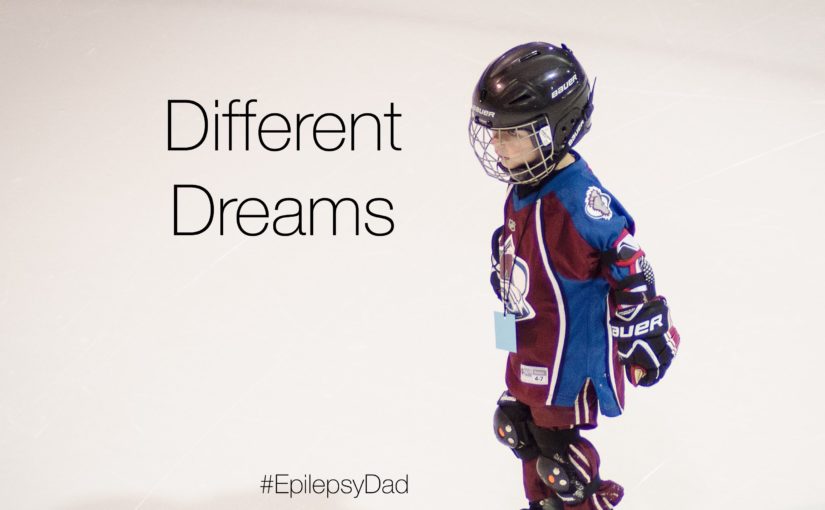
    My son, however, has known since he was born that he wanted to be a hockey player. He and I started playing hockey together before he could walk, and his love for the sport has only grown. Over the years, he’s added careers like a baseball player and professional video gamer. But they have been “in addition to” never “instead of.” Even now, at ten years old, he’s waiting for the call from the Colorado Avalanche or the Vegas Golden Knights to tell him they need him, and we’ll be on a plane.

    To help him pursue that dream, I took him to skating lessons starting when he was two. At four, we added the hockey classes. The look on his face when he got his first official jersey is etched in my mind.

    epilepsy dad different dreamsepilepsy dad different dreams


    But then, just before his fifth birthday, he had his first seizure.

    The first seizure didn’t adjust his course, but the second one did. And the third. And the three months in the hospital battling status. And the exhaustion and side effects of the medication. For more than two years, we struggled to get him back on the ice. We’d play hockey in the basement, but the level of exertion necessary to be on the ice and playing hockey was too much. We’d try a few classes, and his body would shut down for days. During one class, he had a seizure. The fighter that he is, he got right back up and tried to participate, but we needed to keep him off the ice for his safety until we could figure something out.

    We added tee-ball and baseball since those sports were easier to manage breaks and his level of effort. He is good at baseball, and he likes it, but he keeps asking about hockey. He has a friend who has been playing for a few years now, and I can hear it when he talks about his friend that he wishes it was him on the ice instead. But it isn’t. And the reality is that I don’t know if it ever will be.

    The reality is that my son’s seizures are still not under control. The reality is that the more he pushes himself, physically and mentally, the more exhausted he gets, and the more seizures he has, which perpetuates the cycle. No one can tell us if that will ever get any better, so we’ve tried to structure his life in a way where he gets the most out of it while minimizing the impact of his epilepsy. But the thing that he loves the most, the thing he’s dreamed about all his life, is the thing we haven’t figured out how to give back to him.

    I never had dreams when I was younger, so I don’t feel any remorse or regret for where I wound up. I think I am where I am supposed to be, with the family I love and a job in a field that I’m good at and find rewarding. Looking back, the choices that I made, even subconsciously, all aligned on a clear path to here.

    I believe the same will happen for my son. He will be where he is supposed to be. But I’ve always wanted to give him every opportunity to succeed, every opportunity to explore every possibility, and to feel supported every step of the way. Part of my purpose is giving that to him, and doing everything I can to help him achieve his dreams.

    It breaks my heart to think that I may need to tell him that he needs to have different dreams.

  • Let’s Go To The Tape

    Let’s Go To The Tape

    I remember watching sports on television as a kid. There would be a dramatic play or a questionable call, and the announcer would say “Let’s go to the tape”. Instantly, the previous play would be on the screen and analyzed by the commentators and the millions of people who were tuned in. They would collectively be looking for conclusive proof that the play went one way or the other, and the outcome of the review had the power to change the course of the game.

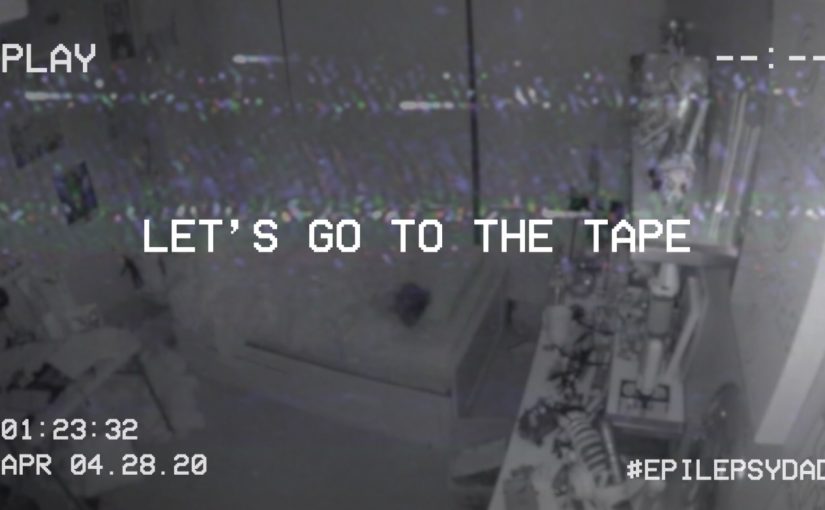
    Every morning, I go to the tape. But instead of reviewing the result of a questionable call, I’m scrubbing the recorded video from my son’s monitor to see if he had a seizure. I’m looking at clips from each time the camera detected motion to see if it was caused by normal turning over or if a seizure had taken control of his body.

    More often than not, there is something to see. Even though his seizures are short, most are easy to catch. There is an unnatural silence in his room as his breathing stops and his body stiffens. A few seconds later, the loan moan fills the room as his body jerks and his arms move.

    As I watch the video, I’ll see myself enter the frame. I’ll sit on the edge of my son’s bed, rub his back, and try to comfort him. Once the seizure ends, I’ll help him get back into the middle of his bed, cover him with a blanket, and walk out of the camera’s view, heading back to bed myself.

    I’ll also see more subtle seizures. Ones where there wasn’t a sound. Ones where I didn’t wake up. Ones where I didn’t come into the room to comfort him. These are the ones that remind me of reviewing a play from a game. I’ll watch the same clip multiple times. I’ll slow it down. I’ll turn up the sound. Did the player come down in bounds? Did my son’s body stiffen? Was the play offsides? Did I hear the faint sound of a seizure?

    The difference is that I’m not trying to make a decision on a play that will determine the winner or loser because there isn’t one. This is a match that may never end. Instead, it feels like I’m using these reviews to determine the score and, most nights, epilepsy gains a few points.

    But I’ve got a lot of other tapes to review, as well. Videos of my son playing baseball, and laughing, and doing a lot of things that he couldn’t do a few years ago when epilepsy was controlling the game. So if we get points every time my son does something he couldn’t do before, or just something amazing, then we’re racking up points every day.

    And we’re ahead.

    By a lot.


  • What Is Left To Say?

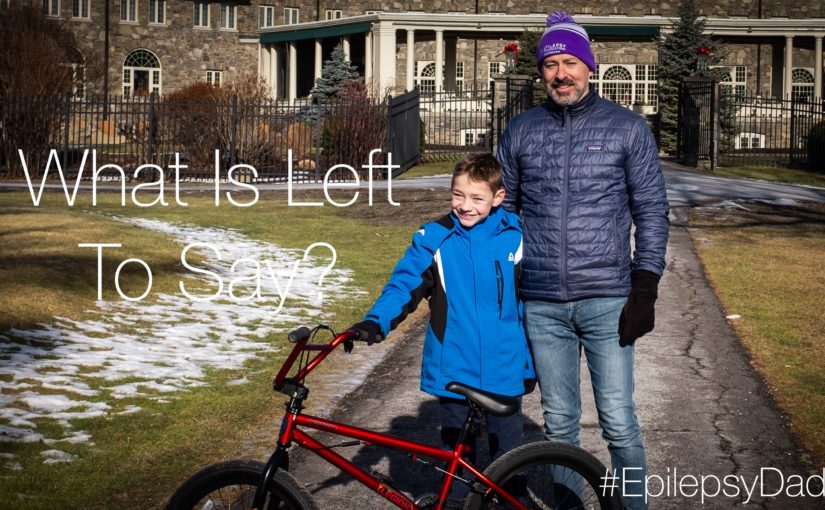
    What Is Left To Say?

    When I started this blog almost 5 years ago, we were only just beginning our epilepsy journey.

    The first few posts were written from his room on the neurology floor of the children’s hospital as I watched the doctors tried to stop his seizures. I wrote as a way to process my thoughts and feelings as I worried about losing my son and learned about words like status epilepticus and refractory.

    After we left the hospital, I wrote about how our life changed. I shared stories of how we tried to rebuild my son after those initial waves of seizures took so much from him. I wrote about his therapies and how the exploration and experimentation with different medication led to the same frustrating results or unbearable side effects. I wrote about my fears about VNS surgery and my frustration with the hardship of the ketogenic diet.

    For the past year, very little has changed. In spite of having a VNS implanted, adjusting his medication, and continuing the ketogenic diet, my son is still seizing almost every day. I still worry about the risk of SUDEP. I still worry about the long term effects of these seizures as I watch him slowly fall behind his peers at school.

    When I would sit down to write, it started to feel like I was always wanting to write the same things and that I had already put my thoughts and feelings down. I wasn’t sure what was left to say, so I didn’t write anything.

    Not writing had the additional benefit of not having to look beyond the surface of our lives. I could stop probing how I felt about the challenges my son faced and what it meant for his future. I could just live in the present and deal only with what was in front of me. But that began to feel like I was shirking my responsibility as a father and doing a disservice to myself and to my son.

    During the time I stopped writing, I also received a number of messages from the epilepsy community. They reminded me that that others were going through the same challenges. I started this blog for myself but it brought me into a community of people who had already been where I was as well as people who were just starting on this path. The unexpected benefit of putting ourselves out there was that is reminded us that we weren’t alone. When things were dark and scary and uncertain, that gift provided immeasurable comfort.

    I was worried that because nothing has changed that I wouldn’t have anything to write about, but that is part of this journey. The ups, downs, and the long stretches in between filled with uncertainty, frustration, accomplishments, and joy are all part of life. They are the things that remind us why we are here and bring us closer together. They are our outstretched hands reaching in to the darkness that are met by the hands of others grasping for connection.

    As the new year began, I have started waking up early again. I make my coffee and sit on the couch in a quiet house staring at a blank page. I think about our life, past, present, and future. I think about the people we’ve met along the way, and I start filling the page with words.

    It turns out, I might have more to say after all.

  • On The Surface

    On The Surface

    Recently, on the way to school, my son told my wife that he wasn’t feeling good. She turned around and took him home where he slept for three hours.

    Usually, he will try to push through. I don’t know if he doesn’t recognize what is happening in his body or if he is too stubborn or eager to please, but he goes dangerously beyond his limits until he crashes. We have spent so much time picking up the pieces and putting him back together after he does.

    My son started having seizures before he developed a reference or the vocabulary to describe what he was feeling. He only knows seizures, and medications, and side effects, and fatigue. There was never an absence of these things that he can recall and contrast when it happens to him today. For him, that is normal.

    We have spent years watching him closely and trying to be the external monitor of his condition. We ask probing questions when we suspect that he is off, but he often answers “yes” as if he assumes we know what he is feeling or can describe what he can’t. But we only see the external signs. We can only see what is on the surface. And our vocabulary and ability to describe what is happening to him is as limited as his.

    Me: “Do you have a headache?”
    My son: Yes.”
    Me: “Do you know what a headache is or feels like?”
    My son: “No.”

    I write every day. At work, I use words to describe complex systems. But the words that I know seem inadequate to describe what I can only imagine he is feeling. It’s words and concepts in another language that I am just beginning to understand after five years. We’re trying to use that language to communicate but too often things are lost in translation.

    It’s another one of the many frustrating things about being the parent of a young child with epilepsy. I want to make the seizures go away, but I can’t. I want to eliminate the side effects of his medication, but I can’t. At a minimum, I want to understand what he is going through so that I can help him but there is so much about his condition that is invisible to us. It’s a terrible feeling of helplessness.

    I’m hopeful that, as he did on the way to school, he’s starting to build awareness of what is happening inside his body and vocalizing it. Becoming an advocate for himself and expressing his needs will be critical for him to be able to navigate a world that is not always kind or forgiving or tolerant of people who are different.

    For the past five years, we have been the monitors of his condition and the ones expressing his voice. As much as I felt ill-equipped for the role, it was necessary because my son was not able to do it himself. It made me feel needed and useful instead of focusing on my inability to find a way to make the seizures stop. I am comfortable filling that role but I can only account for what is on the surface. There is so much more to him and his condition than what I can see.

    The reality is that the more I take on that responsibility, the longer it will take my son to learn to do it himself. It will take longer for those symptoms and feelings that exist below the surface to reveal themselves. And it will take longer for him to get what he needs because he won’t learn to put his needs out there. At some point, the help I am trying to give him becomes the thing holding him back.

    Reality and I don’t always agree, but it is usually right.

  • The Sleepover

    The Sleepover

    A few weeks ago, my wife and I spent our first night away together since my son was born. Individually, we’ve been away. I’ve gone on work trips, and my wife has gone to visit family. But we’ve never both been gone for the night and let someone else watch our son.

    In some ways, it wasn’t practical. We don’t have family that lives near us, so leaving him at grandma’s house wasn’t an option. But there is also the reality that our son has seizures almost every night. Spending the night isn’t just about giving him a place to sleep. It’s an active task that involves monitoring him and responding to seizures.

    Our son is never alone. Even sleeping in his bed, we have a camera pointing at him that I watch all night long. When he is in his room playing, we keep a cautious ear listening to what is going on. He receives individual attention at school, and his nanny is substituting for us when we aren’t there.

    That level of involvement is not something that transfers well to someone unaccustomed to that level of care. It’s not something that lends itself to people lining up to take on the responsibility. It’s our every day, but it’s not theirs. I can imagine the conversation with the parents would go something like this:

    As you know, our son has epilepsy. And it’s very likely that he’s going to have a seizure really early in the morning. Probably more than one. The seizures are likely going to wake and frighten your child. And you’ll need to help my son reorient to the world as he comes out of it and make sure he doesn’t fall out of the bed or try to walk around and fall down your stairs.

    [silence]

    If the seizure lasts too long, his rescue medicine is in his overnight bag. The good news is that we haven’t had to use it in a while. The bad news is the delivery mechanism.

    [silence]

    Also, you’ll need to make sure he doesn’t eat or drink anything we don’t send with him. He’s on a medical diet and if he eats anything else he could start having seizures.

    [silence]

    Oh, and don’t let him stay up too late. The more tired he is, the more likely his is to have seizures.

    [silence]

    His medicine is also in his bag. Make sure he takes all of his pills because if he misses any…you guessed it, more seizures.

    [silence]

    Other than that and, I guess, his depression and behavioral side effects of his medicine, I think you’re all set. Ok, goodnight!

    [overwhelming silence]

    I couldn’t burden someone with that responsibility because nothing could prepare them in one night for what has taken us years to adapt to. But I would also spend the night worrying and wondering. It wouldn’t have been a good night for anyone involved.

    I really struggle with the idea that no one else can or will want to take care of our son. But at the same time, I find reasons why no one else should. They don’t know my son. We can’t prepare them for what it is like. What if something happened?

    In the end, our nanny provided the perfect opportunity. She has been working with our son for over a year. She’s seen his seizures during his nap, and she’s helped him manage his behavior and emotions. We trust her to keep him safe. When she agreed to an overnight stay, it felt right.

    Even though it was only one night, it opened my eyes to a new possibility. I’m not going to say that I still didn’t worry or wonder. But coming from a place where I didn’t think it would be possible at all, that first night was huge. It may not have addressed all my fears about the future, but it was a good first step.