Tag: seizures

  • Endurance

    Endurance

    My son just turned 8 years old. It’s been amazing to watch the changes in him over the last few years. He’s reading more on his own. He put together a 500-piece Lego set by himself. He’s doing more things by himself that he used to need our help with. This stage of life and of development has continued to surprise me.

    Many things have not changed, though, too. He’s still having seizures in the morning. He’s still juggling medications and side effects. He’s still on the strict ketogenic diet, which means he still can’t eat what he wants. He still gets constipated. He still feels different. He is still having a hard time making it through the week and sometimes through a school day.

    We’ve been on this part of our journey for more than three years. More than two years on the diet. More than ten medications. Hundreds of doctors appointments, tests, and therapy sessions. We’ve seen countless seizures, and they keep coming with no end in sight.

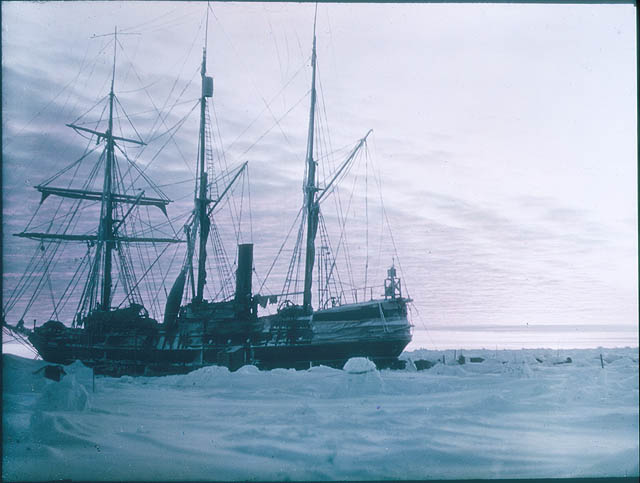
    Earlier this year, I read [easyazon_link identifier=”0465062881″ locale=”US” tag=”epilepsydad-20″]Endurance[/easyazon_link] about Ernest Shackleton’s journey to Antartica. It’s an incredible tale of a failed overland expedition to the content. The title of the book was taken as much from what the explorers went through as it was from the name of their ship. They survived the loss of the Endurance, treacherous conditions, and a lack of food in an unforgiving part of the world. Along the way, groups were left behind to establish camps while others continued the search for help. Imagine the feeling of watching your best chance of survival disappearing in the distance, hoping they will return.

    I called to the other men that the sky was clearing, and then a moment later I realized that what I had seen was not a rift in the clouds but the white crest of an enormous wave. ~Ernest Shackleton

    Some days I feel like Shackleton, pushing through, fighting for my son, stopping at nothing until I can save him. We’re trying to function, to get up every day, to go to work, to try to live a normal existence. Because we have to. Because there is no alternative, even under the siege of enormous waves. Because, like Shackleton believed, there is too much at stake.

    Other days, I feel like the men he left behind. Stranded on an island, waiting, and hoping that someday we will be rescued. Every day, they woke up, walked down to the shoreline, looking for a ship. For months, that ship never came. Like them, we’re afraid. Every day, we wake up and look to see if we will be rescued. Instead, we watch our son lose control of his body. Every day, we see how hard he fights. Every day, for three years, with no end in sight.

    Most days, I fluctuate, rising and falling like the cold waves crashing on to the frozen shore. I am not brave enough or strong enough to face every day like Shackleton. It tears me up to see what is happening to my son. To see him struggle every day in so many ways. It strips away my courage and leaves me wanting to be rescued. But the unbounded love I have for my son and my family forces me to soldier on, to fight for everything we get, and to not let epilepsy take more than it has.

    Eventually, Shackleton’s journey came to an end. After more than a year of impossible challenges, Shackleton and his team found help. They went back and rescued the rest of their men. One day, those men that were left stranded make their way to the shore and looked out on to the horizon to see their captain returning for them. To see their lives returning to them.

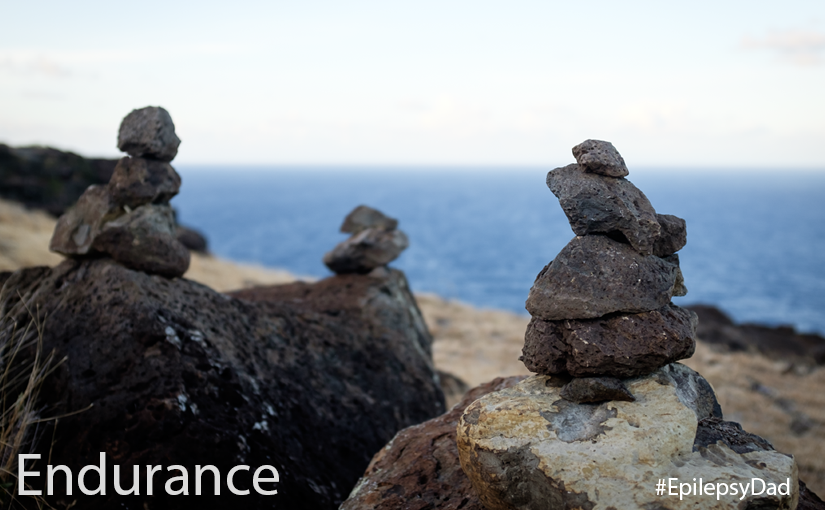
    I can only imagine the glory of that feeling. We are standing rocks, piled together on the shore looking in the expanse before us. I long for the day when I will look out on to the horizon and see a different life than the one we have been leading. A life where my son doesn’t have seizures. A life where he doesn’t struggle to do what so many others take for granted. A life where he can be free.

  • Early Morning

    Early Morning

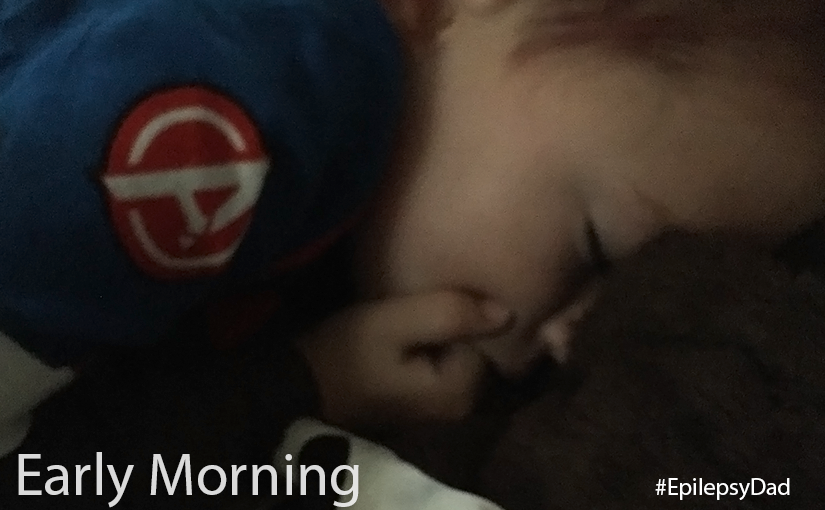
    Lying in bed, I opened my eyes in the early morning and stared at the ceiling. My son’s arm was draped across my chest and his head rested on my shoulder. Ahead of our move, he’s been sleeping with us. The chaos of our lives and the distance to his room has become increasingly problematic. Until we move into our new place, it’s a concession we made so that we can all be together and so we can monitor his seizures.

    I brought my free hand up and rubbed his head. Usually, my wife is the recipient of his slumbery affections. I get the other end with a face-full of feet as he turns horizontally on the bed. But not that morning. That morning, I looked down to see my the beautiful face of my boy sleeping peacefully. I remember smiling as I made minor adjustments to my position and was once again comfortable. I closed my eyes, my hand still rubbing his head, and enjoyed the moment.

    It’s in these early morning hours that I’ll catch my son talking in his sleep. Sometimes the words are decipherable. He has had unconscious conversations about baseball and hockey. Once he talked about his iPad, which I’m pretty sure is a sign that we let him use it too much. Other times, his voice is too low or the words are too jumbled but it’s still clear that he’s having a conversation.

    Sometimes, his hands or legs will twitch. It’s like watching a dog dream of running and watching its limbs move in response. We had a cat once that would dream of drinking and we would watch him lap at the air as we laughed quietly so as not to wake him. It’s impossible to tell what activity my son was trying to do in his sleep, but it still made me smile. Dreaming at seven looks very different from dreaming at forty.

    That morning, though, a different and unfortunately familiar sequence began. It started with a tensing of his muscles. As he laid at my side, I could feel his body start to stiffen and elongate. I adjusted my position to give his body room the room it needed. The room went quiet. The only sound was me telling him that everything was going to be okay as I kept my hand on his head.

    At its apex, his body is rigid and long like a piece of wood. His body continued to squeeze, forcing the air from his lungs. The audible moan also started as his body expelled air past his vocal chords and out his mouth. His body relaxed before tensing up again, the rhythmic jerking of a myoclonic seizure. Every pulse of his body made me feel more and more helpless, but there was nothing to do but wait it out. So in the early morning darkness, that’s what I did.

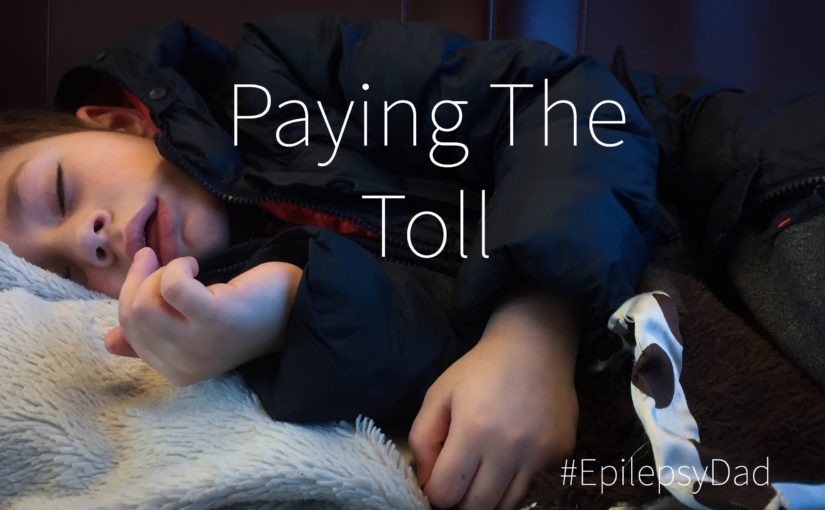
    A few seconds more and the seizure was over, but the postictal state began. Like he usually does, my son sat up, smacking his lips and looking at the world through squinted eyes. I continued to console him and let him know what he was safe until he gathered enough of his faculty to know where he was. Then I helped him lay back down and get comfortable. I draped his warm, green blanket over his shoulders and pulled it down to cover his feet. He put his two fingers that he likes to suck on in his mouth, closed his eyes and drifted back to sleep.

    I could not go back to sleep. I struggled to not have my thoughts drift to all the negative possibilities. I should have gotten up to distract myself but I wanted to be near him in case he had another seizure. So, instead, I listened to his breathing and returned my gaze to the ceiling.

  • The Long Run

    The Long Run

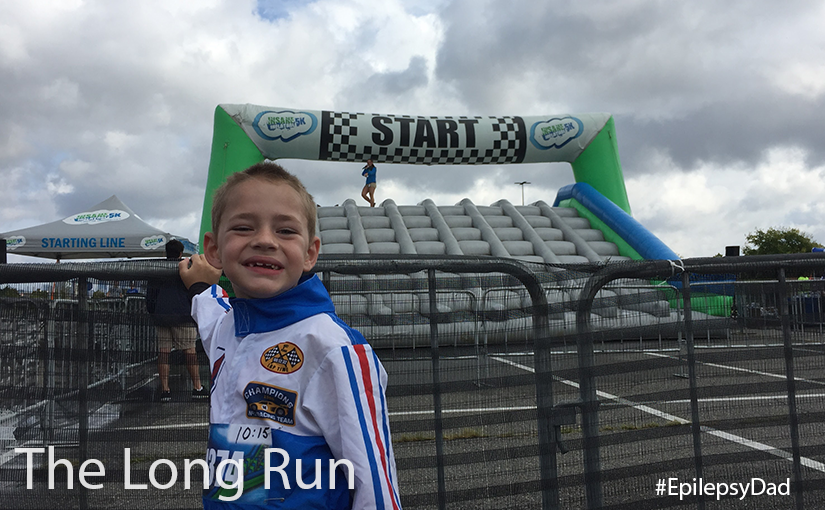
    My son stood on top of the first obstacle at the start of the race. He had just given an interview and talked about having seizures that had the crowd let out a collective “aww”. In his hand, he held the blowhorn that would signal the start of our wave. The emcee counted down then helped him push the button on the horn. It called out with its loud sound and the crowd cheered in response. The race had begun.

    By the time I had climbed the first obstacle to reach my son, he was already on to the next one. He thought he needed to lead our wave for the entire race, so I sprinted to reach him and told him to slow down. “It’s a long race, buddy,” I said. “This is only the beginning.”

    That is how my son approaches most things…head on and at full speed. It’s inspiring to see but also nerve-wracking. He’ll push himself beyond his limits without considering the consequences. For him, the consequence of physical exhaustion is seizures. My wife and I take on the role of the governor to regulate his unstoppable, unrelenting engine. That puts us in the middle of his desire to conquer the world and our desire to keep him safe. It’s an impossible balance and one that I rarely feel successful at. But I tried my best to pace him but also let him open up a little and have fun.

    He tackled each obstacle with a determined attitude and a beaming smile. There were people who saw his interview that ran by to cheer him on. He would wave in response as he eyed the next challenge. Another person came up and told him that she had epilepsy, too and that it wouldn’t stop either of them. I was proud of him, for how he was tackling the race, for talking about his epilepsy, and for that smile.

    If there were ever a metaphor for our life, it was that race. There will be obstacles that we need to face. There will be times that we need to be brave. There will be times we need to lean on and be grateful for the support around us. But there will also be fun and the sense of accomplishment that comes from doing things that are hard.

    As he came down the slide on the last obstacle, I could see a huge smile on his face. He put his completion medal around his neck and told everyone how he made it through each obstacle. Then, on the way home, he said he wasn’t feeling good. He went straight in for a nap and I could tell his body was shutting down. During his nap, he had a cluster of seizures, more than he has had in a while. That was the gut-wrenching part where I questioned whether I let him push himself too hard. I know that uncertain feeling too well, and it’s heartbreaking.

    As his body contorted against his will, I wondered whether it was worth it. The sense of accomplishment, the fun, and the experience. Was it worth what was happening to him? The lives of the people he touched when bravely stood on top of the first obstacle and told his story. The awareness he brought to epilepsy. The support he received from the people around him. Was that worth it?

    I used to think that was an impossible question, but maybe the answer is simple. What makes it worth or not it isn’t measured by finishes or medals or seizures. What makes it worth it is that feeling that, in spite of his epilepsy, he can do amazing things. What makes it worth it is knowing that we are in this together, for the good and the bad. What makes it all worth it, in the long run, is filling his life with moments that make him smile.

  • Wherever We Go, There They Are

    Wherever We Go, There They Are

    Whenever we go to a new place, in the back of my mind I want that place to change my life. It seems like a tall order, which may be why it hasn’t happened yet. I want to go to a place and be so inspired that I start writing that book that I’ve been thinking about. I want to leave a place a better person, having a better relationship with the people in my life. But mostly, I want to go to a place where my son doesn’t have any seizures.

    My son didn’t show any signs of having epilepsy until we moved to Philadelphia. I was only partially joking with the doctors when I asked them if it could be Philly causing his seizures. The first time we went back to Colorado, I was ready to move back if he was seizure-free during the trip. But he wasn’t. I had the same thought when we visited Florida. Maybe Colorado was at too high of an elevation and he needed an ocean breeze. But he had seizures in Florida, too. And in New York. And in California. Wherever we went, there they were.

    Even so, when I stepped off the plane in Hawaii, I had that same thought. That maybe this was going to be the place where my son would be seizure-free. If it was going to be any place, Hawaii wouldn’t be terrible. Before we even picked up our bags, I convinced myself we could make it work. I could find a job, even if it meant working remotely. I was sure the children’s hospitals would be fine, and we could make regular trips back to the mainland for care. But we wouldn’t need to, because he wouldn’t be having seizures. It was the perfect plan. Until it wasn’t.

    In our first early morning in paradise, the sound worse than every other sound filled the hotel room. His seizures had found us. Across the continent, across the ocean, to an island in the middle of the Pacific. In a place we’ve never been before, hidden from the world. Wherever we go, there they are.

    In a way, I was grateful that the seizure came quickly because it lifted the pressure that I had put on our vacation. The longer I carry that pressure, the less present I am and the more I miss of our life. But instead of worrying about that seizure around the corner, it had already come.

    It was freeing.

    It allowed me to focus on having an amazing vacation with my family in spite of our stowaway. It allowed me to be present and to be grateful for the moments that we have. I saw the beauty of the island. I saw the smile on my son’s face. It reminded me that it’s not a destination that is going to change my life. It’s that feeling that I get when I see his smile that makes my life better every day.

    epilepsy dad wherever we go

  • It Looks Like Rain

    It Looks Like Rain

    When my son was at his worst, with relentless seizures and medicine flooding his body, he wasn’t our boy. He was uncontrollable and so, so angry. He would have fits for hours where he would try to hurt us and say terrible things. We’d spend those hours holding him, telling him that we love him, and waiting for the storm to pass.

    There were long stretches of weeks where we would only see glimmers of the boy that he was, like a break in the clouds. But, inevitably, the clouds would expand, find each other, and hide the light behind them.

    After too many months, the enormous storm that ravaged our lives started to break up. The seizures were more under control and we were able to reduce his medications to only a handful. We sought counseling for dealing with his condition and with each other. With a lot of hard work, we had more breaks in the clouds, more times where we saw the light from our boy shining on our lives.

    We spent a lot of time basking in that light. We were starved for it after so much time without it. There were still rumbles in the distance, a seizure or an outburst, that made the hair on our necks stand up. Occasionally, a storm would pop up, but it was usually brief and not as violent. Still, we remained on guard.

    Lately, the sound of thunder is getting louder.The hairs on my neck are standing up again. We’re seeing the tell-tale signs of a storm. There are times when he can’t control his body or regulate his emotions. There are days when he’s not there and when he’s not processing and not aware. There are more times when he gets angry and pushes everyone away. We’re adjusting his medicine again and these signs act as our barometer that tells us when the dose is too high.

    I know we have to adjust his medicine to keep the seizures in check, but I also know what that brings with it. I can see the clouds forming. It looks like rain.