Tag: seizures

  • Modified Atkins Diet for Epilepsy

    Modified Atkins Diet for Epilepsy

    Last summer, I wrote about how my son was switching to the Modified Atkins diet after nearly seven years on the Ketogenic Diet. Since it has been a year on the new diet, I wanted to share an update on how it is going, as well as a few tips and foods we’ve depended on with the new diet.

    The Ketogenic Diet is a special high-fat, low-carb diet that can help control seizures for some people with epilepsy. We started on the diet soon after my son began having seizures, and after it became clear that we would need more than medications to prevent his seizures.

    Keto was initially a struggle, both in terms of finding foods and ways to introduce fat into my son’s diet and the effort and logistics involved with measuring every ingredient and preparing meals separately from the meals my wife and I ate. We would bring his food with us to restaurants and, when we traveled, extended trips required a place to stay that had a kitchen. But we made it work because the diet, along with medication and a VNS, helped manage my son’s seizures. We have never been seizure-free, but we found the right balance between medication and quality of life, even if my son mostly ate the same handful of meals.

    The Atkins diet is a low-carb diet from the 1970s. Similar to the idea behind keto, the idea is to limit the number of carbs. The Modified Atkins diet blends the low-carb approach with adding more fat. For my son, it opened up a new world of food, especially since the popularity of Atkins and other low-carb diets have introduced a number of products on the market that are easily available on the shelves of most grocery stores.

    My son now gets a set number of net carbs a day and a minimum amount of fat that he should have, although we’re always trying to add more fat into each meal. He can have as much protein as he wants, which he demonstrates by piling up the hamburgers and hot dogs onto his plate (he’s less excited when chicken and fish are on the menu). Net carbs are calculated as total carbs minus fiber, so fiberous vegetables in a salad are a mainstay, as well, and my son hasn’t seen this amount or variety of vegetables since before keto.

    When we transitioned from keto to Modified Atkins, we monitored my son closely to see if there were any changes to his seizures as well as any changes to his cognition…there are some reports of keto helping improve cognition. In both cases, we haven’t seen any meaningful changes so far. His seizure frequency and duration are the same, and we haven’t noticed any worsening in his cognition.

    The most significant change that we’ve seen is his quality of life. My son was so excited to have a sandwich for lunch, just like the other kids in school, rather than the fat-heavy ice cream we usually sent him with. He can also have a small bowl of low-carb cereal for breakfast, just like his friends. And now we eat the same meals at dinner, just in different proportions.

    I was wrestling over the past few years with the Ketogenic Diet as I saw my son notice how his food differed from his friends. I started questioning the value of the diet and pushing to get him off it while the doctors were convinced that it was helping him. The Modified Atkins diet feels like a step in the right direction. Even though it is still a medical diet, there are enough options that it doesn’t feel as much like a restrictive diet as keto did.

    Overall, the change has been a positive experience for my son and our family. While it may not be an option for everyone, it is worth having a conversation with your doctor if you’re looking for alternatives to the ketogenic diet to help manage seizures.

    If you’re on or thinking about the Modified Atkins diet, first check with your doctor. But I wanted to pass along a few items that are staples for us that have made the diet more manageable and delicious.

    Catalina Crunch Cereal – There are a few low-car cereals (5g net carbs per 1/2 cup) on the market, but we’ve found Catalina Crunch to be easily available and tasty. You can find them in the cereal aisle at Whole Foods, or try a sample pack of flavors through Amazon or direct from the manufacturer.

    Schmidt Oldtype 6/47 Bread – At 6g net carbs per slice, this is the bread that allows my son to have a sandwich at lunch. The taste and structure are close to that of other breads and it holds up well. The bread comes in a few varieties, as well. There are other 6/47 options like buns and bagels, but those have more net carbs. The bread is available at our local Acme grocery store.

    Outer Aisle Sandwich Thins – Found in the frozen section of Whole Foods, we toast these in the oven and use these as hamburger buns. Two slices is only 2g of net carbs.

    Outer Aisle Pizza Crust – Also from Outer Aisle and available in the frozen section at Whole foods is their pizza crust. When we were on keto, we made crust out of soy flour, mayonaise and egg. These are bigger (and already made) and only have 3g net carbs per crust.

    Mission Carb Balance Tortilla – These are available in most grocery stores and offer a low-carb option for burritos, quesadillas, and wraps. At only 4g net carbs per tortilla, my son can have two good-sized quesadillas for dinner with cheese and meat or beans snuck inside. Pro-tip: If you slather on some mayo and then add the cheese, it’s a good way to add more fat to the meal, too.

    Atkins Bars – Atkins bars are great to have for a snack. There a meal replacements, snacks, and treats, each with differing amounts of net carbs. But we usually add one of these to my son’s lunch box for school (Snickerdoodle is his favorite). In most stores, Atkins products are near the pharmacy and health section, not in the granola or Kind bar aisle.

    Impastable Noodles – These are the best low carb pasta we’ve found so far. They come in different types, allowing us to mix up different recipes including traditional spaghetti or mac and cheese. I usually cook it a little longer than recommended to get a better texture, but we all eat these now on Spaghetti Sunday.

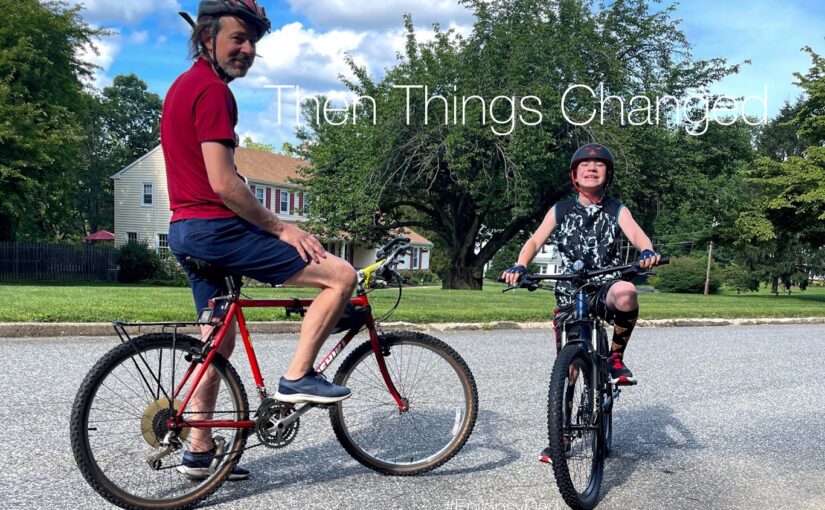
  • Then Things Changed

    Then Things Changed

    This is the first time in months where I have sat down to write.

    Before I did, I skimmed my posts from earlier this year. I wanted to be reminded of where we were. Our family felt isolated and trapped in the city, and there was no hope of moving. My son was struggling with his virtual school, and there was no hope of finding a way of learning that would work for him.

    I wrote those posts as a way to process my thoughts. I wrote those posts as a way to ask the universe for help. I wrote those posts because I had to get those feelings out. They were real. They are real. Putting them down in writing felt like the last act of acceptance that nothing was going to change.

    But then things did change.

    I’m writing this post in our new house. I’m writing this post early in the morning before my son wakes up and gets ready to go to his new school that is only a few miles away with kids that have challenges just like him. I’m writing this post the day after my son spent hours in the yard playing with other kids from the neighborhood who didn’t treat him like he was different at all.

    The contrast between where we were and where we are is surreal, but I know things won’t always feel this way. My son is still seizing every day. The cognitive, social, and emotional gap between him and his peers is obvious, and it is growing. And the one constant thing in our epilepsy journey, for better and for worse, has been change.

    At this moment, though, I am immeasurably grateful to have landed where we did, when we did. Because we needed it. Because we are together. Because we can breathe. And because for the first time in a long time and despite the struggles he faces every day, my son is happy.

  • Breaking The Mold

    Breaking The Mold

    Regardless of who actually said it (it probably wasn’t Einstein), at times I feel like I’m living the definition of insanity by doing the same thing over and over again and expecting different results.

    At the center of this insanity is a compulsion to fit my son into the world’s definition of “normal”. There is a mold made up of societal norms and expectations that I try to force him into, even though it is clear that the mold is the wrong shape.

    Still, I try to make it work because I’m scared that, if I don’t, the world won’t accept him and it will cast him out. Or label him. Or make him feel “less than.” As a result, I correct him when he does something that makes him look different from everyone else rather than celebrating his uniqueness. I spend more time trying to make him work inside what the world expects of him rather than finding ways to make the world work for him. And I keep repeating that pattern, in spite of all the signs that it isn’t working and that it isn’t the right thing to do for my son.

    I think that is partly because I don’t know what does work for him. The things I try are the things that are familiar to me. They are the things that I know exist. They are the things that I grew up with because somehow, in spite of feeling very different, I managed to get a traditional education, and go to college, and get a job. I was able to existing inside of the “normal” that most other people seem to also make work for them.

    My wife is much better than I am at flipping the narrative and seeing that it is the world needs to change to include our son. She looks for places where our son can feel like he belongs rather than making him fit into any molds. But given the state of the world and its indifference or intolerance to anyone who is different, I can see her frustration and anguish every time the world doesn’t understand him, or us, or our situation.

    She’s the reason that we are looking at alternative schools for our son. She’s knew it years ago but no one would listen. I might have thought I was listening, but I was too afraid to act on it because I thought things would get better. I thought I could make my son fit into that mold if we just kept trying. Worse, even when I knew it wasn’t working, my fear led me to just keep trying the same things because it was less scary than going into uncharted territory and discovering that he doesn’t fit in anywhere. I was as accomplice in the notion that we could simply remove a few expectations from him to make him fit the mold better. But all that did was make him disappear.

    I am trying to stop the insanity. I am trying to redefine my view of the world and what I expect my son’s path to be because I am seeing that his path does not need to look like my path. His path will be made up of his experiences, tailored to who he is. It’s big and it’s scary and I don’t know what it will look like, and it may take endlessly battling the world to make room for him. But that is something worth doing over and over again.

    The world seems intent to prove that it is my son who is the wrong shape, but the world is wrong. My son broke that mold the first time he had a seizure. Actually, he broke that mold the day he was born.

  • Tapped

    Tapped

    My son does this thing where the muscles in his face loosen. His cheeks look chubbier as they drape softly down to his jaw. His mouth separates a little, and I can see the tip of his tongue pushing through. Sometimes he’ll swallow slowly, which at the same time seems automatic but also like it takes all of his concentration and energy.

    That is one of the signs we see that lets us know when he is tapped.

    There are other signs, too. He has an even harder time with his executive functioning and memory than he normally does. It’s more difficult for him to regulate his emotions. He gets angry and frustrated. But that look on his face is the look of someone who has given everything they can for the day. It’s how we know he’s done.

    This isn’t something that only happens occasionally.

    It happens every day.

    There are days when it happens sooner, usually around this point of the school year or when we did such things after a baseball game. There are days when it happens later, like on a lazy weekend. And there are days when it happens more than once, usually once before and then later on after a nap. But it always happens. Every day. Every day, my son gives everything to get through the day.

    Every day, my son gets tapped.

    The other day, I sat on the edge of the bed with my son and studied his face as he leaned against his pillow, watching his iPad. I tried to be present with him. I asked him what it felt like and if there was anything I could do for him, but even asking a question forces him to try to muster enough energy to think and respond. He’s such a good kid that, even tapped, he tried to find enough energy to process my question and think of an answer. It felt cruel. I felt terrible. And so I didn’t ask any more questions, and I sat with him and rubbed his head and let him tune out.

    Unless you knew him, you wouldn’t know that anything was going on. He might just look like a tired kid. Its invisible nature is one of the many curses of epilepsy. His doctors, who have seen the same in other patients as they see in my son, understand it. But it’s harder to convey to others because they don’t know him and because they don’t have a reference for that level of exhaustion.

    “Imagine climbing a mountain. Now, imagine if everything you did felt like climbing a mountain. Now, imagine if that is what you felt like every day. “

    Every day, my son climbs that mountain. Every night, he falls asleep only to find himself back at the base of the mountain when he wakes up. Then he starts to climb again. He pushes, he grinds, he stumbles, he gives everything he can until his body, and his brain can’t do anymore.

    Every. Day.

    He’s eleven years old.

  • The Long Plateau

    The Long Plateau

    We are standing on a plateau.

    For the past few years, my son’s condition has remained the same. He still seizes almost every day. He’s still on a handful of medication multiple times a day and the ketogenic diet. He still struggles in school and navigating relationships with his peers.

    I should be grateful that he hasn’t gotten worse.

    The beginning of our journey with epilepsy was the equivalent to falling off a cliff. We went from a normal childhood to fighting for his life in the matter of months. We went from school and friends to hospitals and doctors and nurses and therapists. We went from playing hockey to being toxic on medication and needing to be carried to the bathroom. Back then, I would have longed for things to stay the same.

    Once he was stabilized, we spent the next few years trying to rebuild what he’d lost. Progress was agonizingly slow, especially as we discovered more pieces of him that could not be rebuilt. We stumbled every time we pretended that things were ever going to be like they were before. While we were no longer falling, the slope of ascent was so gradual that it was hard to tell if anything was getting better.

    Eventually, some things did get better. There were fewer seizures, confined mostly to the early morning. He graduated from a handful of therapies. He stepped foot in school again. Some things did get better, but not back to where he was before that first seizure. And not any further.

    Are we really plateauing or does it just feel that way? Are we doing everything we can to keep making progress or, like a person trying to lose weight, are we giving the appearance of doing everything but secretly skipping workouts or sneaking in extra calories? Or have we truly reached our limit of progress?

    Years ago, when the direction of my son’s condition turned around, every day probably felt this way. I wondered whether things were as good as they would get, much like I’m doing now. I wondered if we were doing everything we could and whether we we doing everything right. I looked for someone to blame rather than accepting the reality of the situation. Because it’s impossible to believe that, no matter what you do, things will never be what you though they were going to be.

    The longer things stay the same, the more I forget how far we’ve come. The more that “this is it” feeling takes over. The longer I sit in that feeling, the harder it is to hold on to hope for better.

    And this plateau feels so long.