Tag: parenting

  • That Parent

    That Parent

    The stories about the overly competitive sports parents are true. I’ve seen them in the stands yelling at their kids, yelling at the coaches, and yelling at the umpires. They’re the parents trying to make their kid the next Micky Mantel, or Jackie Robinson, or Randy Johnson. Or they’re the parents that felt robbed of a chance to be the star and are reliving their glory days through their children.

    I never wanted to be that parent. When my son started playing hockey, it was because he wanted to. When he moved on to baseball, it was because he wanted. He loved it. I thought my great advantage was that I never played organized sports as a child so I had no delusions of fame and fortune for myself or him. He could play a sport because he wanted to without fear of it being a proxy for my unfulfilled dreams or the pressure of making it his career.

    But at a recent game, I caught myself yelling at my son about his mechanics. Get your elbow up! Keep your eye on the ball! I yelled to get his attention when he wasn’t in the right position or was playing with his hat. What are you doing? Pay attention!

    During one of his at-bats, I was louder than his coaches. I could see that he was anxious and overwhelmed by all the other voices coming in at him. I knew he was also nervous because he was in a hitting slump. I wanted to be louder so that he would focus on my voice because I thought that would settle him down. When he struck out, I got mad at everyone else for yelling at him and distracting him. When my wife tried to talk to me, I snapped at her. Then, it hit me.

    I had become “that parent”.

    I tried to convince myself that it was different. I wasn’t trying to live through him on the field or get him a contract. I thought he would be happier playing baseball if he did better and I knew he could do better. I was trying to help him stay on task and remember his steps so that he would be able to draw some enjoyment from something in his life. It was for him, not for me.

    But from his perspective, his dad is yelling at him because he is doing something wrong. My son walks around apologizing for everything, anyway. I can’t help but think those things are related. Am I snapping at every little thing and making him feel in a constant state of disappointment where he feels the need to apologize all the time?

    I know that that’s like. I grew up with an unhealthy expectation of perfection. I’m still struggling with it today, and I see how it limits me. I wasn’t placing expectations on my son to become a professional baseball player. I wasn’t trying to relive my youth. But I still risked ruining the game that he loves by transferring my baggage to him and, worse, watching it seep into the rest of his life, too. I desperately want to learn those lessons before it’s too late because I don’t want him to turn away from something he loves because of me. I don’t want to be “that parent” who takes the joy out of the game. Because I can’t get out of the way.

    Baseball has been very good for my son. It continues to teach him how to be a part of a team. It gives him opportunities to believe in himself and work through difficult situations. It teaches him how to be a gracious winner and loser. And it shows him that he can get better at something through practice because he can see how he is better at the end of the season than he was at the beginning.

    Baseball has been good for me, too. It gives me opportunities to see my son in different situations where he can fail and succeed. It shows me that he can do so much more than I think he can, and it shows me when he can’t. And it’s causing me to look inward at my issues with perfection so that I don’t make them his.

    I want to do better. I think I am doing better. I hope I am doing better. Because at the end of the season, I want to see how much better I am than I was at the beginning.

  • Looking Back

    Looking Back

    We had a friend over recently and showed her a video from one of my son’s baseball games. We streamed the movie from my Google Photos account through my phone on to our television. Once the video was done, I pulled up another video from the library because most of the pictures and videos from my son’s entire life are stored there. We watched a silly hockey battle video we made when my son was two. A video of our family sledding in the Rocky Mountain National Park when from when we lived in Colorado.

    Using these devices and technology, we don’t have to remember anything because they remember everything for us. We can type a word in to a search bar and pull up a list of memories. We can replay our lives in sequential order in a level of detail that was unimaginable even a few decades ago. Now, our lives can flash before our eyes a`t the push of a button.

    Sometimes when we look at these memories, it’s like my son is seeing them for the first time. Years of his life are covered by a thick fog. Sometimes he can make out shapes if he tries hard enough, but mostly it’s just a blur. He likes seeing the videos because he likes the idea that he did those things. Meeting a football player. Getting high-fives from hockey players on their way on to the ice. Seeing the world from the top of the Empire State Building. But they’re in a convoluted state somewhere between first person and third person, but not quite either.

    While it’s amazing to have these memories so readily available and the ability to look so far back into our lives, it’s also a curse. It means we can never forget those things that we might want to forget. When Google Photos or Facebook offers up a memory, they can sometimes be painful. Like the time he was in status for days and we almost lost him. Or the time he was toxic on a medicine and couldn’t move his body for two days. Or they can be reminders of a time before my son was diagnosed with epilepsy that forces me to reconcile that there was a before and that there is an after.

    I’m glad that he will have the digital versions of his memories so that he knows we did everything we could to make his life special. I want him to be able to look back and know that, even though his life was sometimes hard, we didn’t let epilepsy stop us from living our lives. And, even though some of the memories can be hard, I’m grateful we have them, too. Because they also serve as a reminder of how far we’ve come.

  • Not Feeling “Less Than” Because Of Epilepsy

    Not Feeling “Less Than” Because Of Epilepsy

    One of my fears for my son is that the world will make him feel “less than” because of his epilepsy.

    There is a quote by Temple Grandin where she says “I am different, not less,” referring to her autism. I like the sentiment of her message. Having a condition like autism (or epilepsy) doesn’t make one less of a human being or less important than anyone else. But “different” doesn’t go far enough to describe the impact that epilepsy has on my son. “Different” is blonde versus brunette, hazel eyes versus brown eyes. Those differences are superficial. Epilepsy affects every aspect of his life, from his behavior, to how tired he gets, to the food that he eats, to how he learns and how he feels about himself. Having epilepsy is more than about being different. It’s a vital part of understanding my son.

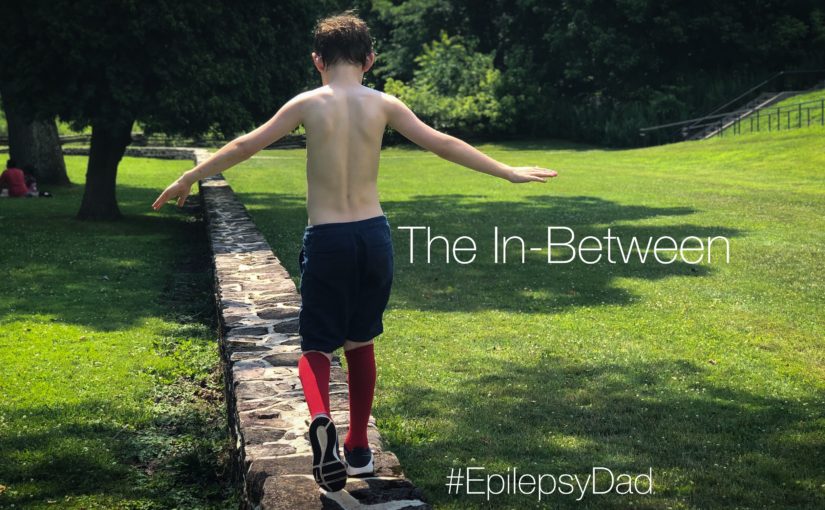
    I struggle with balancing the importance that epilepsy has on his life with just saying that it makes him “different.” I want to hide his condition to protect him from the people who will use it as ammunition to attack his sense of worth. At the same time, I want to share that part of him with the world so that it can see how special he is. But I know I can’t have it both ways. I know that the tightrope between protecting him and showing the world who he is will get harder to walk as he gets older. The more he shares that part of himself, the more vulnerable he will be to the people around him that don’t understand or who are looking to exploit his condition as a way to boost their own perceived worth. At eight, the jabs are more innocent. At sixteen, the jabs will be meant to injure.

    So what is the answer? Maybe my son will grow out of his epilepsy and never have to deal with feeling different when he is older. It could happen, but I’m not betting on it. Even if it did happen, though, that’s not the answer. I need to continue to build him up, to help him understand his value, to understand that his epilepsy does make him different but that it does not make him “less than” someone who doesn’t have epilepsy. I need to continue to reinforce that message until he accepts it for what it is…truth. It might not feel like the world’s truth, but it must be his.

  • In The Moment

    In The Moment

    I remember a few months ago sitting on the floor holding my son who was in the middle of an angry tantrum. I don’t recall what set it off but he had clearly lost control. His eyes were glazed over and he was saying hurtful, mean things while trying to hit me. It was an all too familiar Jekyll and Hyde moment when my son became someone else.

    I sat there, holding him, and tried to not get hurt or become angry by what he was saying and doing. I remember thinking “This is our life now.” Things were never going to change. Things were never going to get better. For the rest of my life, I would need to be there to shield the world from my son.

    Even when this episode passed, I felt like I would only be waiting for the next one. And there was a next one. And another after that. But with each of those episodes, I began to notice the moments in between. Those moments when we weren’t on high alert. The moments when we might have looked like a normal family. I tried to let myself believe those moments would become our new normal, but that didn’t happen, either.

    My mistake was treating these highs and lows and my feelings and reactions to them as a permanent thing. When I was sitting on the floor holding my son, those fears and emotions were very real and very consuming. They were all I could see. When we were happy and hopeful, I held on to those feelings tightly. They were all I wanted to see. But in both cases, the moments passed. Those feelings fell into the stream of time and it carried them away.

    The current of the stream is strong and unbiased. It takes away the good and the bad. When it takes away the good, it’s always faster than I want it to. Those precious moments sometimes disappear before I can appreciate them. When it takes away the bad, it’s never fast enough. The pain and heartache seem to consume me and linger longer than I think I can endure.

    I’ve tried to control the stream. I’ve tried to hold on to those good moments longer by slowing the flow. But I wind up focusing too hard on not letting go that I wind up not being present. While I struggle to hold on to that one moment, others are floating by without notice.

    I’ve tried to push away the bad moments. But the more attention I give them, the more they seem to stay with me. Instead of being pulled away by the current, they bob up and down in front of me, creating a compounding log jam of moments behind them.

    The hardest thing to do is to give up trying to control every moment and, instead, to be in the moment. To be aware of how the moment affects me and my reaction to it. To be present in each moment and to take what the moment offers but then to let it go.

  • A Different Life

    A Different Life

    There have been times when I have wondered how my family’s life would be different if my son didn’t have epilepsy. There have been times when I have wondered what it would be like even if his seizures were under control, or if he didn’t have the side effects that he does from his medications. But a television show forced me to confront a much tougher question.

    I’m a big fan of the show Black Mirror, and I found a similar show on Amazon Prime called Electric Dreams, based on short stories from Phillip K. Dick. In an episode called The Commuter, the protagonist is a father who has a son prone to violent outbursts. As the story develops, the father is offered the chance for a different life, an easier life, in which his son was never born.

    electric dreams the commuter parenting
    The Commuter, Philip K. Dick’s Electric Dreams, Amazon

    As I watched the episode, I thought about turning it off. The story hit too close to home, because I’ve also thought about what my son’s future will be like if we can’t get his seizures under control. I’ve wondered what his future will be like if his emotional and behavioral issues weren’t able to be controlled. And I was ashamed that, when things were at their worst, I also wondered where my life would be if my son wasn’t born.

    Even writing it down, I feel sick. I’m looking at those words and I’m not sure where to go with them. I want to spin it to be about my son because this wasn’t the life that I dreamed for him. But, while that is part of it, there is also a selfish component. When we were having to hold him to control his angry, dangerous outbursts, my thoughts went to darker places. I thought about having to do that for the rest of my life. I thought about someday having to put him in an institution or visit him in jail. I dreaded the phone call where someone on the other end tells me something that my son has done that we can’t excuse or take back. But those thoughts weren’t about what his life would look like. They were about what my life would look like.

    Our life is hard sometimes. It’s also amazing, and we’re very fortunate in so many ways. But it’s also impossibly hard. It’s hard to watch my son struggle every day. It’s hard to feel like everything is always out of our control. It’s hard to keep having conversations about what to try next because everything we’ve already tried didn’t work. It’s hard to hold on to hope for a future that is different than what is in front of us. It’s hard to not let fear take over and seek out alternative paths.

    But having the thought isn’t the same as wanting it to be true. If I were given the choice, I would choose this life every time. I would choose my son every time, because being his father is one of the best things about my life. Being his father has made me a better person and a better man. Being his father has opened me up in ways where I can have these impossible thoughts and come out the other side knowing that I am where I am supposed to be. And every day, when I see his face, I also know that I am where I want to be.