Other than dying, I think puberty is probably about as rough as it gets.
Rick Springfield
I can relate. We’ve faced both of the top items on Mr. Springfield’s list during our epilepsy journey. There were many times when we didn’t think our son would reach puberty. There were long stretches when our son was in status, when we were in the hospital, not knowing if there would be a tomorrow. Once his condition stabilized, even though his seizures not being under control led to an increased risk of SUDEP, we worried that when puberty did come, his seizures would get worse because of the hormones and the changes in his body and brain.
Well, we have reached that part of our program where our child begins the transformation into a young adult. That thing we weren’t sure would happen that then loomed over us when we thought it might happen is here.
Puberty.
Part of me appreciates the miracle. The body is an incredible, complex system that changes as it matures and grows. We literally started as a clump of cells and were able to invent medicine, computers, and space travel. It’s also a miracle that our son is here at all. In a different time, in a different place, his journey could have gone in a very different direction.
Another part of me is right there with the man obsessed with Jessie’s girl.
Puberty is rough.
I don’t have any good memories of puberty. I do remember that I didn’t have any real guides or explanations for what was happening, so I largely experienced it alone. My parents and friends didn’t talk about it. In school, we learned the basics of biology from a book, but that didn’t cover the confusing, very personal, and very real changes that were happening to me. That experience left me feeling lost and insecure, and those insecurities carried well into my adult life, even today.
I want my son to have a very different experience than I did. I want him to have more answers than questions. I want him to feel supported rather than alone. But helping him navigate this part of his journey feels like asking for directions from a tourist. Oh, and also, there is a seizure monster that may or may not attack you along the way.
I’ve had enough therapy to know that the first step is setting the intention for it to be different for my son than it was for me. Check. We’re also very fortunate to be supported by his school and the team of people at our children’s hospital. There are many more well-informed, science- and data-backed resources available today. And I have an amazing partner, so our support system is in place. Check.
The next thing to do is start, although admittedly, I’ve felt like I’ve stumbled a bit taking those first steps. His access to both good and bad information and our evolving understanding of gender and sexuality have left me unsure of where we are starting. But with the right resources and support, we are starting to get our bearings, and we are on this journey together.
That’s already a better start than I had.
I wanted to pass along this book that has been helpful in grounding my understanding and the language we use when talking about gender, sexuality, and related topics. The book is For Goodness Sex: A Sex-Positive Guide to Raising Healthy, Empowered Teens by Al Vernacchio. Al also has a few TED talks and videos available that are wonderful resources for parents.
The lights went out. Conversations ended abruptly. We, along with the thousands of people who surrounded us, focused our attention in the same direction. A single voice echoed around us. We listened to the words…to the message. We understood. We were together. We were ready.
The voice stopped.
Silence.
Then…
Music.
The speakers bellowed the energy from an electric guitar across the arena, over the crowd, into our ears. The bass washed over us with its low, repeating waves. The drum forced its thumping waves into our chest.
The lights came on.
The band was revealed. The lead singer stepped to the microphone.
We knew the song. We waited for that moment. The moment when we, the band, and the crowd would unite in filling our lungs with the shared air of the arena before it burst out through our vocal cords and out through our mouths as the first word of the first song of my son’s first concert.
I barely remember my first concert. I know that it was David Lee Roth, touring solo after his split from Van Halen. I’m fairly certain I went with my sister and one of her friends, and that they picked the concert. I remember at one point David Lee Roth came off the stage through a tunnel to surface near where we were sitting and I thought it was the coolest thing ever.
It was years before I attended another concert. We moved to Florida, but my sister stayed in Connecticut, which meant that my ride and reasons to go to concerts also stayed in Connecticut. In my teens, I experimented with different types of music, but none of my friends were concert-goers, so it wouldn’t be until I moved to Colorado in my 20s that I would see my next concert. That experience marked the start of a string of countless shows, including a number of performances at Red Rocks and Lollapalooza in Chicago, big stadiums, small venues, and outdoor amphitheaters. My favorite performance, though, will always be sitting at a bar in the foothills of Colorado, watching my then-girlfriend, now-wife, singing on stage.
On a side note, we discovered years after we were married that my wife was also at one of those first concerts in Colorado. We saw that same band at a concert a few months ago. Kismet.
My wife brought music into our house, and we kicked off the marriage with our own concert for a few guests. It was no surprise, then, when our son was born, he came out with a love of music.
When he was an infant, I would sit in the yellow swivel chair in his bedroom and play the simple strumming patterns that I knew, singing him songs from The Decemberists, which he’ll still occasionally listen to on his Alexa as he falls asleep. He grew up surrounded by musical theater from my wife’s school. He’s jumped from guitar to piano to drums as he seeks his musical expression, listening to equally diverse styles of music.
Seeing him at the concert, surrounded by thousands of other fans, with the lights, the fireworks, and the band kinetically generating energy that washed over the crowd, was special. But seeing his face as that energy washed over him, especially with the social, emotional, physical, and sensory challenges that he has, was nothing short of magical.
All these years later, his love of music only continued to grow. He goes to bed with music playing. He’ll have Alexa playing music while he plays video games. Music while he is outside playing basketball in the driveway. When he needs an extra boost or motivation, he’ll put on a song to pump himself up.
Once he got sick. Sensory issues. Crowds. Exgaustion and staying up late. The right mix of him doing better, and a band that we all like coming to town. He was ready.
My son thinks he can do anything. It’s one of his best qualities. He’ll say “yes” to everything with complete confidence that he can do it. However, it’s one of his biggest challenges because there is often a disconnect between what is possible and what is required to accomplish the goal.
It’s one of my biggest challenges, too. When my son says he wants to do something or can do something, my reaction is to sometimes question his ability to dissuade him from wanting to do it or believing that he can.
I think I’m doing it to protect him. I don’t want him to be disappointed when he can’t do something. I don’t want him to disappoint other people who might depend on his ability to do something. I don’t want him to feel like a failure, so I convince him that he can’t do something so that he doesn’t try.
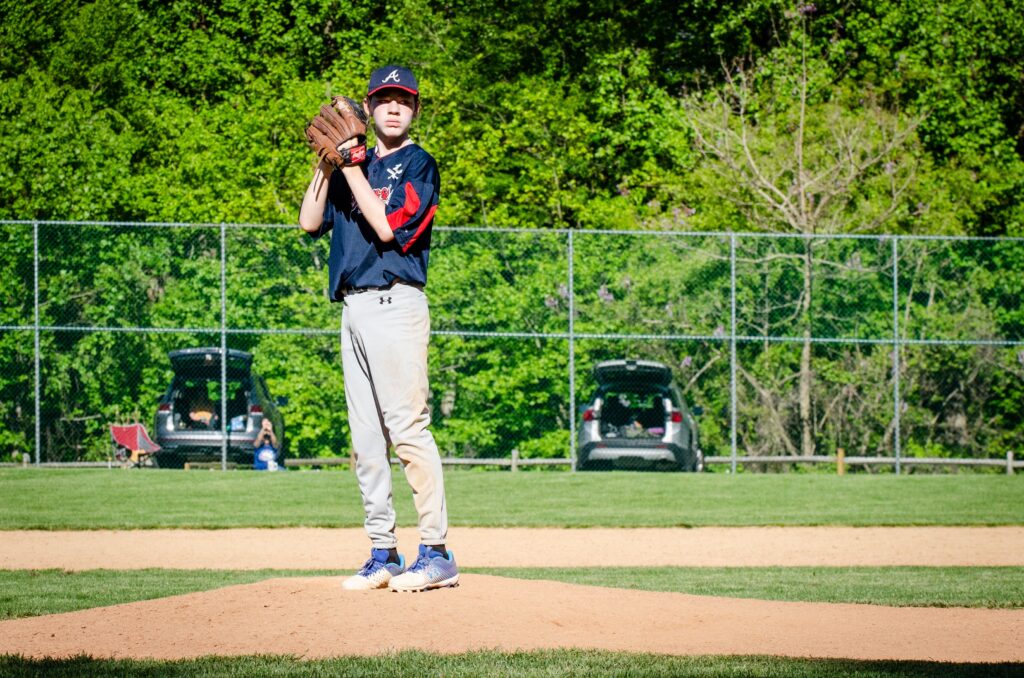
Baseball started again and, at his age level, my son is surrounded by kids who are more athletic, more experienced, and more skilled than him. They already know the intricacies of each position, how and where to move in most situations. While there are a few more dropped balls, errant throws, and wild pitches, it’s like watching a scaled down version of a professional game. The pitches are getting faster, the balls are getting his harder, and the level of competition is higher.
The start of the season was rough. We hadn’t practiced much in the off-season, so it was as if my son had to learn the basics again, while most of the team looked like they never stopped playing. My heart would sink every time my son missed an easy catch or fumbled a ground ball. I felt anxious every time he was on base, worried that he wouldn’t understand his coach’s instructions or be fast enough to get back to the base if the pitcher tried to pick him off.
Despite those mishaps, he showed up every game. He did his best and had great moments of big hits and dramatic defensive plays. His coaches and his teammates were supportive and celebrated his successes, and, above all, he felt like he was part of the team. He was so much a part of the team that, when his coach was talking about giving the players chances at different positions, my son said he wanted to pitch.
My first thought was to talk him out of it. The pitchers at this level were already throwing a variety of pitches. They were shaking off signs from their catcher, giving looks to keep runners close to the bases, and occasionally trying to pick them off. They changed the speed of their windup and delivery to confuse the batters. Imagine a professional pitcher, only shorter. My son does not fit that description.
Instead, I told him if he wanted to pitch, he would have to practice with me every day. The next day, the first thing my son said to me after work was to ask me to go outside and practice. That first time, we measured out the 60′ 6″ distance from the mound to the plate, and it seemed impossibly far.
We started with warmups to get his arm loose, mixing in a few grounders and popups. When he was ready, we pretended it was the bottom of the 9th inning, and his team was leading, and he had to get three outs to win the game.
He stepped onto the makeshift pitcher’s mound, and I squatted at the plate. He went through the motion of his windup, let the pitch fly, and I watched it sail over my head. Our make-believe team lost that first game as he walked batter after batter, but mixed in with the wild pitches were a few perfect strikes.
By the third day, he was throwing more strikes, and rather than losing, we tied and had a wiffle ball home run derby to settle the score (he won). On the fourth day, he walked only two batters before he got the third out. He threw so few pitches that we had to change the story of our game to start in an earlier inning to give him more pitches to throw.
My son talks about those backyard simulations as if they were actual games, causing a few confused looks from his team when he doesn’t give them the context. But the smile on his face after striking out an imaginary opponent filled my heart with joy.
I promised my son that I would reach out to his coach to let him know that we were practicing pitching. But as much as he had improved in the backyard, my fears and concern crept back into my mind. What if he couldn’t deliver in a real game? What if the other kids made fun of him? What if that ruined the joy of the game for him?
Each day I would think about contacting his coach, and each day I would convince myself not to send the message. But it felt wrong, not only not honoring the promise I made to my son, but because I knew these were my obstacles, not his, that were preventing me from taking the next step. I had to trust that the coach would make the right decision and would be able to navigate the situation in a way that wouldn’t catastrophize the situation and hurt my son’s heart.
I typed out the message, trying not to lower the bar too much. I said that my son has been practicing his pitching every day, and if there were an opportunity in practice or an upcoming game, he would like to give it a shot. “Ok” was the only response.
A few days later, at our next game, we were short a few kids, and the score matched our player deficit. I’m not sure who initiated it, but toward the end of the game, my son came over to tell me that he was going to pitch. I smiled and said, “Awesome!” but inside, I could feel my body tense up—the moment of truth.
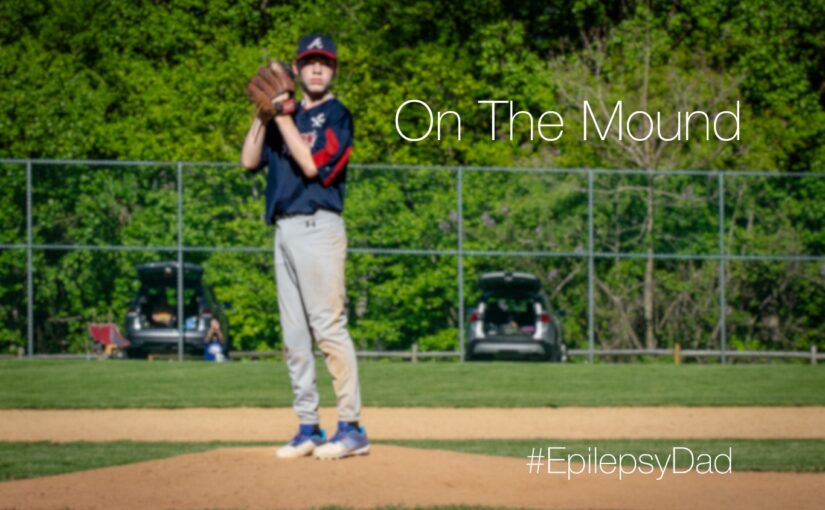
I watched as he warmed up with another player and was pleasantly surprised that he reliably got most of his pitches to the catcher. With only a few innings left, the coach told me that unless we scored a bunch of runs before the last inning, my son would go in. We did not score those runs, and I watched in slow motion as my son stepped through the gate to the field and took the mound.
I had one of those moments where I wondered whether my presence was helping or hurting. He would look at me after every pitch, but I couldn’t tell if he was looking for my approval, guidance, encouragement, or support. But he was on the mound. He was pitching. And, while there were more than a few pitches that got past the catcher, there were just as many that sailed over the plate.
His pitches weren’t fast, so there were a few big hits. He walked a few batters. But he kept stepping back on the mound. His teammates fielded a grounder and got the first out. My son snagged a scorcher right back to him as casually as I’ve ever seen him field a ball and made the throw to first for the second out. And then, after being up 1-2 on the pitch count, the last batter hit a soft grounder to first for the final out. My son had pitched a complete inning.
“Awesome,” I said again, and I met him on the field. It was awesome, in the literal sense of the word. I was in awe of his dedication to his goal, his bravery in stepping into the unknown, and his willingness to have doing his best be enough.
I’m coming up on the 8th anniversary of the Epilepsy Dad blog. That’s more than 200 posts documenting our journey since my son was diagnosed with epilepsy in 2014.
The beginning of that journey was pure chaos. We were coming through nearly losing our son when the doctors couldn’t control his seizures when I wrote my first post. I captured the endless and severe side effects of the medications we tried. I shared our experiences with therapy as my son lost control of his emotions. I documented every attempt to control seizures, from CBD to the VNS, that were never able to silence them fully. And I captured not just my son’s challenges but the impact that this complicated condition had on my family and me.
Admittedly, the last few years have been sporadic with posts. I’ll get the inspiration to write when we reach a new milestone or when we encounter a new setback, but largely it’s gotten more difficult to find that inspiration because our life feels pretty settled.
Settled. It’s a strange word to be using. My son still seizes every day. He still takes handfuls of pills multiple times a day. He still struggles in school, socially, and emotionally. His future is still uncertain. From the outside, it must look anything like being settled. But this is our normal. This is our every day, and less and less does anything happen outside that normal.
That’s not to say that we don’t celebrate the exceptions when they do happen, no matter how small. A good report from his teachers or doctors. A hit at a baseball game. A dominant win at Uno. We also have the good fortune to have had amazing experiences and see interesting places. In many ways, we’ve worked hard to get to this place so that this could become our normal, in spite of the challenges.
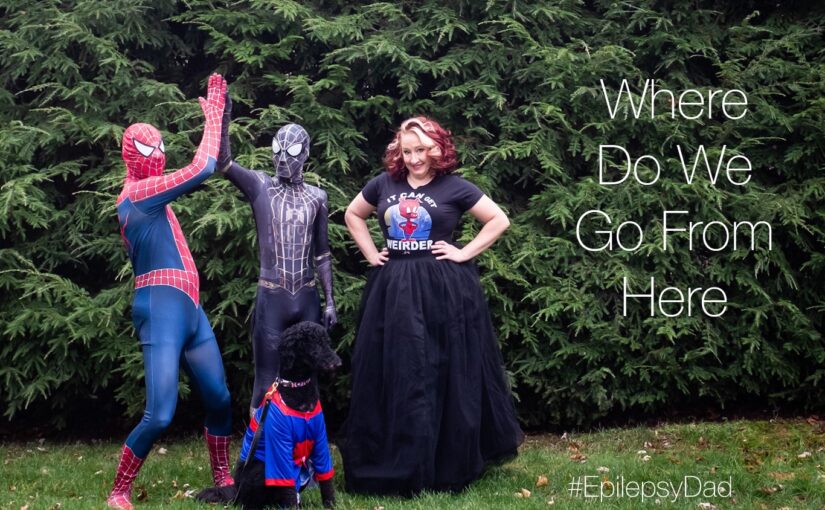
But where do we go from here?
When I sat down to write, my intention was to make that question about the blog. What else is there to write about? What other part of our story was there to write about when most days feel like a re-run of the previous day?
It was different when the blog started. I used this blog as a way to process my thoughts and feelings about my son’s diagnosis when every day brought new challenges, or when I was reacting to a new obstacle or achievement. It felt like every day there was something to write about, then it was every week, then every month. And now, I’m writing about how there isn’t much to write about.
As I pondered that thought about the blog, though, the act of writing down my thoughts changed to thinking about the future of my son and our family. So much of the last few years have been reactionary, but now we’re trying to shift our gaze from looking backwards to looking forward. From being reactive to being proactive.
Where do we go from here? Forward. Where we go from here is to experience what is ahead of us. Where we go from here is unwritten and unknown, but it is also something we can influence and contains the potential that we can work towards. And maybe, there will be something to write about.
I don’t plan on shutting the blog down, but posts may not be as frequent as we step into the future. But I hope you’ll check in. I hope you’ll be in touch, whether its leaving a comment or sending me an e-mail. And I hope, wherever you are in your journey, that when you find your normal, you can be grateful for the progress, make the most out of every single moment in the present, and be hopeful and intentional about the future.
A few weeks ago, we attended the yearly fundraising event for my son’s school. The event was an opportunity to interact with other parents, teachers, faculty, and board members and to collectively celebrate that a place exists for kids like my son.
This year, the guest speaker was a Hollywood movie producer who attended the same school when he was my son’s age. The producer accepted the school’s Achievement Award and gave an emotional speech about how much the school helped him learn and grow and how it changed how he felt about himself and his outlook on the future.
Earlier in the day, he spent time with the kids, including my son. The kids worked together to create movie pitches and presented them to the producer. My son came home beaming, feeling proud of himself for his accomplishment, and also because the producer gave my son the inside scoop that there would be another Captain America movie.
We didn’t learn all the details until we spoke with one of my son’s teachers at the fundraising event. He often has a hard time remembering and sharing details, but his teacher was so proud of him, and we were equally proud and grateful that the producer had spent time with the children.
In his speech, the producer talked about his experience with the kids. He said it reminded him of what it was like to find a place like this school after struggling for so long in other schools. He looked at the faces of the kids and wanted to inspire them and show them that, even though they have challenges, with a loving family and by the right support, anything was possible.
When he said that, I felt a light come on.
I think a lot about my son’s future. I wonder what he will be capable of, and what options will be available to him. Often, those thoughts are about the things he won’t be able to do because I see how much he struggles today. But I think a part of that is because we traveled so much in the unknown, without the type of support that schools like this provide. Based on our experience, the unknown is dark and scary, and we spent so many years navigating potential futures in that dark, feeling around for a way out.
When it’s that dark, everything feels like a wall.
But that moment in the producer’s speech when the light came on made me think about how much our life has changed in the last few years. Our new home in our new town, my son’s new friends, and my son’s new school have all changed his life. They’ve changed our life. The school, in particular, has given him a sense of belonging in a safe space and the tools he needs to learn. He is surrounded by other kids like him. He is being taught in a way that works for him. And now, he’s seeing examples of what other kids like him have done.
The school has provided light in the dark, and, for the first time, we can see a little further ahead.
It’s because of that light that, for the first time, we can see that we’re not just surrounded by walls. We can see doors, too.