Tag: school

  • Milestones

    Milestones

    The Latin is “milia passuum,” meaning a thousand paces. The Romans also erected stone markers at mile intervals to notify the passerby of distances covered or the number of miles to go to reach their destination.

    The Lower Merion Historical Society

    We sat in our chairs among other parents, siblings, grandparents, and friends. The gymnasium was filled with nervous energy as we waited for the ceremony to begin.

    It was a day that we weren’t sure would ever happen. For 10 years, my son struggled with unrelenting seizures, medication side effects, and behavioral issues. After he was stabilized, although never seizure-free, he faced social and intellectual challenges in learning environments tailored for students who were not like him. At the same time, my wife and I fought school districts that seemed motivated to make him disappear. That was until we found his current school.

    For the past 3 years, he was in a place where he belonged. He was in a place that saw him for who he was and celebrated it. He was surrounded by peers on similar journeys and was able to bond, make friendships, and learn. When we received the results of his recent neuropsychology test, it showed progress. He was below his grade level, but there was progress. After his testing a few years ago, the doctors predicted only regression. We started looking at functional schools, assuming the academics would be too challenging. That was until we found his current school.

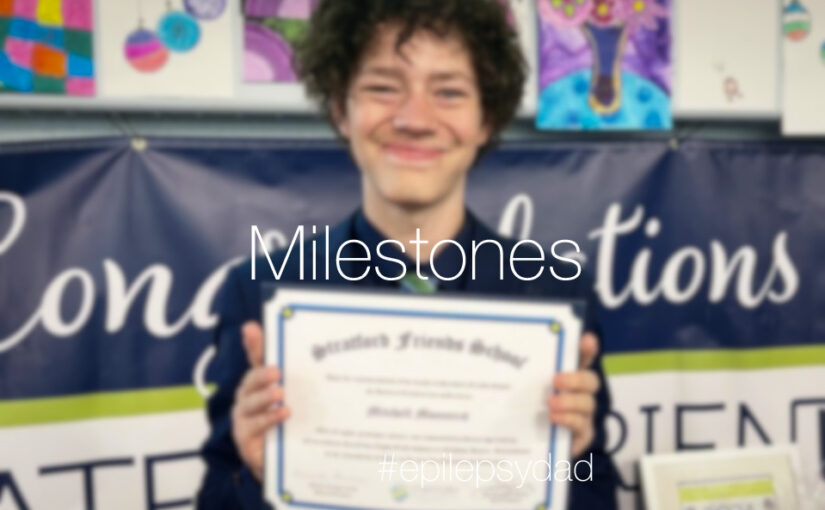
    As I took it in, Pomp and Circumstance began playing, and the room collectively turned to face the door. Our son, dressed in his blue suit and tie that matched the school colors, led the procession of 8th-grade graduates to the stage.

    I looked at the faces of the families around me in the gym. I listened as they spoke about their experiences with the school and how proud they were of their children for reaching this milestone. My heart swelled as I watched the video the school made, combining pictures and videos of the students being interviewed about what they learned and what they would take away from their experience at the school.

    When it was time to hand out diplomas, I walked to the back of the room and hid behind my camera. I’ve gotten to know many of the graduates and their families, and I knew it would be emotional for everyone.

    There is a tradition at the school where the teachers put together an acrostic poem using each student’s name. As each student stood on the stage, teachers took parts to read. Every line of every poem showed how well they knew each student with a great mix of pride, humor, and recognition.

    My son was the last to the stage. He stood tall as he climbed the steps, but I could tell he was nervous. The anticipation of this day and this moment had been building for weeks. As he stood to the side, the teachers read his poem, which, appropriately, included a Marvel reference. He looked so happy when he received his graduation certificate, and he and his teachers exchanged big, warm hugs.

    And then it was done. Students, faculty, and families came together and filled the gym with love, and pride, and gratitude. I found my son in the crowd and he fell into my arms as I gave him a long hug. My wife came over and we all embraced and shared the moment as a family.

    There are milestones and there are MILESTONES, and this was definitely the latter. It is a moment set in stone to let us know how far we have come along our journey, even if we don’t know how far we have to go.
  • Walls and Doors

    Walls and Doors

    A few weeks ago, we attended the yearly fundraising event for my son’s school. The event was an opportunity to interact with other parents, teachers, faculty, and board members and to collectively celebrate that a place exists for kids like my son.

    This year, the guest speaker was a Hollywood movie producer who attended the same school when he was my son’s age. The producer accepted the school’s Achievement Award and gave an emotional speech about how much the school helped him learn and grow and how it changed how he felt about himself and his outlook on the future.

    Earlier in the day, he spent time with the kids, including my son. The kids worked together to create movie pitches and presented them to the producer. My son came home beaming, feeling proud of himself for his accomplishment, and also because the producer gave my son the inside scoop that there would be another Captain America movie.

    We didn’t learn all the details until we spoke with one of my son’s teachers at the fundraising event. He often has a hard time remembering and sharing details, but his teacher was so proud of him, and we were equally proud and grateful that the producer had spent time with the children.

    In his speech, the producer talked about his experience with the kids. He said it reminded him of what it was like to find a place like this school after struggling for so long in other schools. He looked at the faces of the kids and wanted to inspire them and show them that, even though they have challenges, with a loving family and by the right support, anything was possible.

    When he said that, I felt a light come on.

    I think a lot about my son’s future. I wonder what he will be capable of, and what options will be available to him. Often, those thoughts are about the things he won’t be able to do because I see how much he struggles today. But I think a part of that is because we traveled so much in the unknown, without the type of support that schools like this provide. Based on our experience, the unknown is dark and scary, and we spent so many years navigating potential futures in that dark, feeling around for a way out.

    When it’s that dark, everything feels like a wall.

    But that moment in the producer’s speech when the light came on made me think about how much our life has changed in the last few years. Our new home in our new town, my son’s new friends, and my son’s new school have all changed his life. They’ve changed our life. The school, in particular, has given him a sense of belonging in a safe space and the tools he needs to learn. He is surrounded by other kids like him. He is being taught in a way that works for him. And now, he’s seeing examples of what other kids like him have done.

    The school has provided light in the dark, and, for the first time, we can see a little further ahead.

    It’s because of that light that, for the first time, we can see that we’re not just surrounded by walls. We can see doors, too.

  • Stepping Up To The Plate

    Stepping Up To The Plate

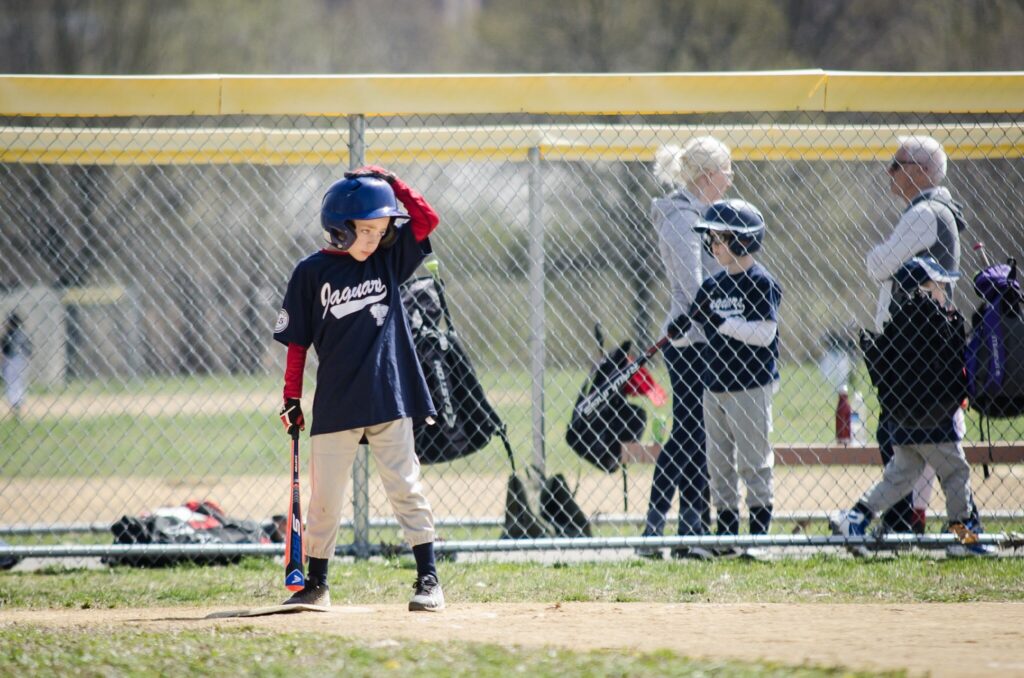
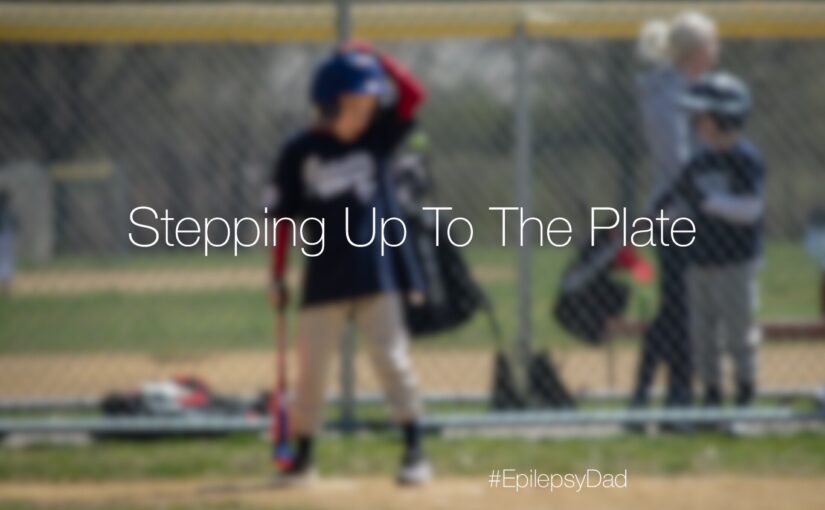
    There is a screen saver on our television that lets us use our own photos. One of the pictures we used that has come up in rotation is from one of my son’s baseball games. He’s standing at the plate, adjusting his helmet with his left hand while his bat hangs down from his right.

    It feels like that picture was taken in another life so long ago. But it’s only been a few years. “Only,” as if that is an insignificant amount of time.

    He said the other day that he misses baseball. I miss him having baseball. I miss him playing a game that he loves, surrounded by other kids being kids. I miss the look of his “game face” or the excitement and expression on his face after he got a hit. I miss his laugh as he and the other kids ran around the bases at the end of the game and created a pile-up as they slid into home plate. I miss retelling the best moments from the game in the car on the way home.

    We had signed him up for this season, hoping to introduce a bit of normalcy back into his life. But because of an abundance of caution for his health and other changes on our horizon, we decided to pull him.

    I still haven’t told him.

    Seeing that picture on the screen is my reminder, not just to have the hard conversation but also about how isolated he is. Baseball was one of the only places where he showed up as an equal. That feeling and those bonds that he made on the field were the same as the other kids. But the other kids created bonds in school, as well, that my son missed out on because of his long absences over the years.

    He plays Fortnite with a few of his former classmates, but I can hear the conversations sometimes, and, with a few exceptions, he is treated as an outsider. Many of the kids who developed those classroom bonds still go to school together or play sports together. They have the real-world bond that carried through to the online world. It’s hard to compete with that when the only interactions that you have are virtual ones.

    It’s the same reason my son is struggling with a virtual school. In addition to the difficulty many of us have to stare at a screen all day and the mind-numbing burden of an all-day video call, he’s getting zero in-person social interactions. He’s not making friends, even though he receives online social skill classes because it’s hard to build those relationships and connections in a meaningful way when the person on the other end is only a face on a screen or, worse, one of the dozens of faces on a screen.

    But even though the other kids have stronger bonds and sometimes exclude him, he still sends that invite to play online with his friends. Despite feeling like an outsider and that sting that comes from not getting picked, I’ve seen my son be so kind and generous and play the game modes that his friends want to play. I’ve also seen him put his own needs out there and ask to play the games he wants to play.

    He still wakes up every school day and sits in front of that screen, and he tries to follow along. He fights through his exhaustion and attention issues to participate in the class as best as possible. In both cases, despite the challenges, he shows up with an open heart and a willingness to learn, be included and connect. Like the picture on our television, every day, he steps up to the plate.

    And I couldn’t be more proud.

  • Breaking The Mold

    Breaking The Mold

    Regardless of who actually said it (it probably wasn’t Einstein), at times I feel like I’m living the definition of insanity by doing the same thing over and over again and expecting different results.

    At the center of this insanity is a compulsion to fit my son into the world’s definition of “normal”. There is a mold made up of societal norms and expectations that I try to force him into, even though it is clear that the mold is the wrong shape.

    Still, I try to make it work because I’m scared that, if I don’t, the world won’t accept him and it will cast him out. Or label him. Or make him feel “less than.” As a result, I correct him when he does something that makes him look different from everyone else rather than celebrating his uniqueness. I spend more time trying to make him work inside what the world expects of him rather than finding ways to make the world work for him. And I keep repeating that pattern, in spite of all the signs that it isn’t working and that it isn’t the right thing to do for my son.

    I think that is partly because I don’t know what does work for him. The things I try are the things that are familiar to me. They are the things that I know exist. They are the things that I grew up with because somehow, in spite of feeling very different, I managed to get a traditional education, and go to college, and get a job. I was able to existing inside of the “normal” that most other people seem to also make work for them.

    My wife is much better than I am at flipping the narrative and seeing that it is the world needs to change to include our son. She looks for places where our son can feel like he belongs rather than making him fit into any molds. But given the state of the world and its indifference or intolerance to anyone who is different, I can see her frustration and anguish every time the world doesn’t understand him, or us, or our situation.

    She’s the reason that we are looking at alternative schools for our son. She’s knew it years ago but no one would listen. I might have thought I was listening, but I was too afraid to act on it because I thought things would get better. I thought I could make my son fit into that mold if we just kept trying. Worse, even when I knew it wasn’t working, my fear led me to just keep trying the same things because it was less scary than going into uncharted territory and discovering that he doesn’t fit in anywhere. I was as accomplice in the notion that we could simply remove a few expectations from him to make him fit the mold better. But all that did was make him disappear.

    I am trying to stop the insanity. I am trying to redefine my view of the world and what I expect my son’s path to be because I am seeing that his path does not need to look like my path. His path will be made up of his experiences, tailored to who he is. It’s big and it’s scary and I don’t know what it will look like, and it may take endlessly battling the world to make room for him. But that is something worth doing over and over again.

    The world seems intent to prove that it is my son who is the wrong shape, but the world is wrong. My son broke that mold the first time he had a seizure. Actually, he broke that mold the day he was born.

  • Fewer Choices, Less Time

    Fewer Choices, Less Time

    It feels like we are in a constant search to find a school where my son belongs.

    For the first few years, we sent him to one of the city’s best public schools. They didn’t know what to do with him, so he drifted from grade to grade while we struggled to make accommodations for his stunted academic and social growth.

    Last year, we moved him to a new virtual school, hoping to alleviate his anxiety that my son felt going to his previous school. While it may have achieved that goal, virtual learning amplified my son’s challenges in the classroom settling and left him further behind. Sitting in front of a computer all day on a video call with a big group of other 5th graders results in a controlled chaos that taxes my son mentally and physically in ways that I didn’t expect.

    As a result, we’re once again exploring our options. But the reality is that every time we do this, we do so with fewer options and less time.

    When we try a new approach, make a modification, or check out a new school that turns out to not be the right fit, we have fewer choices. The traditional classroom-based, lecture, teach-to-the test education system, which is how the vast majority of schools operate, doesn’t work for my son. He tries so hard, but his difficulty with executive functioning, processing, and retention taxes him to the point of mental and physical exhaustion. That exhaustion makes his processing and retention worse, feeding back into itself until his body and mind tap out and we are left picking up the pieces.

    There are other schools, but the ones that have a different teaching method are scarce, expensive, or far away. We called them, though, and talked to the administrators. In some cases, we were told that their school wouldn’t be a good fit. In other cases, we were told that it might be a fit based on our description, but we continue to struggle to get the right amount of documentation to accurately represent where he is. But we can’t get that because we haven’t found a place with the resources or the expertise to make a recommendation for a child who doesn’t fit into a predefined box.

    Now, we’re looking at 6th grade. That’s only three years until high school. Three years, and there is no guarantee, even if we find a new school this year, that it will be any different. We’re running out of time to find a place or a way to educate my son enough for him to enter the world. I used to feel like he had his whole life ahead of him, and now I just feel the pressure to find a solution before the system cuts him loose.

    I had always expected that someday my son would be like everyone else. I used to believe that, with modifications, we could educate him alongside his peers who didn’t have his challenges. I used to have “normal” as the bar. It’s the same mistake that the education system makes. It’s the same mistake that the world makes.

    I don’t feel that way anymore. It’s difficult to predict the future of his condition or to know what he will be capable of as he stumbles through school. We are so focused on finding a way to educate him now that we’re not thinking about college. I’m not even sure that college will be in the cards for him if we can’t find a solution that works for him in middle school and high school, and those grades went from being far out on the horizon to staring us in the face.