
Tag: seizures

  • Rock On

    Rock On

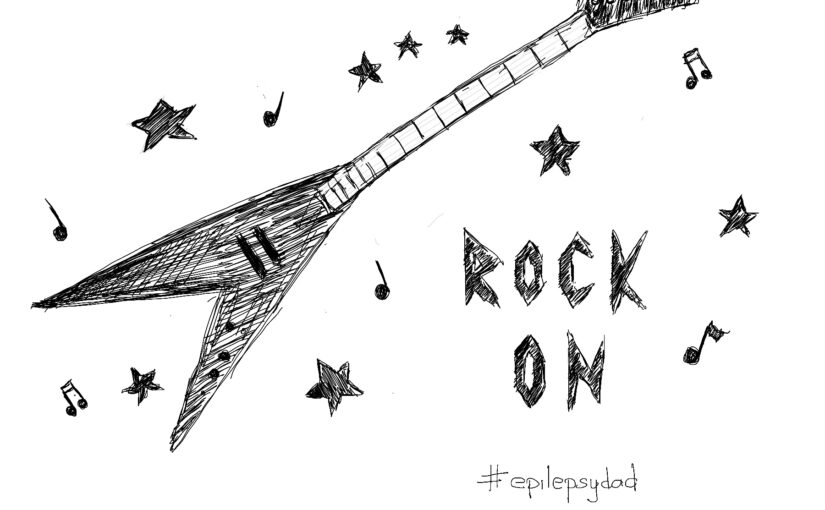
    The image above was 10 years in the making.

    The photograph on the left was taken in July 2014. We were in Philadelphia ahead of our eventual move from Colorado. My wife and son had a long week of exploring and house hunting, and we thought we’d unwind and play games. About an hour after that picture was taken, we’d be standing in the lobby waiting for a taxi and watching our son have his first seizure.

    Over the next 10 years, we’d see our son have countless seizures. We’d have many nights where we thought we would lose him. We would spend months in the hospital saving his life and then years trying to rebuild what was damaged. We would struggle to find his place in the world.

    The photograph on the right was taken at Dave & Buster’s a few weeks ago after our son’s last school day before winter break. As I walked around the corner and saw him pick up the guitar, I had the image of my present-day and my son 10 years ago, like two different realities, crashing together in my mind.

    While we’ve had struggles and challenges in the last ten years, the significance of that moment was that we’ve also had successes and accomplishments. Our son is 15 now, and we’ve had so many years we weren’t sure we would get. He plays baseball, enjoys gaming and streaming, and has friends. He’s in a school for kids like him, which gives him a place to learn and grow.

    When the picture on the left was taken, we didn’t appreciate how little knowledge and control we had over the future. Later that night, any vision we had for the future was shattered. The picture on the right reminded me that we can never predict the future. We can only learn to embrace every moment, victory, and opportunity to pick up the guitar and rock on.
  • Yet

    Yet

    “Yet” is such a powerful word.

    “Yet” allows us to acknowledge current struggles while leaving space for future possibilities. It’s a bridge between what is and what could be, subtly shifting focus from a fixed state to one of potential.

    There have been so many times when we thought we were out of options when it came to treatments for our son’s epilepsy. We tried all the medications. We tried the ketogenic diet. Because his seizures were generalized, he wasn’t a candidate for surgeries that are available to people who have focal seizures.

    Each time one of the treatments failed to control his seizures, we felt resigned to give up hope.

    But even in the 10 years since my son was diagnosed, there have been many new advancements.

    Genetic testing is being used to identify specific genetic mutations associated with epilepsy, which has enabled personalized treatment strategies, improving efficacy and reducing side effects.

    Epidiolex was introduced in 2018 to treat Lennox-Gastaut syndrome and Dravet syndrome.

    A new surgical technique called Laser Interstitial Thermal Therapy (LITT) that uses a laser to target and ablate seizure-causing brain tissue precisely was approved, reducing recovery time compared to traditional surgery.

    Although it was used off-label earlier, Vagus Nerve Stimulation (VNS), which involves implanting a device that stimulates the vagus nerve to reduce seizure frequency, was FDA-approved in 2017 to treat children as young as 4 years old with drug-resistant focal epilepsy.

    Deep Brain Stimulation (DBS), traditionally used to treat movement disorders like Parkinson’s, is now being used to target brain regions like the anterior nucleus of the thalamus to reduce seizure frequency in individuals with drug-resistant epilepsy.

    We’ve benefited from these advancements. In addition to genetic testing, my son had VNS surgery when he was nine and DBS surgery right before his 15th birthday, even though they weren’t options when our journey started.

    Of course, it’s easier to be on this side of it and say that I always had hope or that I automatically added the word “yet” to the sentence “there is nothing left to try.” I didn’t. I was overwhelmed because everything we tried didn’t stop the seizures. I had almost lost my son, and I was afraid that, with every failed treatment, every door was closing on his future.

    Eventually, I would be reluctant to try a door because that would mean fewer were available. At least with untested doors, there was hope. It’s like in high school, when there was a girl I liked, if I didn’t ask her out, she couldn’t say “no,” so there was always hope for a “yes.”

    What changed for me was seeing the advancements and having them offered. First, there was a new medication, then another, and then the VNS. I saw first-hand how continued progress created more doors, making trying one a little less scary. I began to believe there would be more doors, which made it easier to believe in the word “yet.”

    Right now, our hand is on the DBS door. We’ve cracked it open and are waiting to see what is on the other side. There are never guarantees, but we hope it improves our son’s quality of life. If it doesn’t and we have to close that door, too, when the feeling comes back that there is nothing left to try, I will remember to complete the sentence:

    It feels like there is nothing left to try…yet.

  • Thankful and Grateful

    Thankful and Grateful

    Today is Thanksgiving in the United States.

    While we aren’t the only country that celebrates Thanksgiving, the holiday is widely celebrated in the United States as a time of gratitude and togetherness.

    In our household, we have a nightly routine that has evolved over the years. It includes reflecting on something we are grateful for. Even if we are too tired to do the full routine, we never skip our “grateful for.”

    That led me to wonder about Thanksgiving being a day about gratitude and the difference between being thankful and grateful. According to the vast library of truth that is the internet, gratitude encompasses both being thankful and being grateful, but even though the terms thankful and grateful are often used interchangeably, they have subtle differences in meaning and emotional nuance:

    Thankful

    Definition: Being aware of and expressing appreciation for something good that has happened or for a specific benefit received. Thankful is usually tied to a specific moment or event (short-term and outward-focused).
    Focus: Often more situational and reactive; tied to specific actions, events, or gestures.
    Example:
    “I’m thankful for the gift you gave me.”
    “She felt thankful for the sunny weather during her picnic.”

    Grateful

    Definition: A deeper sense of appreciation and acknowledgment, often tied to an enduring or broader sense of thankfulness. Grateful reflects a more profound, ongoing state of appreciation (long-term and inward-focused).
    Focus: Goes beyond immediate circumstances and often reflects a heartfelt acknowledgment of a relationship, life situation, or intrinsic value.
    Example:
    “I’m grateful for having a supportive family.”
    “He felt grateful for the lessons he learned from his challenges.”

    With my newfound knowledge of the nuances of gratitude, I think about how it applies to the language I use in the context of my son’s epilepsy.

    I am thankful that our son has access to medicine that helps reduce his seizures. I am thankful for the doctors and nurses who cared for him during his surgery. And I am thankful he has a friend who helped him catch up when our son returned to school.

    I am grateful for the support of his friends and his school. I am grateful to live where he can access specialists and get the care he needs. I am grateful for the lessons I have learned from our son’s challenges.

    I’m not sure it’s perfect, but in the end, regardless of the words we use, it’s the feeling that matters. Gratitude improves our overall well-being and strengthens relationships by fostering positive emotions, encouraging mutual appreciation, deepening connections, and helping us focus on the good in ourselves, others, and the world around us.

    On a day intended to celebrate gratitude and togetherness, I think that’s what matters, whatever language we use.

    Because this post mentions Thanksgiving, it’s also important to be mindful that its origins are tied to events that some Native Americans associate with colonization and the loss of land, culture, and lives. If you’d like to learn more, please read about the National Day of Morning, which is observed by many Native Americans on Thanksgiving and is a time to honor their ancestors and reflect on the historical and ongoing injustices faced by Indigenous peoples due to colonization.

  • Probabilities

    Probabilities

    I spend a lot of time thinking about probabilities. Usually, it’s for my day job in artificial intelligence, data science, and analytics. Predictions abound in that world as we figure out the likelihood that something will occur and make a decision based on that likelihood.

    Guided and confined to a business context, the probabilities are mostly numbers I can understand and that are useful for the business to take action on. The other day, I was thinking about my son’s upcoming surgery, and my mind wandered through all of the events that had to happen to get us there.

    The material was drawn from the earth to manufacture the instrument and the tools to perform the surgery.

    The elements that made up that material had to be captured and combined to form a planet capable of creating life.

    A boy on that planet had to grow up to be a neurosurgeon to do the surgery.

    A girl on that planet had to grow up to be a neurologist who saved our son and recommended the surgery.

    My wife and I had to be born, live more than thirty years of our lives, find each other, get married, and create a life.

    Thousands of generations before us had to be born, meet, and multiply.

    A gene had to be passed down through those generations, evolve, and mutate to cause the seizures in our son.

    The cosmic material that formed the genes and the elements had to be forged in the heart of stars over billions of years and make their way to this part of the universe, on this planet, and in these people.

    At any point, a variation could have changed the course of the billions of years of possibilities and choices that led to each successive moment. But all of those possible points of diversion led to this path, to this universe, to this planet, to these people, to my wife, to our son, and his condition.

    Maybe there’s a version of our family without epilepsy in another universe. But there are also infinite versions of me without this family. With the unfathomable probabilities against existing in this moment and with this family, I am exactly where I am supposed to be.

  • Relax, It’s Just Brain Surgery

    Relax, It’s Just Brain Surgery

    At a recent appointment, our neurologist suggested deep brain stimulation for our son.

    Brain surgery.

    A recommendation for another surgery was unexpected. We had just weaned off the Onfi and were down to only two seizure medications. The switch from keto to modified Atkins proved challenging to keep his ketones up, which is shifting us to a trajectory that will place him on a normal diet for the first time in almost 10 years. Still, with those changes, we haven’t seen an increase in seizures. Considering the toll puberty has taken on his body physically and emotionally, I was grateful to be where we were.

    But we’ve been at this long enough to know it’s not just about seizure freedom. Our focus has always been on finding the balance between seizures and quality of life, since heavily medicating him never stopped the seizures but turned him into a zombie. At one point, he was on 4 medications, the ketogenic diet plus the VNS, and even then, seizures would break through. That he can go to school and learn, play baseball and video games, and have a life at all is more than we could have hoped all those years ago, watching seizures wrack his tiny body.

    We also know that our choices aren’t just about the present. We also have to think about the future, and that future includes the potential dangers that come with uncontrolled seizures and epilepsy. Our son’s condition presents similar to Lennox-Gastaut Syndrome, and with that comes an increased risk of SUDEP.

    Any options that lower his risk but still allow him to have a life are worth exploring, especially because our list of options continues to shrink. I hope for continued advancements in technology and medication; deep brain stimulation is a good example. It wasn’t an option for children with epilepsy until recently, but now it is being offered for our son.

    Which brings us back to…brain surgery.

    I’m not sure what I expected before we met with the neurosurgeon. Correction: I expected brain surgery to include opening up our son’s skull with power tools. When the surgeon explained what the surgery actually entailed, I felt a sense of relief. Other than the fact that, yes, things would be inserted into our son’s brain, it sounded similar to the VNS surgery. It also helped that the surgeon, the same surgeon who did our son’s VNS surgery, is the epitome of cool and has done the surgery enough that it sounds like he’s describing a routine task.

    I’d imagine it would be the same as a pilot describing how to land an airplane. Sure, it makes sense, but there’s enough awareness and humility on my part to know that a) I can’t do it and b) you obviously know what you’re doing, so I can relax and let you land the plane.

    I left the consultation feeling less overwhelmed and in favor of the procedure. We also talked to our son about it because he’s old enough to have an opinion about his body. He had a few basic questions but did not hesitate before agreeing to the surgery.

    And, with that, the decision has been made.

    Let’s land this plane, doc.