Tag: epilepsy

  • Father Forgets

    Father Forgets

    Last week, I was listening to the audio book version of Dale Carnegie’s [easyazon_link identifier=”0671027034″ locale=”US” tag=”epilepsydad-20″]How To Win Friends & Influence People[/easyazon_link] on my way to work, and there is a chapter that includes a reproduction of a story by W. Livingston Larned titled “Father Forgets”.  By the time the narrator had reached the second paragraph of the story, I had moved myself to the inner edge of the sidewalk, out of the way, and found myself focusing intently on the words. The words that described how I feel most days after my son has gone to bed; the words that describe my interactions with my son and how I correct his every action and why he always seems to be apologizing when he is around me.

    It took everything I had to keep my composure as the words penetrated my ears and bounced around in my brain. When the story was over, I skipped back to the start and listened to it again. Then a third time. I was convinced that the story was written for me to hear and I wanted to absorb every syllable.

    Navigating this complicated, messy world of epilepsy continues to be a never-ending sequence of impossible situations. But my biggest challenge continues to be separating the condition and its effects from the boy and what is normal or expected at his age. He is so amazing in so many ways and I take that for granted, so I expect him to be amazing in every way and all the time. I forget that he is just a boy. I forget that he is still learning. I overreact hoping that I am curbing any appropriate behavior caused by his medicines or the wiring in his brain when all I am doing is making him feel inadequate and broken and flawed and like he is constantly disappointing me.

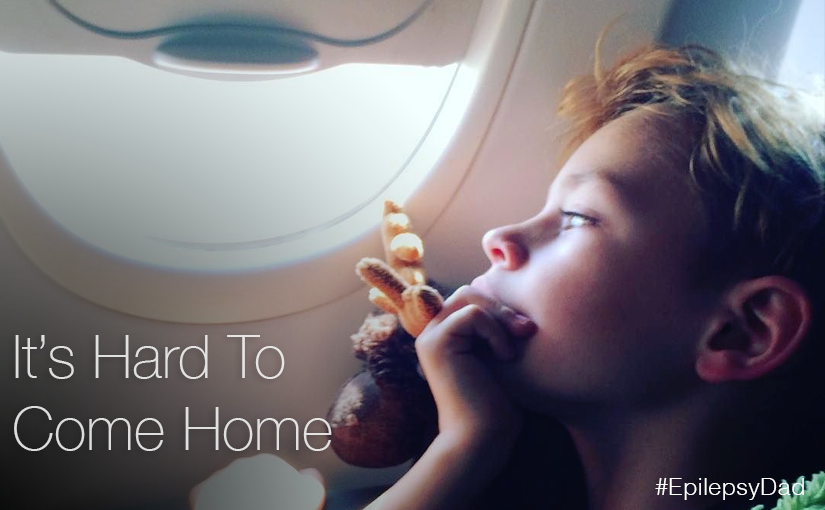
    In spite of this, he enthusiastically greets me every day when I come home from work. He’ll ask me to play hockey or baseball, or to have a tickle party, because we have fun together, even as I’m wrestling internally to not correct every little thing he does.

    I don’t want my son’s childhood to be a constant struggle for perfection. There are enough obstacles and unfair complications in his young life, and I don’t want him to look back on this time and have the happy memories colored with a sense of disappointment.

    It is with the most misguided of best intentions that I find myself at the end of the night finding flaws in my own performance and wishing I had done better. Wishing I had taken that deep breath before I replied with a criticism or adding a “but” to a compliment. The habit of finding fault is not an easy one to break.

    But the look on his face when I get home lifts my spirits. The laughter at the end of the night inspires me to try again the next day.

    Tomorrow, I will try to be a real daddy, too.

    Father Forgets

    Listen, son: I am saying this as you lie asleep, one little paw crumpled under your cheek and the blond curls stickily wet on your damp forehead. I have stolen into your room alone. Just a few minutes ago, as I sat reading my paper in the library, a stifling wave of remorse swept over me. Guiltily I came to your bedside.

    There are the things I was thinking, son: I had been cross to you. I scolded you as you were dressing for school because you gave your face merely a dab with a towel. I took you to task for not cleaning your shoes. I called out angrily when you threw some of your things on the floor.

    At breakfast I found fault, too. You spilled things. You gulped down your food. You put your elbows on the table. You spread butter too thick on your bread. And as you started off to play and I made for my train, you turned and waved a hand and called, “Goodbye, Daddy!” and I frowned, and said in reply,

    “Hold your shoulders back!”

    Then it began all over again in the late afternoon. As I came up the road I spied you, down on your knees, playing marbles. There were holes in your stockings. I humiliated you before your boyfriends by marching you ahead of me to the house. Stockings were expensive‐and if you had to buy them you would be more careful! Imagine that, son, from a father!

    Do you remember, later, when I was reading in the library, how you came in timidly, with a sort of hurt look in your eyes? When I glanced up over my paper, impatient at the interruption, you hesitated at the door. “What is it you want?” I snapped. You said nothing, but ran across in one tempestuous plunge, and threw your arms around my neck and kissed me, and your small arms tightened with an affection that God had set blooming in your heart and which even neglect could not wither.

    And then you were gone, pattering up the stairs. Well, son, it was shortly afterwards that my paper slipped from my hands and a terrible sickening fear came over me. What has habit been doing to me?

    The habit of finding fault, of reprimanding‐this was my reward to you for being a boy. It was not that I did not love you; it was that I expected too much of youth. I was measuring you by the yardstick of my own years.

    And there was so much that was good and fine and true in your character. The little heart of you was as big as the dawn itself over the wide hills. This was shown by your spontaneous impulse to rush in and kiss me good night. Nothing else matters tonight, son. I have come to your bedside in the darkness, and I have knelt there, ashamed!

    It is feeble atonement; I know you would not understand these things if I told them to you during your waking hours. But tomorrow I will be a real daddy! I will chum with you, and suffer when you suffer, and laugh when you laugh. I will bite my tongue when impatient words come. I will keep saying as if it were a ritual: “He is nothing but a boy‐a little boy!”

    I am afraid I have visualized you as a man. Yet as I see you now, son, crumpled and weary in your cot, I see that you are still a baby. Yesterday you were in your mother’s arms, your head on her shoulder. I have asked too much, too much.

    -W. Livingston Larned

  • The Internet Is Not A Doctor

    The Internet Is Not A Doctor

    My son’s epilepsy diagnosis came with words that I didn’t know. Status epilepticusRefractory. Subclinical. I had a lot of questions about these words and what they meant for my son, so I turned to the same place I always turn when I have complicated medical questions.

    The Internet.

    Sure, our doctor would also have been a good source since, usually, she is the one using the foreign words. But being in the doctor’s office after a long exam and a long day is overwhelming, and being a web-savvy-engineer-type, the Internet is my happy place. Besides, nothing bad every happens on the Internet.

    Turns out, that’s not true.

    I’m one of those people who search for symptoms on WebMD, the place where a stuffy noise quickly escalates from common cold to incurable cancer.

    epilepsy dad webmd research

    Searching for the words surrounding my son’s diagnosis quickly leads, after a few clicks, to truly terrible conditions, none of which could my son possible have. But the seed of despair gets planted and, after a few more clicks, somehow his epilepsy also gave me an incurable disease. I don’t (as far as I know) have a disease, but I do have cyberchondria (one of my new, favorite words).

    Hello, Internet, my old friend. I’ve come to search WebMD again.
    ~ Simon and Garfunkel (98% sure)

    Once I was able to tear myself away from WebMD, I pulled up Google. I had more questions that weren’t related to solving the riddle about why my son had epilepsy but, instead, were about what his life would be like with epilepsy. Since he was a baby, he wanted to be a hockey player. I searched for “hockey players with epilepsy”.

    google hockey epilepsy

    The results that came back were not promising. Wait, I thought, can he even play hockey with epilepsy? Another Google search.

    google hockey epilepsy

    More unsatisfying answers just led to more questions. Soon I found myself sucked down another rabbit hole, this one less about clarifying a diagnosis and more about what type of possible future my son would have, even before we knew enough to even guess at what his future would be like. Looking at my browser history, it revealed a pattern of creating limitations in my head about what my son could ever hope to accomplish. Worse, I was arming myself with information that I could use to project those same limitations on to him, which is the opposite of what my search was meant to achieve.

    The Internet is an amazing tool. It has the power to connect people, to share information, and maybe one day to help find a cure for epilepsy. It can inform patients and parents afflicted with a condition and provide a common vocabulary for the exchange of ideas. But it can just as easily overwhelm and do more harm than good, particularly with a new diagnosis and especially when the cause of the condition is still unknown.

    My excursion to the dark side of the Internet left me with these two thoughts that I try to remember when I find myself lost on the information superhighway.

    The Internet is not a doctor.

    In the future, everything is possible.

  • The Lesson I Can’t Teach

    The Lesson I Can’t Teach

    When my wife told me that I was going to be a dad, I think I did what most guys do when they are given the same news…I freaked out. Once I had sufficiently calmed myself down, however, I did the next thing that many guys do…I thought about all the wisdom that I had to pass on and the lessons that I would be able to teach my child.

    How to throw a ball.
    How to tell a joke.
    How to shoot a puck.
    How to ride a bike.
    How to program a computer.
    How to cook a meal.
    How to change a light switch.
    How to drive a manual transmission car.

    The first five years, I was checking things off my list all the time. My son had a wicked slapshot, he could throw a ball, and he could expertly tell three knock-knock jokes.

    Knock-knock.
    Who’s there?
    Banana.
    Banana who?
    Knock-knock.
    Who’s there?
    Banana.
    Banana who?
    Knock-knock.
    Who’s there?
    Orange.
    Orange who?
    Orange you glad I didn’t say banana?

    (It’s still funny.)

    Of course, that was before he had his first seizure. After that, his epilepsy got complicated. We spent weeks at a time in the hospital trying to get a handle on his seizures and, suddenly, my list didn’t matter. What mattered was something that I was woefully incapable of teaching him, and that was what it meant to live with epilepsy.

    It was a punch to the gut. When I dreamed of being a father, it always involved my son coming to me with a question and me, for some reason around a campfire (we haven’t camped since long before he was born), wisely answering his question with a profound philosophical response, expounding on complex theories and providing fatherly guidance. But here he was, on only his fifth trip around the sun, and I had already run in to an answer that I could not give and a lesson that I could not teach.

    I’m never going to be able to teach my son how to live with epilepsy. But I can teach him to never give up. I can teach him, even when life gets hard, to believe in himself and to stand up for himself. I can teach him that he can rely on his mother and me, and that he is never alone. And I can teach him that his life and what he can accomplish is still wide open.

    In the end, these are the lessons that are most important, anyway.

  • Epilepsy, The Future, And The Battle Between The Heart And The Mind

    Epilepsy, The Future, And The Battle Between The Heart And The Mind

    If you ask my son what he wants to be when he grows up, he always leads with “a hockey player”. Sometimes he’ll add another sport, or perhaps a doctor, but everything starts with and revolves around first being a hockey player.

    epilepsy dad future heart mind dreams

    According to his plan, he is going to play in the NHL and whichever team he plays for, that’s where I will live, and I will follow him around as he jumps between all of his favorite teams. “That’s a great plan,” I tell him.

    Inside, my heart and my brain drop the gloves.

    My heart wants him to follow his dream. It wants him to watch a hockey game or to play hockey in the basement and know that hockey is what he will do with his life, and to live and reinforce that ambition every day. My heart wants him to hold on to that goal and have it drive him to be a better skater, a solid teammate, a focused student, and to know what it feels like to overcome an enormous challenge to achieve a dream.

    My brain remembers what he was like last year when his ataxia and lack of balance made most physical things, including hockey, impossible. It contemplates the odds of playing a physical sport with seizures and epilepsy that is still not fully under control. My brain wants to err on the side of caution and to focus his attention on something more realistic.

    Like many hockey fights, there is no winner…the two sides just tussle for a few minutes and then have a seat in the penalty box. Neither side wins in my fight, either. The skirmish only brings on more questions. Should I encourage him to continue to pursue his dream and risk devastation when I have to tell him he can’t join a team because of his epilepsy? Should I have him set more realistic goals now to avoid that heartache? How do you tear away the dream of a six-year-old boy?

    I’ve decided that you don’t.

    The future is too uncertain to predict the course of his life or the part that epilepsy will play in it. Yes, he might be burdened with seizures for the rest of his life. Maybe they will get worse. But he might also outgrow them. Someone may develop a better medicine, or they may find a cure, or a new device to control or eliminate his seizures.

    The only thing that I can do is focus on today. Today, and every day until it is proven otherwise, I’m going to do everything I can to support his aspiration to play hockey. We have a skating coach, and work with pucks off the ice. We talk about teamwork, and strategy, and going on the road with him and the team. We watch hockey games and talk about what it will be like when he is playing as if it is an inevitability because the most assured way of him not reaching that goal is to discourage him from trying.

  • Always Something There To Remind Me

    Always Something There To Remind Me

    Epilepsy has infiltrated every aspect of my son’s life, from the time before he wakes up to when his head hits the pillow at the end of the day and beyond. Every new day brings with it reminders of his condition, and every interaction, every task, every breath carries inside of it a burden that he must overcome.

    reminders of epilepsy seizure

    Before my son even leaves his bed, there is an occasional seizure streaming from the camera we installed in his room to the iPad at my bedside. When he comes out of his room, his first stop is in the kitchen so that he can take his first handful of pills of the day. We spend some time together, constantly evaluating his behavior to see if his brain is firing properly, looking for those signs to see if he is going to have a good day or a bad day. Every morning is filled with these little reminders of his condition.

    From there, it’s on to breakfast. Usually once a week, we spend a few hours making batches of pancakes so that he can have a keto pancake with a small amount of fruit. The diet has a high-fat requirement that, if we can’t incorporate the fat in to the food itself, needs to come from a straight shot of oil. My son likes the pancakes because they incorporate all the fat and don’t require any extra oil. If there are no pancakes, breakfast, like most of his other meals, involves looking up each component to find the ketogenic exchange rate, cutting and weighing everything to within a tenth of a gram including, unfortunately, oil.  Every meal is measured this way, so every meal becomes another reminder of the challenges he faces and the things he must do to manage his epilepsy.

    Many other tasks during the day involve helping him stay focused, or breathing to keep his body under control, or sleeping to recover from the exhaustion that is always present on his face…all reminders, every time we look at him, about how present and real and exhausting epilepsy is.

    Before he goes to bed, he counts out another handful of medicine before making his way in to his room with just enough energy to brush his teeth, put on his pajamas, and crawl in to bed. The wash of fatigue that swallows him as he is finally able to just switch off his brain serves as the final reminder of how much effort it takes him to make it to through his daily challenges.

    As he drifts off to sleep, I know that we have to do it all again the next day.

    There is more, though, to our day than just these negative reminders of my son’s epilepsy. There are also the reminders of how lucky we are.

    Those pills that he takes, his first and last activities of the day, are keeping his seizures under control. The magic diet, with all the extra effort and measuring and restrictions, also helps his seizures and cognition. That he is able to read, and is learning at all, shows how much he continues to improve.

    Every morning that he is able to get up and go to school, and the fact that his body is strong enough to ride his scooter to school, is nothing short of a miracle. That he has friends in school and that the kids are sincere when they say goodbye to him fills my heart with such gratitude, as does him having individual support in school and an essential, loving aid when he gets home. He has regained much of his physical ability, allowing him to ice skate and play hockey in the basement, two of his favorite things. Every time he puts on his skates or scores a goal in his stocking feet downstairs, it’s a reminder that epilepsy has not taken everything from him.

    reminders of epilepsy seizure

    Tucking him in, these reminders and milestones make me grateful that we had another day together, and grateful that we get to do it all again tomorrow.