Category: community

  • Giving Back And Getting Back

    Giving Back And Getting Back

    Recently at work, I had an opportunity along with a handful of colleagues to speak to a group of high school students with special needs. The goal was to share our experiences working at a large company, to talk about our background and how we got to where we were, and to highlight practical skills we thought helped make us successful.

    When I introduced myself, I mentioned that my son also has special needs. I could see that look of connection on the students’ faces. When I shared that he has epilepsy, one of the students in front interrupted me. “I have epilepsy, too,” he said. “What kind does he have?”

    “Generalized seizures, ” I replied. “Refractory…we’ve tried a bunch of different medications but he still has seizures.” The young man paused, then mentioned his current medication. I gently interjected and suggested that we talk more after the other speakers. He smiled and nodded, and I continued.

    The kids were great. They were attentive. They were curious and asked questions. And they were gracious. After each speaker, the students clapped enthusiastically.

    After all the speakers had gone, the floor was opened for questions. Two of the students asked technical questions about platforms and architecture. Others asked questions about our company and our products. They asked what kind of jobs our company had. And then one student asked if our company would hire someone like him…someone with a disability.

    The student who asked it was one that I had chatted with before the event. He asked about how much math I needed to do for my job because he wasn’t that good at math. I am surrounded by people with PhDs in math, I thought, but I told him that it depends on the type of job and that our company has a lot of different types of jobs. Now he was asking if our company would consider including someone like him. Someone like the other kids in the room. Someone like my son.

    I didn’t know how to answer his question so I rattled off a list of facts about my company. “Well, our head of accessibility is blind,” I stated. “And I know other people in the company who have other conditions that don’t prevent them from working here.” I mentioned our employee resource groups, including our “Abilities Network” that builds a community around special needs, except I used the word “disabilities”.

    That was when the student with epilepsy spoke up. “They’re not disabilities, ” he said. “People like us, and people like your son, we can do anything we want to do.”

    I stopped talking and I listened. I listened to this teenager as he spoke directly to me about a hopeful future for my son. It was as if he saw right into my fear about the future and wanted to let me know that it was going to be okay. It took me so off guard that I had to struggle to keep my composure.

    When he was done, I thanked him. Because I know that everything he had said was a gift for me. A gift to take home to my son. A gift to carry forward in my life. A gift to share with the people around me.

    I walked into that room to give a piece of myself to those students. I wanted to tell them about my story and my son’s story to connect with them and to inspire them. I didn’t expect to get anything in return, but I got back as much as I gave.

    Maybe more.

  • Invisible In Plain Sight

    Invisible In Plain Sight

    I stepped on to the street on my way to work. As I joined the flow of foot traffic, I saw a young man walking quickly ahead of me. I say “walking”, but he was bouncing more than he was walking. I didn’t see any of the earphones that I and most of my fellow pedestrians were wearing, but he was moving as if he had a soundtrack playing in his head that lightened his steps.

    I noticed him because he was so different from everyone else on the street. He was a tall, young African American teen wearing a bright blue t-shirt surrounded by an army of mostly white business people dressed in muted black, brown, or blue. He head was up as he looked at the world around him while that world was looking down at their feet or at their phones.

    When he stopped at a crosswalk, I got close enough to see that he would sometimes raise his hands and sign to no one in particular. It was as if he was signing the lyrics to the song in his head. Like when the chorus of a really good song comes on and you find yourself singing along, even if only in your head. From half a block away, this young man looked like joy personified walking up the street.

    The light turned green before I could catch up to him. He danced through the intersection and on his way. As he did, I saw that he would occasionally wave to people passing in the opposite direction. Even from my distance, I could see a big smile on his face. But no one that he waved to reacted. They kept their head down. They looked at their phones. They looked the other way.

    Maybe they didn’t see him. Maybe they were busy. Maybe they were really interested in whatever was on their screen. Maybe they were scared. Or maybe they just couldn’t be bothered. We live in a big city and I see people ignoring the world around them and everyone in it all the time.

    I thought that maybe the young man had a disability because he was signing. Or maybe he was just different than, in color and age and general attitude, the other people on the street. But watching how the young man was being ignored made me think of my son.

    Epilepsy is often called an “invisible” condition because it lacks physical markers, but there can be signs. We’ve had more than a few people ask us politely “Is there something wrong with him?” after they spend time with our son. He’s noticeably different in a self-centered world that doesn’t seem to have a place for people that are different. We talk about diversity and inclusion but we look the other way when it is our turn to act…when it is our turn to accept someone who is different from us.

    I watched the world look away from that young man on the street. I saw the world unwilling to acknowledge another human being. I don’t want that for my son but I don’t know what to do about it. I wish I could change the world. I wish I could make it more accepting, more forgiving, more tolerant, more open, more aware. But we’re heading in the wrong direction. I fear that the only thing that I can do is prepare my son for the road ahead.

    But then I turned my attention back to the young man. I could see, as he waved to the next person, that he was smiling. Even with the world ignoring him, he was walking with a bounce in his step and smiling. He would wave at another person. And then another. And he would keep smiling. I watched him not slow down, not shy away, and keep moving forward. I thought of my son then, too, because he has that same persistence, the same drive to bring joy to the world. And for a brief moment, I felt hope.

    I never caught up to him, but I wish I could tell that young man that he brightened at least one person’s morning that day.

  • Awareness Never Ends

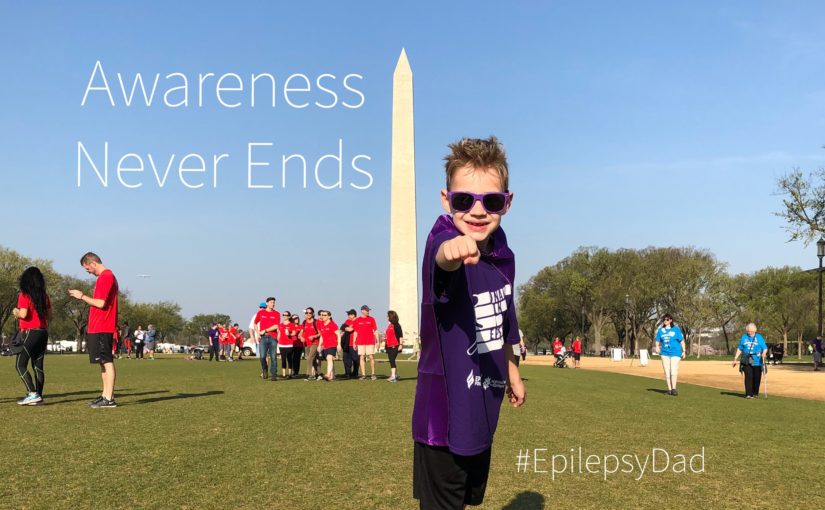
    Awareness Never Ends

    This post is part of the Epilepsy Blog Relay™, which will run from June 1 to June 30, 2018.  Follow along!


    We sat at a large, round table in the special education classroom with half of us seated uncomfortably in child-sized plastic chairs. My wife, our advocate, and I sat on one end of the table. The district’s lawyer, psychologist and special education coordinator, the school’s principal and special education teacher, my son’s second-grade teacher, and his aide filled the remaining seats.

    We were reviewing my son’s IEP that had just been approved. After two years of providing our own DIY education for our son under a makeshift 504 plan, we hired a lawyer to finally get my son a formalized education plan and the protection that it affords him. It was clear as we reviewed the supporting documentation that we needed that protection because the system is not set up for children like him. It was even more clear as we reviewed his test results that they didn’t really know my son.

    They made comments about his learning without fully grasping how hard he works when he is outside their walls. They made judgments based on a few hours of testing and observation but they didn’t really understand him or what he was going through.

    When the special education teacher said that she had other kids with epilepsy, I cringed. “I had another kid with epilepsy” is like saying I’ve seen one shade of blue. The spectrum of what epilepsy is to a person is as broad as the hues and tones that make up every color imaginable.

    This wasn’t the first time that someone at my son’s school generalized epilepsy. The one-size-fits-all seizure plan hanging in the nurse’s office is another symptom of the lack of understanding around his condition. Sometimes, having a little knowledge and convincing yourself that you know everything about something is worse than having no knowledge at all. So we did what we always do and explained how epilepsy is different for everyone and how it affects our son specifically.

    We know that won’t be the last time we need to provide that explanation because awareness never ends.

    There will always be a new school year.

    A new teacher.

    A new aide.

    A new babysitter.

    A new parent.

    A new doctor.

    A new nurse.

    A new coach.

    A new team.

    A new boss.

    A new colleague.

    A new friend.

    Every time a new person comes into our lives, it is an opportunity to help them understand my son. It’s an opportunity to help them understand epilepsy from the perspective of a child and a family living it every day.

    It is not always easy. It’s not easy to retell the story of how epilepsy tried to take our son. It’s not easy to describe how hard he has to work every day or to explain how epilepsy is more than just seizures. But every time we do it, we create understanding. It makes the world around my son a bit more accepting of him and his condition. And, I hope, it creates a bit more understanding in the world for other children like him.


    NEXT UP: Be sure to check out the next post by Clair at http://www.epilepsybumps.com/.

    TWITTER CHAT: Save the date for the  #LivingWellChat on June 30 at 7PM ET.

  • Lessons From The Field

    Lessons From The Field

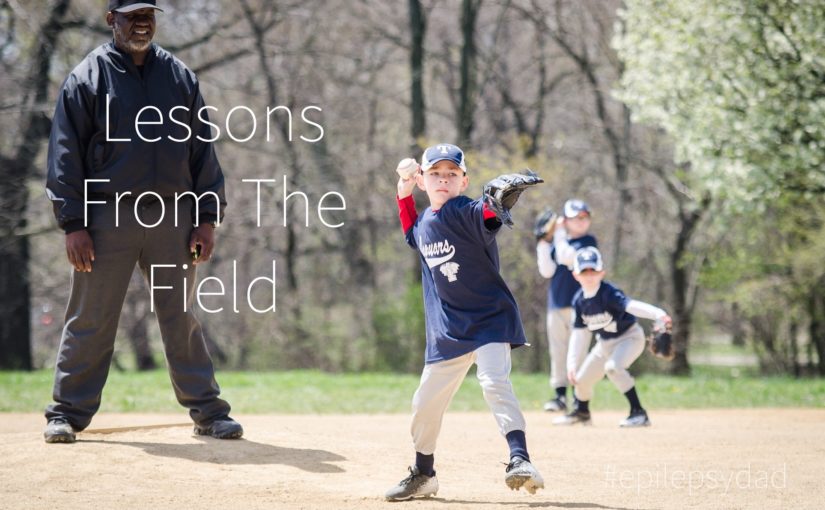
    The welcome arrival of Spring brings with it sunshine, warmer weather, and baseball. Last season was incredibly special for my son and our family because of the team we were on and the experiences that my son had. At a time when my son desperately needed something to hold on to and an outlet of his own, he found it in baseball.

    This season, we are on a new team but there is no reason to think his experience will be any different. We’re fortunate to be reunited with coaches who knew my son from when I coached him and the coaches’ daughter in tee-ball a few years ago. When we reached out to them to give them background on my son, they already knew about him and welcomed him wholly.

    Baseball has been good for my son. It provides him with an opportunity to be around other children, to have fun, and to get better at something that he enjoys. It has been good for me, too, by giving me opportunities to step back and let my son have his own experiences, his own successes and failures, and to let him figure out from those experiences who he is and who he wants to become.

    Last weekend, my son had a chance to pitch for the first time. He was excited. I was terrified. My brain immediately went to what could go wrong. His throwing accuracy is not the best. I was worried that he would be embarrassed. I was worried that he would walk everyone. I was worried that he would lose the lead and that his teammates and coaches would be disappointed. I was worried that he would like it but wouldn’t be asked to do it again.

    Before the inning started, I took him to the side to get him warmed up. He wasn’t great, but he wasn’t terrible. Then they called him up. As I walked him back to the field, I flooded him with instruction and advice. He threw a few more warm-up pitches with the coach and seemed to do ok, but I held my breath as the first batter came to the plate.

    The thing about my son is that he likes to play the part. He’ll see a movie of a baseball player and add the drama and flourishes to what he is doing, even if it’s not appropriate for his situation. On the pitcher’s mound, he looks towards first as if he is going to pick off the runner, not understanding that in his league, the players have to stay on the bag anyway. While he is on a base, he’ll crouch way down like the player did in the Jackie Robinson movie, even though it’s not practical to run from that position. I get frustrated because I think he could do a much better job if he could just focus on the task even though many times he simply can’t. But then he also might not have as much fun.

    On the mound, he threw a few strikes but a lot of balls. He walked a lot of batters and hit one. I could see him start acting instead of following his steps. I tried to get him to settle down before I realized I was likely making it worse. My frustration and anxiety were bubbling up as I watched our sizable lead shrink. The coach was finally able to put in a different pitcher and I started to think about the conversation I would have to have with my son. Should we talk about not playing the part and just focusing on doing his steps? Should we talk about how they may not ask him to pitch again? Should we talk about how he can do better?

    When the inning was over, my son ran off the field with a big smile on his face. “Did you have fun?”, I asked. “That was amazing,” he said.

    After the game, my son and I played catch. He threw the ball right to me every time. I asked him what was different between throwing the ball to me and pitching and he said that when he was pitching, he was nervous because everyone was watching him. I realized that I was so focused on the mechanics of pitching and trying to get him to stay out of his head that I didn’t think to check in with how he was feeling going up to the mound for the first time. I was so focused on my anxiety and my frustrations that I didn’t ask about and acknowledge his.

    It’s hard. It’s hard to step back and to not be the “helicopter dad” always trying to protect him or to keep him on task. I do it with the best intentions. I want to protect him. I want to help him with the challenges his condition and the side effects of his medicine bring to his life. I felt like he needed me to do those things to function in the world, but deep down I know that it’s holding him back. He needs to be able to figure it out without me because I won’t always be here. And he needs to feel like he can do it by himself and for himself so that he develops confidence and a sense of worth. He simply can’t do that if I’m always trying to do it for him.

    On the way home, I asked if he wanted to pitch again and he said “absolutely.” The coaches agreed. Because where I saw anxiety and fear and failure, they saw an amazing kid do something that he had never done before with joy in his heart and a smile on his face. They didn’t expect him to do it perfectly his first time because they know that he’ll get better with experience. They just wanted him to have fun doing it. Once I got through my own baggage, I figured out that so did I.

  • National Walk For Epilepsy 2018

    National Walk For Epilepsy 2018

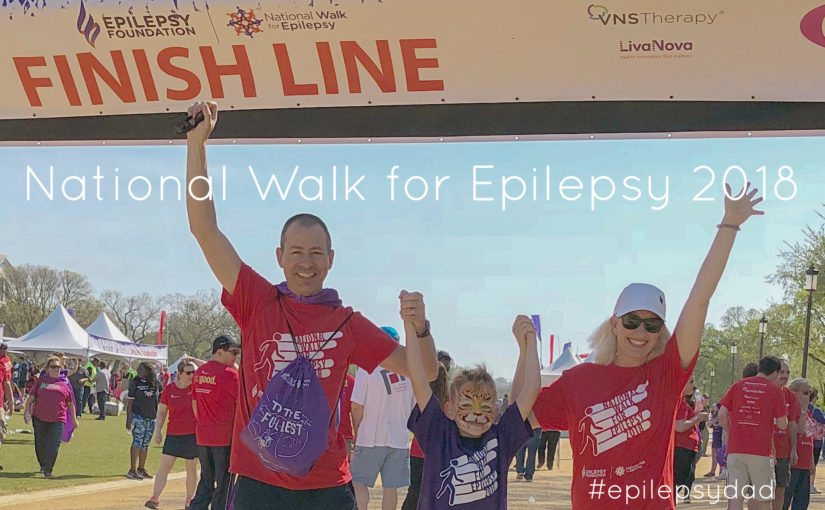
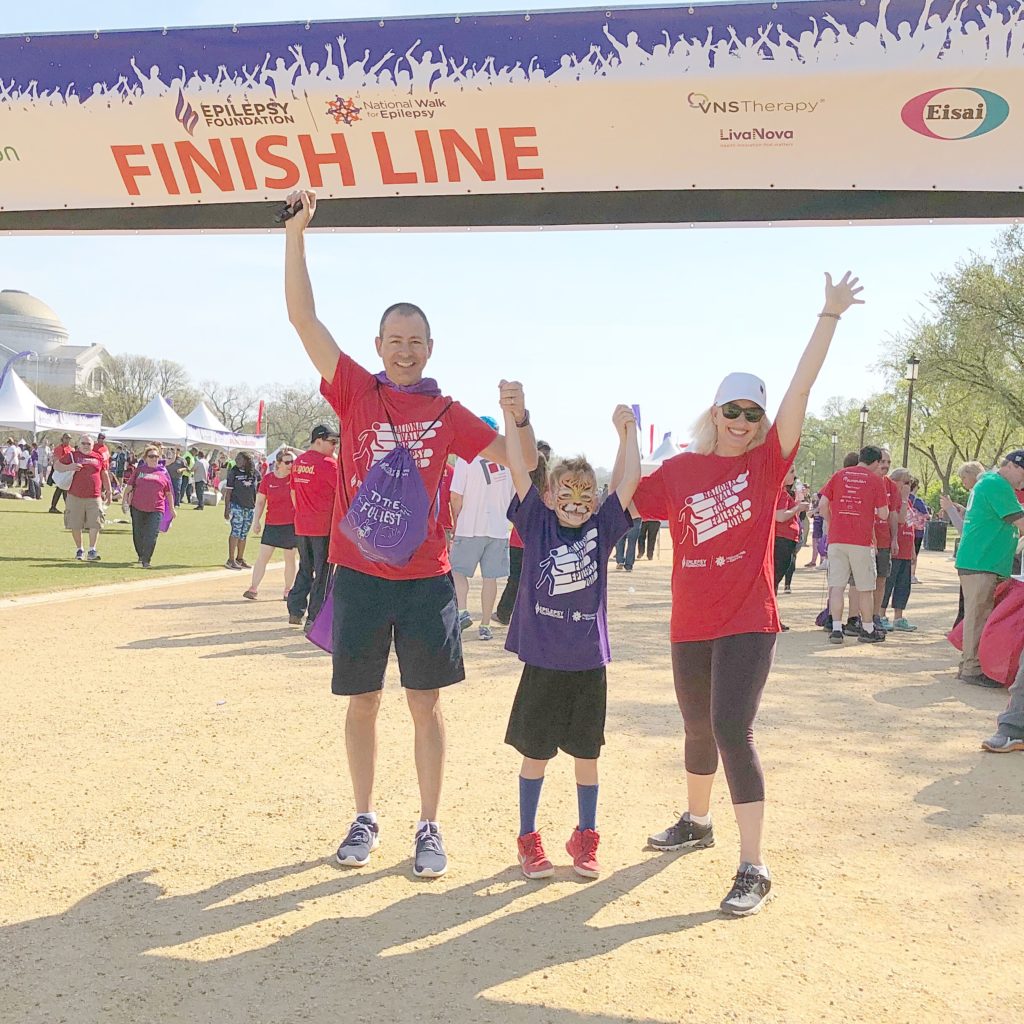
    Last weekend, we participated in the Epilepsy Foundation National Walk for Epilepsy in Washington, D.C. It was so different from the first time we attended two years ago. That year, we were only a few months in to our diagnosis and had only recently gotten out of the hospital. We were physically and emotionally drained and couldn’t even complete the shorter “fun course”. While it should have been comforting, I felt overwhelmed to being surrounded by so many people supporting a cause that we knew little about and were thrust in to.

    This year was a completely different experience. We knew other people at the walk. We met some online friends in person for the first time. We saw people from our local Epilepsy Foundation affiliate. And there was a sense that this really was our community of people trying to make life better for my son and other’s like him.

    It was a lot for my son to take in, too. He was excited when we got there, but the more people we talked to and the more he was exposed to the energy around him, we could see him start to shut down. Right before we started the walk, he slipped in to his “wonky place.” His eyes glazed over and he tried to run away, but I help him and sat with him long enough for him to calm down. He reluctantly started the walk, and I could feel that we were teetering on the edge of a full meltdown. But a quarter of the way in, we passed the Washington Monument that he recognized from the Spider-Man: Homecoming movie. I started talking about the movie and, a few minutes later, he started engaging in the conversation and I could see the tension leave his body. By the end of the walk, he was sprinting across the finish line to officially complete our first National Walk.


    National Walk For Epilepsy 2018

    If you haven’t done either the National Walk or an event from your local Epilepsy  Foundation affiliate, I encourage you to try it. The first one might be overwhelming, but it’s important to know that there are others like you out there, and that there are people and companies that are working hard to improve the quality of life for people living with epilepsy. We are involved with the Epilepsy Foundation of Eastern Pennsylvania, so if you live in that area, you’ll know at least one family at the event, which can make it easier. But if you don’t, go to at least one event and you’ll start building those connections to other families and it can turn a sometimes isolating condition in to one of community. You are not alone.