Tag: parenting

  • Tapped

    Tapped

    My son does this thing where the muscles in his face loosen. His cheeks look chubbier as they drape softly down to his jaw. His mouth separates a little, and I can see the tip of his tongue pushing through. Sometimes he’ll swallow slowly, which at the same time seems automatic but also like it takes all of his concentration and energy.

    That is one of the signs we see that lets us know when he is tapped.

    There are other signs, too. He has an even harder time with his executive functioning and memory than he normally does. It’s more difficult for him to regulate his emotions. He gets angry and frustrated. But that look on his face is the look of someone who has given everything they can for the day. It’s how we know he’s done.

    This isn’t something that only happens occasionally.

    It happens every day.

    There are days when it happens sooner, usually around this point of the school year or when we did such things after a baseball game. There are days when it happens later, like on a lazy weekend. And there are days when it happens more than once, usually once before and then later on after a nap. But it always happens. Every day. Every day, my son gives everything to get through the day.

    Every day, my son gets tapped.

    The other day, I sat on the edge of the bed with my son and studied his face as he leaned against his pillow, watching his iPad. I tried to be present with him. I asked him what it felt like and if there was anything I could do for him, but even asking a question forces him to try to muster enough energy to think and respond. He’s such a good kid that, even tapped, he tried to find enough energy to process my question and think of an answer. It felt cruel. I felt terrible. And so I didn’t ask any more questions, and I sat with him and rubbed his head and let him tune out.

    Unless you knew him, you wouldn’t know that anything was going on. He might just look like a tired kid. Its invisible nature is one of the many curses of epilepsy. His doctors, who have seen the same in other patients as they see in my son, understand it. But it’s harder to convey to others because they don’t know him and because they don’t have a reference for that level of exhaustion.

    “Imagine climbing a mountain. Now, imagine if everything you did felt like climbing a mountain. Now, imagine if that is what you felt like every day. “

    Every day, my son climbs that mountain. Every night, he falls asleep only to find himself back at the base of the mountain when he wakes up. Then he starts to climb again. He pushes, he grinds, he stumbles, he gives everything he can until his body, and his brain can’t do anymore.

    Every. Day.

    He’s eleven years old.

  • The Long Plateau

    The Long Plateau

    We are standing on a plateau.

    For the past few years, my son’s condition has remained the same. He still seizes almost every day. He’s still on a handful of medication multiple times a day and the ketogenic diet. He still struggles in school and navigating relationships with his peers.

    I should be grateful that he hasn’t gotten worse.

    The beginning of our journey with epilepsy was the equivalent to falling off a cliff. We went from a normal childhood to fighting for his life in the matter of months. We went from school and friends to hospitals and doctors and nurses and therapists. We went from playing hockey to being toxic on medication and needing to be carried to the bathroom. Back then, I would have longed for things to stay the same.

    Once he was stabilized, we spent the next few years trying to rebuild what he’d lost. Progress was agonizingly slow, especially as we discovered more pieces of him that could not be rebuilt. We stumbled every time we pretended that things were ever going to be like they were before. While we were no longer falling, the slope of ascent was so gradual that it was hard to tell if anything was getting better.

    Eventually, some things did get better. There were fewer seizures, confined mostly to the early morning. He graduated from a handful of therapies. He stepped foot in school again. Some things did get better, but not back to where he was before that first seizure. And not any further.

    Are we really plateauing or does it just feel that way? Are we doing everything we can to keep making progress or, like a person trying to lose weight, are we giving the appearance of doing everything but secretly skipping workouts or sneaking in extra calories? Or have we truly reached our limit of progress?

    Years ago, when the direction of my son’s condition turned around, every day probably felt this way. I wondered whether things were as good as they would get, much like I’m doing now. I wondered if we were doing everything we could and whether we we doing everything right. I looked for someone to blame rather than accepting the reality of the situation. Because it’s impossible to believe that, no matter what you do, things will never be what you though they were going to be.

    The longer things stay the same, the more I forget how far we’ve come. The more that “this is it” feeling takes over. The longer I sit in that feeling, the harder it is to hold on to hope for better.

    And this plateau feels so long.

  • A Boy’s Journey

    A Boy’s Journey

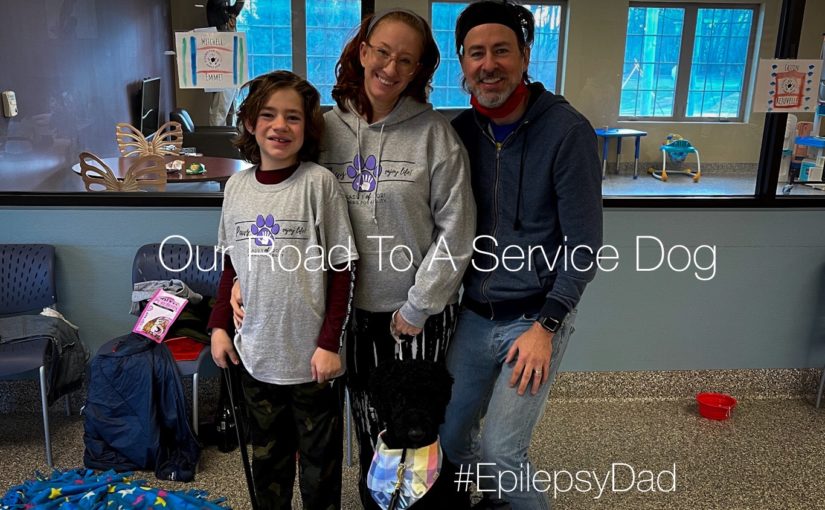
    During the first few weeks of January, we traveled to Xenia, Ohio, to meet our son’s service dog, Emmet. It was a meeting more than two years in the making.

    I’m going to try a few new things this year, so I thought I’d share the first part of a video from our trip.

    I also want to thank our generous friends and family who contributed to our fundraising campaign that made this possible. I am so grateful and humbled to have met and be surrounded by so many amazing people.

    If you would like more information on service and service dogs for children, please check out 4 Paws For Ability.

    Please subscribe to our YouTube channel here EpilepsyDad on YouTube!

  • Maine 2.0

    Maine 2.0

    For the second time during the pandemic, we’ve run away to Maine.

    I’m starting this post on our first morning in the cabin. My son is at the dining room table, doing virtual school with my wife. The fog is starting to lift, and I can see out the window through the trees and across the secluded cove of fresh seawater that salts the air.

    It’s surreal. Many years ago, my wife and I talked about living a more nomadic life, traveling around and doing work and school wherever we happened to find ourselves. I would work in a kitchen somewhere in Europe, and we’d drink wine and play music at night. Back then, I cooked more adventurously, and we drank, and we played more music.

    But over the last few years, the practical part of me that optimizes for safety and comfort, when given a choice between planning that future or turning it into only a dream, chose the latter. I needed a job with good insurance. We needed to be near a hospital and a pharmacy. My son needed special accommodations at school. In a world with unpredictable seizures, changing medications, and endless speed bumps, we needed stability anywhere we could find it.

    Over the years, as my son’s condition started to normalize, even if not stabilize, we’ve started to venture out further. At first, it was back to Colorado or Florida, places where we always had the security of friends and family around us. We’d go for a week at a time to the Poconos, still only a few hours drive back to the city and its services.

    Our first big trip was to Hawaii, where we stayed for almost two weeks. Even though we were with friends, it was the first time since the seizures began that I felt like we were disconnected from the constant watch and care of our safety net. Sure, there were seizures on the plane and in the hotel and on the beach, but we embraced the adventure.

    The next big trip was to Panama. Again, we went with friends, but this time we spent part of our time deep in the mountains away from any major city, and the other part on an equally isolated island. There were seizures on the plane, and in the mountains, and on the island. But I felt even more disconnected there but still safe.

    When the pandemic started and we knew that I was going to be working remotely for the foreseeable future, we decided to pack up and head to Maine for a month. It was just us in a small house in a remote town along the ocean, but I felt like we were actually living in another place. The seizures followed us there, too, but I was working, my son continued his school work with his tutor, and my wife was writing and working. We visited the grocery store, cooked, found a pizza place we liked, and continued our lives, just in a different place. Now, we’re doing it again.

    I don’t know if that truly nomadic lifestyle will ever be in the cards for us. I hope to embrace more working from home, assuming working from an office is ever a thing again. But that voice in my head is also whispering words like stability, and doctors, and pharmacy. It’s telling me that the world is going to get back to normal, and that a job requires an office to go to, and that we need the safety of benefits and insurance.

    But it is in those moments where maybe I need to remember where we’ve been. More so, I need to look around at where we are right now. And maybe I should step outside and go for a walk and reconnect with being disconnected. And be open to a different future where everything is still possible.


  • There Is No Blue Wire

    There Is No Blue Wire

    We don’t really know how long our son was in status epilepticus.

    We had moved to a new city only six months before, around the time when my son had his first seizure. He had his second a few months later, which lit a fuse inside his brain. We started to see more “ticks”. I didn’t think anything about them, at first, because they looked very different from the seizures we saw. But he started having more of them. The fuse was burning and it was quickly reaching the explosives.

    In movies, when a hero defuses a bomb, it’s very dramatic. She’s on the radio with the experts who are talking her through the process.

    “Take off the cover.”

    Our hero unscrews the cover, exposing a spaghetti of wires. “Done,” she says. “I see the wires.”

    “Now, “ a voice says through her earpiece, “carefully trace the wires back to their source. You should see a control board with a power source.”

    Our hero uses the back of her hand to wipe the sweat from her brow. She squints her eyes as she uses the screwdriver to carefully push wires out of the way to reveal a circuit board with a series of glowing lights.

    “Done. I see the board, ” she confirms.

    “Ok, coming off the back of the board you should see a red wire and a blue wire. You need to cut the blue wire.”

    Our here slowly grabs the wire cutters from her pocket. In her left hand, she uses the screwdriver to push back the wires further. As she starts to weave the wire cutters into position with her right hand, she stops.

    In movies, when a hero defuses a bomb, there is a blue wire. In our story, there was no blue wire. The spark ignited. The bomb exploded.

    Inside my son’s brain, an uncontrollable chain reaction began and sent electricity coursing through every cell. His body contorted. He was disoriented. He slept. The cycle repeated for days as another team of doctors tried to contain the secondary effects of detonation, like stopping the spread of radiation after Chernobyl.

    While the doctors managed to prevent the worst possible outcome, the damage was done both from the seizures and the tactics employed to put out the electrical storm. We’re still dealing with those consequences years later. But our son is here, and he’s happy, and we are grateful.