I read about a hundred books a year. Most of them are audiobooks, which I get for free through the local library. It’s one of those habits that has been with me since I was young, the library as a place, the books as company. My goddaughter is also a reader, and a few months ago we got her a library card. Usually she reserves books online and I pick them up on my way back from school drop-off. But occasionally we’ll go together to browse.
(more…)Tag: family
-
Nothing, Again
A few years ago, we did genetic testing for the first time. An exome sequencing — not the full genome, but a significant portion of it. They found a variation in the PRICKLE1 gene, which is associated with epilepsy. It looked like it might be something.
It wasn’t.
(more…) -
The Tallest One
The tape measure at CVS didn’t start at zero.
I noticed it when the person measuring him announced a number that was clearly too high. He looked at me with the kind of satisfaction that doesn’t invite scrutiny, so I let it sit for a minute. But the tape was mounted too high on the wall, and the math was off, and eventually I had to say something.
We agreed to wait for an official measurement.
This was February of last year, ahead of a basketball physical. He was close. We both knew he was close. But close wasn’t the same as over, and the CVS number didn’t count.
A few weeks later, at CHOP for a follow-up, the nurse measured him the right way. He looked at me while she did the math. When she read the number back, he was under six feet. Just under, but under. He gave me a face. Not devastated, just pouty. The face of someone who had been robbed of something they were owed.
“I’m sorry, pal,” I said.
We kept tracking it. Every appointment, every person who checked us in got some version of the story whether they wanted it or not. The fractions kept moving. 5’11” became 5’11” and a half, and then more. Every measurement got reported back to me with the same energy a stock trader uses when the market moves in their direction.
Then, at an allergy appointment, the person checking us in measured him on the way in. She did the math. She read the number back.
Over six feet.
He looked at me. “Yeeeeessss, finally!”
She got the short version of the story whether she wanted it or not.
Later, when the allergy nurse came in — she knew us, knew we’d been tracking this — she asked how he was doing. He didn’t mention allergies.
“I’m finally taller than my dad,” he said. “I’m the tallest one in the family.”
I was genuinely happy for him. I was also aware that I would be hearing about this for the rest of my life.
I was right.
The Stanley Cup came first. His Avalanche beat my Lightning in 2022, 7-0, in a game we went to together. He brings it up with the consistency of someone running a scheduled maintenance check. It never gets old for him. It will never get old for him.
Then the height. Then the Fortnite digs. And then a few weeks ago, a new one arrived. He started calling me “my old man.” Probably picked it up from a video or a show, tried it out, saw me laugh, and filed it away as a working bit. Now it comes out regularly, deployed with the confidence of someone who has found a reliable tool and intends to use it.
He does this. He latches onto things that land and keeps going back to them, past the point where most people would move on. I recognize it. I was the same way as a kid, running a joke into the ground because I’d found something that worked and didn’t want to let it go. For me, eventually, necessity taught me to improvise. To read the room and shift. For him, finding something that works and holding onto it might be doing different work. Generating new material on the fly is its own kind of skill, and it doesn’t come easily for everyone.
So he keeps the inventory. The Stanley Cup. The height. The old man. The Fortnite digs.
My response, when he runs through the list, is always the same.
“You’re taller, better looking, and younger. I get it.”
He considers this.
“And better at Fortnite,” he adds.
He’s not wrong about most of it. And he knows I know that. That’s the part he likes best. Not just winning, but winning with my acknowledgment. The scoreboard only counts if the other person can see it.
I can see it.
He’s the tallest one in the family. He’ll remind me if I forget.
I don’t mind. He’s earned every inch of it.
-
Breaking Patterns
I was watching an episode of The Bear when Uncle Lee says to Carmy, “Sometimes, to break patterns, you gotta… break patterns, man.”
It’s not elegant advice. It doesn’t offer steps or insight. It just states something obvious in a way that feels almost frustratingly circular.
But it stayed with me.
Patterns don’t dissolve because we understand them. They don’t disappear because we can trace them back to childhood or point to the moment they formed. Understanding can make them visible. It can make them easier to name. But visibility alone doesn’t interrupt anything.
Interruption does.
And interruption feels unnatural.
So many of the patterns I carry were modeled long before I could evaluate them. Anger that arrived before curiosity. Distance that felt safer than vulnerability. Silence where emotion should have been spoken. Martyrdom that passed as responsibility. Staying small to keep the peace. Doing everything so no one else had to.
None of it felt intentional. It felt structural. It felt like the way adults move through the world. When something is modeled consistently enough, it stops feeling optional, even if it doesn’t feel good.
And then caregiving arrives, and those patterns get louder.
When your child has seizures, when medications have to be managed precisely, when unpredictability is part of the week, over-functioning feels righteous. Absorbing everything feels responsible. Martyrdom can pass as love. Doing more than is sustainable can look like devotion.
That’s the part that’s hardest to untangle.
Some of those patterns were built for survival. Over time, some of them quietly become what exhausts you.
Breaking one doesn’t feel freeing at first. It feels destabilizing.
If I don’t absorb the tension, who will? If I don’t over-function, what happens? If I don’t step in, does everything fall apart? If I stop being the martyr, am I selfish?
Those questions don’t arrive calmly. They show up as reflex. The body moves before the mind catches up. The old script begins to run.
And the only way to break that pattern is to break it.
Not by announcing it. Not by explaining it. But by behaving differently in the moment that used to be automatic.
By not escalating. By not withdrawing. By not stepping in immediately when someone asks for something I am no longer responsible for carrying. By letting discomfort sit without rushing to smooth it over.
It doesn’t feel noble. Sometimes it feels cold. Sometimes it feels like I’m betraying the dependable version of myself that kept everything moving for so long.
But repetition built the pattern. Repetition is what will undo it.
Some patterns I have already loosened without realizing it. I don’t shut down the way I used to. I don’t flare the way I was shown. I don’t disappear when things get hard.
Other patterns are still active. I feel them when I’m pulled toward old roles. When I want to fix what isn’t mine to fix. When being needed feels safer than being equal. When doing more feels easier than drawing a boundary.
It’s uncomfortable to interrupt that instinct. It feels like stepping off familiar ground. But familiar and healthy are not the same thing.
I know there are patterns I haven’t seen yet. The ones so embedded they feel like personality instead of inheritance. Those will surface in time. I’m not finished.
Breaking patterns isn’t a declaration. It’s a practice. It’s noticing the reflex and choosing a different response. It’s tolerating the silence that follows. It’s accepting that not every relationship survives change. It’s trusting that steadiness doesn’t require self-erasure.
Sometimes, to break patterns, you really do have to break patterns.
There isn’t a softer route around it.
You interrupt. You tolerate the discomfort. You repeat.
Slowly, what once felt inevitable begins to feel optional.
That’s where the change lives.
-
The Water Level: Disability and Technology
When driving comes up, I tense.
It doesn’t happen every time, but when we’re with other families and someone mentions permits or practice drives or the freedom of having a new driver in the house, something tightens in me. I watch my son. He doesn’t say anything. He just goes quiet and waits for the conversation to move somewhere else. I usually help it along.
I don’t know exactly what he’s thinking in those moments. I don’t ask. Maybe it’s nothing. Maybe it’s everything. But I was in that exam room when his neurologist answered his question about driving, and I know what “probably not” sounds like when it lands.
His friends are getting permits. He’s watching that happen from the outside, the way he watches a lot of things.
I think about his future more than I let on to him. I think about medications they haven’t discovered yet. Therapies. Devices. I think about his independence — what it might look like, what it might require. Autonomous vehicles have been part of that thought for a while. Not as a certainty, just as a possibility worth holding onto. So when I came across a podcast recently about autonomous vehicles and what they might mean for people who can’t drive, I expected something that confirmed what I’d been quietly hoping. Instead it pulled in two directions at once.
The first part was about job displacement — the ways AI is already eliminating work, particularly at the lower end. Automation moving through the kinds of jobs that don’t require a degree or specialized training. The ones with structure and repetition. Then the second half shifted to autonomous vehicles and the disabled community. The argument was straightforward: people who can’t drive because of a medical condition, a physical limitation, age — autonomous vehicles could give them something they don’t currently have. Independence. The ability to get somewhere on their own.
And then someone in the episode pointed out that the disabled community was being used to make the case for technology that primarily serves other interests. That the promise of accessibility was real but also convenient. I don’t know where the truth lands on that. Probably somewhere uncomfortable.
My son is sixteen. He wants to be a hockey player or a streamer. Neither is straightforward. Hockey as a player isn’t realistic, though being involved in the sport in some other way might be possible someday. Streaming is something he genuinely enjoys, but it requires consistency, memory, sequencing — things that are hard for him right now, harder than they look from the outside. He has dreams the way any teenager has dreams. He just has more walls. And the jobs most likely to be within reach for him — the ones with structure, repetition, and the right support in place — are the same ones that automation is already eliminating.
I’ve worked in AI for more than a decade. I use it every day. The work it’s making easier is white collar work — the kind that requires education, executive function, the ability to synthesize and decide. The jobs it’s eliminating are the ones that could work for him.
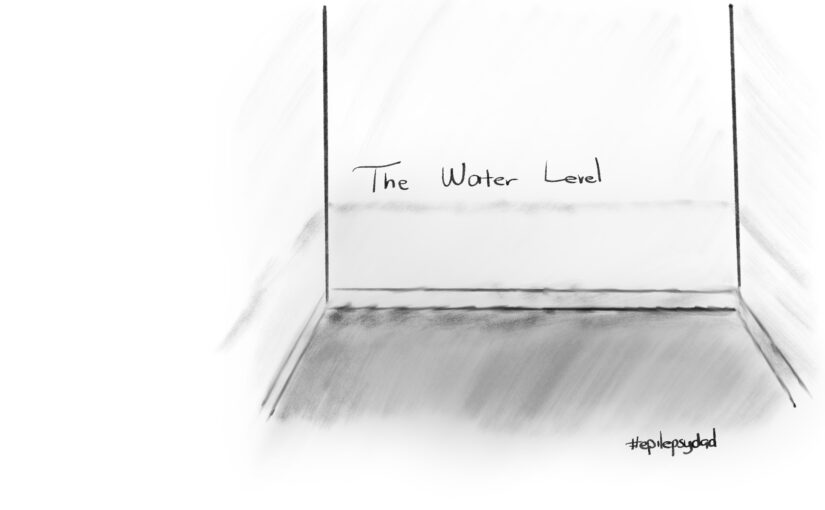
The water level keeps rising. He’s already underwater.
That’s the part I can’t think my way out of. Autonomous vehicles might eventually give him a way to get to a job on his own. That would matter. That would be real. But if the job itself has been replaced by the time the technology arrives, the independence doesn’t have anywhere to go.
I don’t know how to hold both of those things. I’m not sure I’m supposed to yet.
What I keep coming back to is that exam room. His neurologist exhaled before she answered. My son sat there and took it without flinching. Part of him probably already knew. Part of him was hoping for a different answer.
He’s been doing that his whole life — absorbing the gap between what other kids have and what’s available to him. Sitting quietly while the conversation moves on. Waiting.
I don’t know what the world looks like when he’s thirty. I don’t know which promises will have been kept and which ones will have turned out to be convenient. I don’t know if the door that technology seems to be opening will still be open, or what will be on the other side of it if it is.
I just know he’s sitting with questions he shouldn’t have to sit with at sixteen.
And I know what it looks like when he goes quiet.
I also wrote about this topic from a different angle on davidmonnerat.com, where I explore the structural side of the question — who technology is built for, who it displaces, and why those two groups are often the same people. You can read that piece here: The Other Hand: AI, Disability, and the Cost of Progress.