Category: parenting

  • Making the Invisisible Visible

    Making the Invisisible Visible

    One of the challenges of navigating the world as a special needs parent is finding the time to manage caregiving responsibilities while still maintaining a sense of self. In our family, no one knows this more than my wife.

    Before we moved to Pennsylvania, my wife ran a successful musical theater school in Colorado. When the opportunity came up to relocate for my job, she was ready to start something somewhere new, so we jumped at the chance. Within six months of moving, however, our son was admitted to the hospital in status where he would spend the next few months.

    Even after he was out of the hospital, there were continuing health and behavioral issues, as well as endless appointments. My wife became the primary caregiver so I could go to work, which meant she struggled to find time for herself and had no time to pursue her next opportunity.

    Occasionally, my wife would try to start a small music class, but the unpredictability of our son’s condition made it impossible to maintain a routine. Classes became random private lessons, but it wasn’t what we hoped for her when we made the move.

    Months became years. As the number of appointments declined, her focus shifted to fighting for the services he needed at school and finding other ways to help him reacclimate to the world. There weren’t fewer things to do as his medical condition stabilized; there were just different things to do.

    Epilepsy is sometimes called an “invisible disability” because it doesn’t present external characteristics. Unless you spent time with our son, you wouldn’t know how his condition impacts his thinking, memory, or activities.

    The same label extends to my wife and to many caregivers of children like our son. You wouldn’t know by looking at her what she gave up or the emotional and physical challenges she has had to endure caring for our son. She literally kept him alive, fought for his services, found the right doctors, and spoke up when she knew something wasn’t right. She gave of herself to give him the life he had when there were times we weren’t sure he would have a life at all.

    I continue to be in awe of her. In addition to what she did for our son, she fights through her own health and emotional issues. In spite of that, she published a children’s book last year (it’s amazing, you should get a copy!) and joined a band (they’re amazing, you should see a show!).

    I wanted to time this post for Mother’s Day to make the invisible visible and thank my wife for everything she has done for our son and family. I am also incredibly grateful not only for what she did for our son but for what she has done to help me be a better father, husband, and human.

  • Be Curious

    Be Curious

    Curiosity is one of my favorite character traits. I had a boss who would assign traits to different people to focus on when we interviewed candidates, and I always took curiosity.

    One reason is that, for a role like mine, curiosity is an often overlooked characteristic that directly impacts whether someone will be successful or not. The other is that I am a curious person myself. One of my social media taglines is “endlessly curious,” which is why I am also taking a drawing class and French lessons.

    I would ask questions in my interviews to elicit a person’s curiosity. What was the last thing you wanted to learn about? Why did you want to learn about it? What did you do to learn about it? What did you find out? Why was that the topic you shared? The best answer I received was from a candidate who had less experience than other candidates but was so passionately curious about the subject matter and asking the best questions that we ended up running over our time. He got the job.

    It’s easier to be curious about a topic than about a person. Even a complicated topic is easier to understand than a complex person. It takes curiosity on our part and an openness to share on the other’s part. It takes willingness on both sides to be vulnerable, which can be terrifying. But the reward for being vulnerable and for being curious is a deeper understanding. It’s the difference between dismissing someone at first glance and building a connection. It’s the difference between being invisible and being seen.

    There’s a great scene about being curious and the perils of not being curious from Ted Lasso where Ted plays darts with Rupert, the narcissistic ex-husband of Rebecca, his boss, friend, and the team’s manager.

    Asking questions and being curious is the key to understanding our world. And it’s the key to us understanding each other. We don’t know what other people have going on in their lives, but we make judgments anyway.

    I think about how this applies to my son and how people judge him without asking questions, without being curious about him, without knowing about him, without understanding who he is and what he endures every day to be a part of the world. They see someone who is different. An outsider. Without being curious, they will underestimate him. They won’t see his kindness, his bravery, or his heart. And that’s their loss. But it’s a good reminder for all of us.

    Be curious, not judgemental.

  • We All Have Needs

    We All Have Needs

    We need joy as we need air.
    We need love as we need water.
    We need each other as we need the earth we share.

    Maya Angelou

    In psychology, Maslow’s Hierarchy of Needs depicts a five-tiered model of human needs: physiological, safety, love/belonging, esteem, and self-actualization. It’s often depicted as a pyramid with the idea that lower-level needs must be satisfied before higher-order needs can be fulfilled.

    Source: https://en.wikipedia.org/wiki/Maslow%27s_hierarchy_of_needs

    Growing up, my physiological needs were largely met. I had food, drink, and shelter. I was clothed with the finest sneakers from the grocery store and mismatched Underoos from Goodwill.

    The next level, safety, is about order, predictability, and control. There wasn’t much of this in my childhood. I grew up in a different time, surrounded by a system that still believed in corporal punishment and people who were angry, frustrated, and mean. The lack of control, the fear of being punished, and the unpredictability of my environment made it impossible to feel safe.

    If I was sad or scared and expressed my needs through crying, I never knew if I would be comforted, ignored, or told, “I’ll give you something to cry about.” The people around me couldn’t handle their feelings; mine were often too much, inconvenient, or wrong.

    My safety level was never fully satisfied, so there was little hope for anything above that. My desire for love and belongingness conflicted with my need for safety, especially within my family. This is especially common with children and why people cling to abusive parents or partners. I had friends but never friendships, and giving and receiving love was confusing and dangerous.

    Esteem is about the desire to be accepted and valued by others. It’s hard to feel worthy when you don’t feel like you belong, and it’s impossible to achieve self-actualization, the top level of needs, when you don’t believe you have any potential to become anything of significance.

    Over the years, I tried many ways to make my needs important to have them met. I would put other’s needs above my own and do my best to satisfy them in hopes that they would do the same in return, but the people I surrounded myself with were only interested in having their needs met. If I did find someone willing to consider my needs, my programming reminded me that it was dangerous and that they wouldn’t be met anyway, so it would be better not to express them to avoid disappointment. I had a therapist who once told me that in a healthy relationship, there is room on the shelf for both persons’ needs, but I operated as if there was only room for one, and the needs on the shelf weren’t mine.

    I’ve seen more and more how I interact with the world determines how my son interacts with the world. Whether it’s his desire to show his mother he loves her by heading straight to the flower section when we go to the grocery store or his unfortunate habit of not knowing when to stop a joke, I see what I do in him. I also know how the things that I don’t do but should do are absent from his behaviors.

    I think about the example I am setting for my son. Even if he didn’t have special needs, I would want him to feel comfortable putting his needs out there and being surrounded by people who are willing and capable of meeting them. He deserves to know what a healthy relationship is and feel like an equal partner in these relationships rather than unworthy or afraid like I did. The reality is that he does have special needs, and he will be more dependent on others and will most likely be less able to navigate the world alone.

    Change is hard, but there are so many ways in which our journey has already made me a better husband, better father, and better role model for my son. He already has the biggest heart and is sensitive to the needs of the people around him. I want to ensure he knows his needs are just as important and that he is worthy of having them met, too.

  • We All Need Help Sometimes

    We All Need Help Sometimes

    Growing up with a busy, single mother and a rebellious, angry sister, I was used to not having help when I needed it, even when I asked for it. Eventually, I learned to internalize my struggle and figure out a solution. Externally, I looked like a clever, self-sufficient boy. Internally, I questioned whether I could depend on anyone for help or whether I was worthy of being helped at all.

    That early programming stayed with me all my life and served me. The truth was that I was a clever boy, and I could figure things out. Those skills helped me navigate my childhood and transition to adulthood and a successful career. I was low-maintenance, a quick learner, hard-working, and productive.

    That’s not to say that I never had help. Throughout my life, I’ve had many good teachers, bosses, and friends who were generous with their guidance and assistance. But I rarely asked for it, and when it was freely given, it often made me feel uncomfortable and that there was something wrong with me because I couldn’t do it by myself. Receiving help made me feel ashamed. That shame motivated me to need less help in the future. That made me a better employee and resulted in more opportunities. I had it all figured out.

    In the words of Marshall Goldsmith, ‘What got you here won’t get you there.”

    In hindsight, the pseudo-reward cycle between shame and progress is neither healthy nor sustainable. No one can do everything and solve every problem, and that’s not a sign of weakness—it’s reality.

    Nowhere was that more evident than when our son was first diagnosed with epilepsy. And I don’t mean medically. I could not have done what the doctors, nurses, therapists, and support staff did to keep our son alive and put him back together during the first few years.

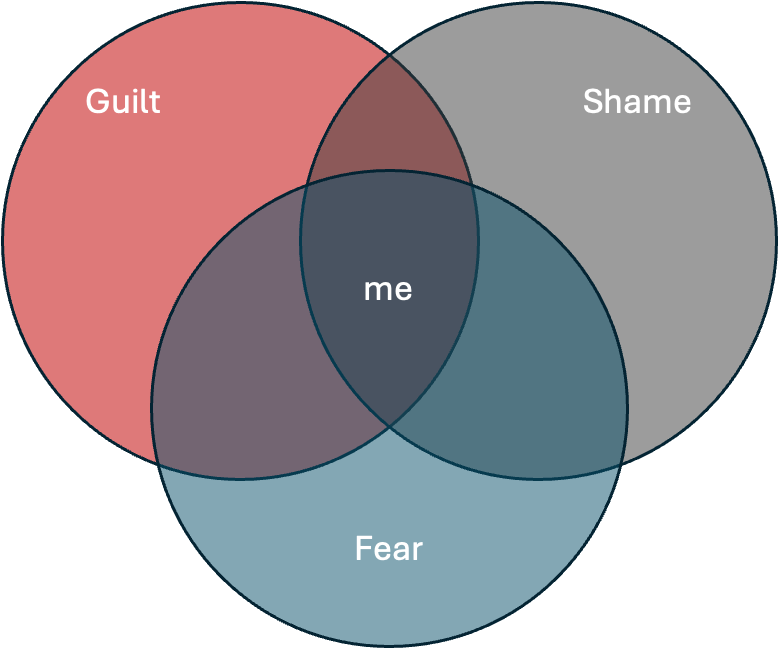
    There were other areas where I needed help, but rather than ask for it, I, again, internalized those needs. I needed to be strong and carry on. I could take care of my fears on my own. I could deal with the stress those years put on my marriage and still focus on my career. The more I realized I wasn’t doing any of those things, the more shame I felt and the more I turned inwards.

    That cycle didn’t only affect me; internalizing it also distanced me from my family, especially from my wife. Not only was she dealing with everything I was, but she bore the brunt of the load and was the target of our son’s outbursts and anger. She also saw what was happening to me and was unable to help because I couldn’t let her.

    That led to many hard years. When I finally sought help, it was almost too late. A family can only take so much before it crumbles.

    That help came through therapy. That help came from an incredible wife and partner. That help is why our son and family are where we are today. It showed me that asking for help is not a weakness, that I am worthy of being helped, and that there are people who I can depend on for help.

    It also helped me realize that people want to help. Being vulnerable and asking for and accepting help brings people closer. I’ve seen that in my relationship with my wife and hope to instill that behavior in our son. He’s going to need help as he navigates his life and I want him to know that asking for it is okay, that there are people who he can depend on to help, and that he is worthy of being helped.

    Like every change, it’s a journey. I still have a lot of programming to unravel. I’m better at asking for and accepting help at home than in other environments, like work. But it feels like I am on the right path.

  • And

    And

    “And? And is just one word. How is that helpful?”

    Monnerat, K. (2022). And. kettlepot press.

    I had to look up how to do a proper book citation for the quote above. You may notice that the author’s last name looks familiar. Hint: it’s also my last name. That’s because the author is my wife, Kerri.

    A few years ago, she published And, a book about feelings, friendship, grace, and permission to feel multiple, conflicting feelings all at once. The book won a BookFest Award in 2023 and received positive reviews and comments about the impact of the story and the powerful three-letter word.

    As with many impactful books, And is drawn from the years of experience my wife had teaching children and her journey as the mother of a child with special needs. It’s also a word and idea we live by in our home that helps us navigate and have a common language for the complex and sometimes conflicting feelings we experience every day.

    A very common example in our house is when my son is doing something, whether a school performance or a baseball game, and he is feeling nervous and excited. This situation comes up so often that my son, who likes to make up words, created the portmanteau “nervou-cited,” and we use that as shorthand for talking about his feelings in those situations.

    We have had many conversations where someone will interject, “That’s an and.” We can be talking about a situation at work or the state of the world. The conversation can be about the dogs or our relationship with another person or family member. The reminder that we don’t need to force these experiences to have one emotion by dismissing the others is a truer representation of how we should be navigating the world and reduces the urge to focus only on the negative emotion or to try to force ourselves only to let ourselves feel the positive emotion.

    The reality is that being a father is stressful and joyous. Being a special needs dad is scary and rewarding. A project at work is challenging and impactful. An upcoming presentation brings nervousness and excitement… nervou-citement.

    By giving ourselves permission to feel multiple emotions at once, we can better navigate the complexities of life in a more honest, more effective way by dealing with everything we are feeling, not just the one emotion we think we should feel or the one that feels bigger.

    In recognition that 1 in 26 people will develop epilepsy in their lifetime, get 26% off your order with the code EPILEPSYDADBLOG when you order directly from kettlepot press.