Category: lifestyle

  • Traveling With The Ketogenic Diet

    Traveling With The Ketogenic Diet

    My son has always been a good traveler. When we lived in Colorado, we would visit our families in Florida and California, flying across the country a few times a year. When my son was old enough to have his own seat, he decided to take mine at the window, relegating me to the middle seat. After nearly every flight, he tells me that I can have the window seat “next time”, only to change his mind when we get in line to board the next plane.

    epilepsy dad traveling keto ketogenic diet epilepsy

    As good a traveler as he is, it’s still stressful traveling with a child. Getting out of the house, to the airport, through security, and seated on the plane without forgetting a toy or a favorite blanket (or a child) can be a daunting task, no matter how well we prepare the night or the week before. Those people who travel with more than one child should automatically earn a merit badge. That’s a level of legendary coordination, preparation, and timing that I’ve only read about in books and saw scratched on the back of a stall door in the airport restroom.


    The more we traveled, though, the more the experience went from a general feeling of panic to more of a controlled chaos. We figured out what preparations we could do the night before and how early we wanted to be at the airport so that there was no praying that we are able to drop our bags off in time or pushing a stroller in full sprint to the gate. Worst case, we make it through security with enough time to hit the restroom before boarding the plane. Best case, we can also grab a lunch and a magazine for the plane. Usually, we wind up somewhere in between, which as far as traveling with children is concerned is pretty much the sweet spot.

    epilepsy dad traveling keto ketogenic diet epilepsy

    This year, another variable was added to complicate our travel, and that was the ketogenic diet for our son’s epilepsy. The ketogenic (or keto) diet is a high-fat, low carb diet that has been shown to have positive benefits for kids with difficult-to-control seizures.  The diet requires a specific fat-to-everything-else ratio, and each ingredient must be measured to a tenth of a gram. The sources of fat for the diet are butter, mayonnaise, or oil, each of which present challenges when traveling by plane. For example, mayo and butter are both perishable and need to be refrigerated. Mayonnaise and oil are liquids according to the TSA and fall under the 3 ounce rule.

    Our son, as well as many other “keto kids”, prefers to take his fat as an oil chaser with his meal. This allows him to eat “normal” food without having to incorporate butter or mayo in everything, but of the three sources of fat, oil is the one least likely to be found inside an airport terminal. We may be able to find a packet of mayonnaise or a pat of butter in a sandwich shop, but any oil that we find will be suspect in terms of purity, and there shouldn’t be a lot of guessing when it comes to the diet since a possible outcome of a bad fat ratio is a seizure.

    Since we’ve been on the diet, we’ve made a number of trips and we’re getting better at accommodating the diet in our travels, so I wanted to pass along some insight for those of you that are just starting the diet or are concerned about traveling while on the ketogenic diet.

    Pack Snacks For The Plane

    Typically, we’ll measure and pack the food the night before the trip. Travelers are allowed to food through the security checkpoint, so we will pack a lunch and a snack. For the fat exchanges, since our son prefers oil, we use the [easyazon_link identifier=”B000WKNW2Q” locale=”US” tag=”lightningbuddha-20″]Medela Breastmilk Containers (2.7 Ounce)[/easyazon_link] bottles. They seal well and, at 2.7 ounces, they are under the TSA 3 ounce rule but provide enough capacity to hold more than a meal’s worth of oil. Since different meals might have different amounts of oil, each container gets labeled and paired with the associated food, and we might pack an extra oil in case we get delayed and need to rely on airport terminal food.

    When using mayonnaise instead of oil, the prepackaged [easyazon_link identifier=”B00HZAJHR0″ locale=”US” tag=”lightningbuddha-20″]Hellmann’s Mayo Packets[/easyazon_link] are a great option. Treat them as liquids going through TSA, but since they are sealed, they won’t spoil sitting out on a long delay on the runway. You may be able to score some of these inside a restaurant in the terminal, too.

    In every case, weigh the food before you get on the plan. For the scale to work, it needs to be on a flat, level surface, which is impossible at 35,000 feet.

    Pack The Scale And Ketogenic Guide In Carry-On

    We pack our scale and ketogenic manuals in our carry on. Both get used for every meal, so whether it’s because of an extra long flight delay or a forgotten lunch, the scale, manual, and an open shop or restaurant are all we need to get food for our son at the airport. Never pack these items in checked bags.

    Use TSA Pre-Check

    One of the best investments we made recently was to get both my wife and I signed up for TSA Pre-Check. For $85, we can now use the TSA Pre-Check line, which means we don’t have to take off our shoes, or take our liquids or laptops out of our bags. Less disassembly on the front end means less reassembly on the back end, and it makes the whole security screening process less stressful. In order for both of us to go through the Pre-Check line, both of us needed to apply for the program, so keep that in mind.

    You Can Travel While On The Ketogenic Diet

    Finally, I wanted to let you know that you can still travel while on the ketogenic diet. The keto diet brings with it a lot of lifestyle changes. Dining out, birthday parties, and playdates all require special considerations for food. One of my fears before starting the diet was that we wouldn’t be able to travel. Where would our son eat? What would he eat? The answer is easy. Ever place we travel to will have food.  If we aren’t staying with friends or family, we’ll book a hotel that has a kitchen, which gives us more options to prepare food ourselves and in advance. But even without the kitchen or a refrigerator, we bring our scale and keto guide, buy a bottle of canola oil which doesn’t need to be refrigerated and we’re set to jet.

    I hope these tips help. If you have any travel tips that you would like to share, please do so in the comments.

    Happy travels!


  • The First Day Of Kindergarten

    The First Day Of Kindergarten

    Last week, we had another happy milestone: the first day of kindergarten.

    epilepsy seizure first day of kindergarten

    The week before, my wife, son, and I went in to meet his teacher for the first time. I left work and met my wife and son at the school…a big, square, old building with dark bricks and small windows. We walked through the tired playground, past the worn jungle gym, and up to the entrance in the back. I pulled the heavy door open, a door that showed much more wear up close, and we entered the lobby. The door landed heavy against the frame as it closed behind us, echoing against the painted cinder block walls of the empty school. We entered the front office to sign in. The dim fluorescent lights that hung overhead did little to brighten the dark brown walls and dark wooden furniture.

    In Colorado, our son was in a new charter school, where everything was freshly painted, where the walls and the books and the toys were new and clean. When we came out to Philadelphia, he started in a bilingual French school that was small and tucked away on the first level of an office building, but that school was also relatively new. Those schools were everything that this school, an inner city public school, was not. But this school had one important thing going for it. It had the services that our son needed.

    Our teacher came in to greet us in the office and brought us to her classroom. The special education teacher, who my wife had also spoken to on the phone, came to join us, as well. After a few minutes, the conversation went from pleasantries to epilepsy and our son’s history, and we could see his teacher start to tense up. She obviously didn’t get the message that my wife had sent giving her a heads-up, and she was slowly being squeezed by the overwhelming pressure that one of her twenty-eight students had such significant issues. Twenty eight kids with only one aide is daunting enough.

    I took our son to the shelves of heavily used books and read while my wife filled in more of the story for the teachers.  We’re sensitive to have too many of those conversations while our son is listening. He could probably recite his history by himself, but there have been too many days when his epilepsy history is the only conversation people have about him, and it’s usually about him but not with him.

    After a length discussion, his teacher looked less like she was ready to run away, and that was our cue to return. With the one-on-one assistance request, the shortened school day, and the other medical accommodations explained, and I led my son back to her desk. He reintroduced himself to his teacher, and she spent the next few minutes testing him on his kindergarten readiness…numbers, shapes, and letters. The overachiever, he read more letters and counted higher than she had asked him, although in all honesty, it was most likely because he has a hard time following directions, not because he was showing off. But she smiled and said that he was more than ready to start kindergarten.

    When she said those words, it was hard to not be emotional. Since we moved to Philadelphia and since his seizures started, my son had probably only gone to school for a few months, scattered out around the times when he wasn’t seizing, or too sick, or in the hospital. He hadn’t gone long enough to develop many bonds, or to just be around other kids, or people who weren’t his parents or a doctor or nurse. In that moment, when his teacher said those words, there was hope…something that was so hard to hold on to in the last year. But here it was, back again, filling the room and my heart with possibility.

    The night before his first day, my son was as excited as I had seen him in a while. We packed his clothes, supplies, and a keto lunch. Rightfully so, it took him longer to fall asleep, but he finally did and we weren’t far behind.

    When he got up the next day, I was still at home so we made a big fuss, and a sign, and took some pictures. He was still tired…I’m not sure how much he actually slept the night before.

    epilepsy seizure kindergarten

    Probably because he was so tired, he had a seizure shortly after breakfast, something that would have rocked us only a few months ago, but he quickly recovered and went right back to getting ready. I had to head in for an early meeting, but I constantly checked my phone as my wife texted me the details of the drop-off and his excitement. He didn’t have any more seizures that morning, and he had lunch and recess with his classmates.

    After recess, I was there to pick him up and take him home for his nap. As we started to leave the classroom, his teacher told the class that Junior was going home, and they all said goodbye to him as he left the classroom. “Bye,” he said. “See you tomorrow.” We headed out the door, down the dark, cinder block hallway, past the dim office, back through the heavy, brown doors and through the tired, aged playground. And the day could not have been any brighter.

    epilepsy seizure first day of kindergarten

  • Celebrate Things Big And Small

    Celebrate Things Big And Small

    Last week, we were visiting my parents in Florida. My wife and son were in the bathroom getting ready for bed when I heard my wife’s voice start to go up in a combination of nervousness and excitement before she let out a huge cheer. My son came running from the bathroom, mouth dripping with blood exclaiming “I lost my first tooth!” My wife followed, beaming, with the tooth wrapped up in tissue paper.

    I stood up and gave him a big hug. Grandma and Grandpa came in to the room and congratulated him, and we all set about making the necessary preparations for the long anticipated tradition. Grandma brought in an envelope, which my son addressed to the Tooth Fairy (with love) and slid his tiny tooth inside. He finished getting cleaned up and rushed in to bed, eager to fall asleep so that he could wake up to see the bounty that the Tooth Fairy had traded for his precious pearly white.

    epilepsy normal life seizures

    During the last year, my son has dealt with so many obstacles that most kids will never deal with, but that night he experienced something that most kids get to experience. There was no cloud of epilepsy hovering over the event, no addition of the disclaiming phrase “because he has epilepsy” that sometimes accompanies other milestones. There was just a kid, my son, mouth bloodied with his tooth in an envelope, excited about the Tooth Fairy.

    A few weeks before our trip, there was another rite of passage when my son rode his bike for the first time without training wheels. A great achievement, for sure, but amplified by the knowledge that there was a period in February when he couldn’t walk or talk, followed by months of severe ataxia where he would shake and wobble and fall. Those first ten feet of training wheel-less peddling reminded me of my agile two-year old boy zipping around our neighborhood on his balance bike, long before we had any knowledge of seizures and epilepsy and ataxia. My wife and I cheered for him as he traversed the park, found his balance, learned how to stop, and looped around trees. A couple near us that was watching him commented at how amazed they were that it was his first time. To them, he was just a normal boy out doing normal boy things. If they only knew. But for a few moments, we felt exactly the same way.

    epilepsy riding bike seizures ataxia

    There will be many challenges in my son’s life, some because of his epilepsy, some not. There will be times when even good moments will have attached to them a caveat about his condition. It’s hard, very hard, to be present in those moments and not think about the past before any of this happened, or the future and its possible limitations. But it is my responsibility and my privilege to be present, to let my son know that I am there for and with him, and to celebrate all things, big and small.

  • Easier, But Not Easy

    Easier, But Not Easy

    We’re two months in to the ketogenic diet. The doctors say that it’s working. We’ve been able to go down on meds without a significant increase in seizures, although the reduction was more due to my son being toxic on the meds rather than the gradual weaning of meds that sometimes follows the diet. But we also haven’t been admitted to the hospital in months, which admittedly is a pretty low bar.

    His behavior is better, but it’s still bad. There is less screaming, and the outbursts don’t last as long, but they still happen. And his impulse control is still nonexistent. We’ve had to add a chain lock to our front door to prevent him front running out on the street, which he did. We can still see it in his eyes, when his brain gives up on making any decision and following natural impulses that, for a 5-year-old, involve flipping, and running, and hitting.

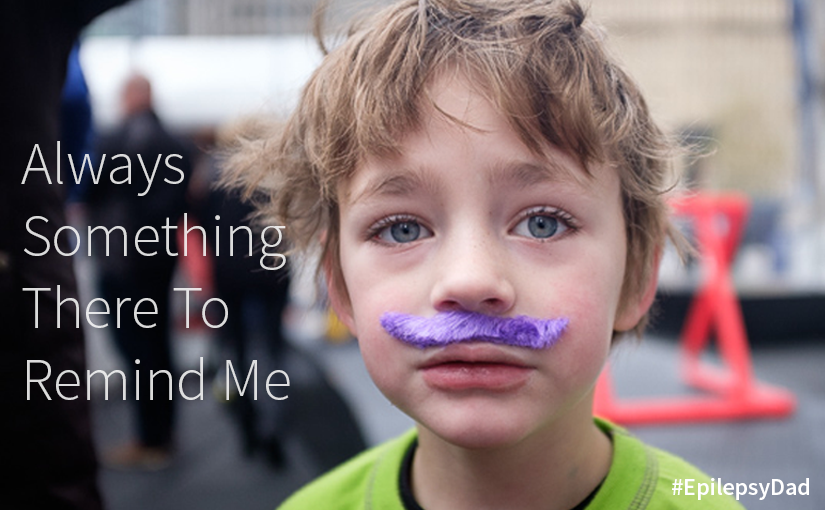
    It’s still hard to look at him and to see him struggle. It’s still hard to do something fun only to have it end with a seizure because his body gets too tired to prevent it. This picture was taken at a festival in the park next to our house. About 30 minutes after it was taken, he was on the ground having a seizure, concerned bystanders offering to help.

    easier but not easy epilepsy seizure ketogenic diet

    In the past month, we’ve gotten help to come during the day. We’re also getting additional services through the hospital and through the state. We are getting better at managing. Managing his routine. Managing his seizures. Managing his behavior. The help and structure have made the day-to-day easier.

    Easier, but not easy.

    Like I imagine so many other families are dealing with, epilepsy has its own gravity that forces everyone to exert much more energy to keep moving. Every step is harder to take. Everything takes longer. Even the simplest things are exhausting. I wish I could grab my wife and son, strap on some rocket boosters, and break free from the unrelenting pull of gravity, but so far, we continued to get pulled back by more seizures or other complications.

    Easier, but not easy.

    There are families that don’t get easier or easy, and I’m grateful for the progress that we have made and for the support that we continue to receive. I’m still hopeful that all this will somehow, magically go away and that we won’t talk about the year when my son was five and he had all those seizures. We’ll skip ahead from his Disney World fifth birthday party to whatever we do for him when he’s six, and forget everything in between. Short of a magic wand to make it go away, I wish I had a remote control to fast forward to that time.

    That would be easy.


  • Perfection (The Game, Not The Goal) For Fine Motor Rehab

    Perfection (The Game, Not The Goal) For Fine Motor Rehab

    During his hospital stay in February, my son had a bad reaction to one of his anti-seizure medicines and developed ataxia, which is the loss of full control of bodily movements. For two days, he couldn’t walk, or talk, or hold his head up. We had to carry him to the restroom and feed him, which was a shock considering he was ice skating only the week before. We didn’t know if this was a permanent situation or if he would ever recover.

    Fortunately, by the third day he started to move again, although he was incredibly shaky. His gross and fine motor skills were both severely impacted, and we watched through our tears to see him struggle to hold himself up or hold a spoon or form a thought. While we were still in the hospital, he started occupational therapy, physical therapy, and speech therapy to try to rebuild the skills that were damaged. By the time we left the hospital a few weeks later, he was functioning at about 50% his pre-admission level both mentally and physically.

    Since then, he has continued his rehabilitation and, while he is still wobbly and has impulse and attention difficulties, he is better than he was. The therapists at our hospital have been amazing, and they’ve incorporated games as a way to engage my son for rehab without realizing that it what he’s doing. Taking a cue from his occupational therapist, this week we’ve been playing a lot of [easyazon_link identifier=”B00CXEXSUU” locale=”US” tag=”lightningbuddha-20″]Perfection[/easyazon_link].

    epilepsy rehab ot occupational therapy perfection game ataxia

    The game helps develop two different skills. First, the fine motor control required to grab the stem of each piece and navigate the shape in to the board is challenging. I watch as he tries to twist the stem with his fingers to rotate it to fit, dropping it many times but diligently picking it back up. When he rushes or when his ataxia is worse, it’s helping him really focus on muscle control.

    Cognitively, he’s having to identify the shape and scan the board to find the match, which can be difficult because there shapes that are similar to each other. He also needs to align the shapes, so his mind has to tell his fingers which way to rotate the shape. Oh, and he’s doing it against the clock.

    For now, we set simple goals, just trying to beat his score from the last time. Sometimes he does, other times he can’t. But we encourage him to keep trying because every time he plays, he’s exercising those muscles and pathways that were damaged, which is what they need the most.

    [easyazon_infoblock align=”center” identifier=”B00CXEXSUU” locale=”US” tag=”epilepsydad-20″]