Category: lifestyle

  • Relax, It’s Just Brain Surgery

    Relax, It’s Just Brain Surgery

    At a recent appointment, our neurologist suggested deep brain stimulation for our son.

    Brain surgery.

    A recommendation for another surgery was unexpected. We had just weaned off the Onfi and were down to only two seizure medications. The switch from keto to modified Atkins proved challenging to keep his ketones up, which is shifting us to a trajectory that will place him on a normal diet for the first time in almost 10 years. Still, with those changes, we haven’t seen an increase in seizures. Considering the toll puberty has taken on his body physically and emotionally, I was grateful to be where we were.

    But we’ve been at this long enough to know it’s not just about seizure freedom. Our focus has always been on finding the balance between seizures and quality of life, since heavily medicating him never stopped the seizures but turned him into a zombie. At one point, he was on 4 medications, the ketogenic diet plus the VNS, and even then, seizures would break through. That he can go to school and learn, play baseball and video games, and have a life at all is more than we could have hoped all those years ago, watching seizures wrack his tiny body.

    We also know that our choices aren’t just about the present. We also have to think about the future, and that future includes the potential dangers that come with uncontrolled seizures and epilepsy. Our son’s condition presents similar to Lennox-Gastaut Syndrome, and with that comes an increased risk of SUDEP.

    Any options that lower his risk but still allow him to have a life are worth exploring, especially because our list of options continues to shrink. I hope for continued advancements in technology and medication; deep brain stimulation is a good example. It wasn’t an option for children with epilepsy until recently, but now it is being offered for our son.

    Which brings us back to…brain surgery.

    I’m not sure what I expected before we met with the neurosurgeon. Correction: I expected brain surgery to include opening up our son’s skull with power tools. When the surgeon explained what the surgery actually entailed, I felt a sense of relief. Other than the fact that, yes, things would be inserted into our son’s brain, it sounded similar to the VNS surgery. It also helped that the surgeon, the same surgeon who did our son’s VNS surgery, is the epitome of cool and has done the surgery enough that it sounds like he’s describing a routine task.

    I’d imagine it would be the same as a pilot describing how to land an airplane. Sure, it makes sense, but there’s enough awareness and humility on my part to know that a) I can’t do it and b) you obviously know what you’re doing, so I can relax and let you land the plane.

    I left the consultation feeling less overwhelmed and in favor of the procedure. We also talked to our son about it because he’s old enough to have an opinion about his body. He had a few basic questions but did not hesitate before agreeing to the surgery.

    And, with that, the decision has been made.

    Let’s land this plane, doc.
  • Transfer Learning

    Transfer Learning

    The sound of a seizure woke us. Normally, they only last a few seconds in the morning, but this was louder, longer, and more intense. We rushed into our son’s bedroom and saw his body rigid, his head turned, and saw the rhythmic pulses of the seizure gripping him. We held him and cleared the drool from his mouth. I grabbed the magnet for his VNS, handed it to my wife, and ran to get the rescue meds. Swiping the magnet did nothing, nor did the first dose of rescue medication. I wasn’t sure if it was because we did it wrong since this was the first time we used the nasal delivery, but we grabbed a second dose and gave it to him. A few minutes later, his body started to relax.

    I grabbed my phone so we could lay in bed with him and saw that I had a number of calls overnight. I listened to the voicemails, and they were from the assisted living facility my parents live in. My mother had a fall and was rushed to the hospital.

    I called my father, who didn’t have many more details. His memory is fading, but he knew that she had fallen and the staff had called for an ambulance.

    I called the hospital to get the details. Eventually, a nurse returned my call and said that my mother had a stroke and was recovering in the ICU.

    I checked my watch. It was only 8 AM.

    Good morning to you, too.

    My wife took care of our son so that I could go to my mother. When I got to the hospital, my body went on autopilot. This wasn’t the first time I had to rush to the hospital after receiving a call. It was a regular occurrence in the early years of my son’s epilepsy. My wife would call and let me know they were on their way to the emergency room, and I would stop what I was doing and head to the hospital to meet them.

    Walk in the door. Hand the check-in desk my driver’s license and get my visitor pass. Get the room number and directions. Hallways. Elevators. More hallways. Nurse’s station. Room.

    There is a technique in artificial intelligence called “transfer learning,” where an algorithm trained to do one task is repurposed for another related task. My hospital process trained for the children’s hospital worked perfectly. The only difference this time was that the patients I passed were adults, but the routine transferred perfectly to this new environment.

    When I saw my mother, it was very similar to the postictal state my son would be in after an intense seizure. The disconnect between the brain and the body as everything came back online caused a loss of understanding, a loss of language, and involuntary motor movements. The same patience we used with our son helped me understand that when my mother said, “I am cold,” it meant, “I want to be cold,” because she was covered in blankets.

    Throughout the day, she continued to improve, and by that evening, she was able to communicate more easily. When I returned the next morning, she was out of bed and sitting in a chair, and her language skills were much improved. Like my son, after he had a seizure, she didn’t remember many details or that I was there the entire day.

    I have a lot of practice sitting at a bedside in a hospital. I have a lot of experience watching a loved one in a scary situation. While I am grateful that the experience helps me stay present and responsible, I would much rather have experience doing almost anything else.

  • 3,128

    3,128

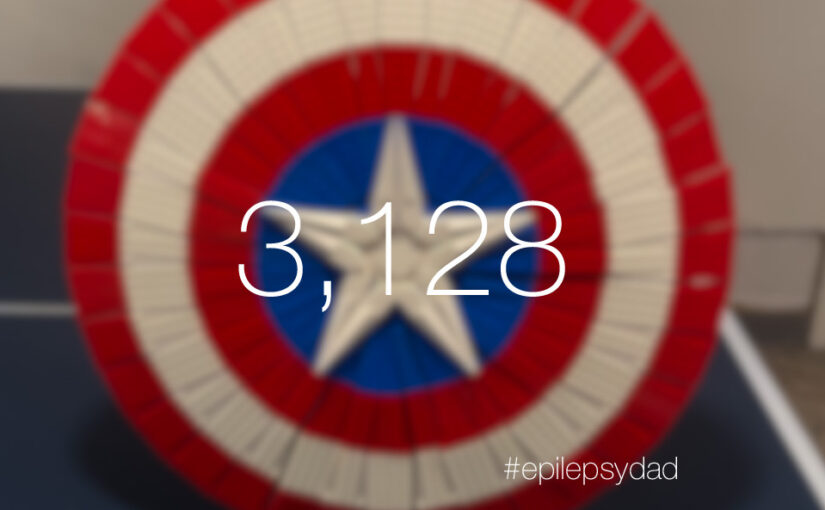
    We are almost as much a Lego family as a Marvel family, so when Lego releases a new Marvel set, it quickly finds its way into our house.

    A 3,128-piece Lego Captain America Shield had been sitting in a box in the basement for a few weeks. One day, my son casually mentioned that he was working on it, and then, a few days later, he said he had finished. He brought us down to look at it, and it was amazing. He was so proud of himself for accomplishing such a marvelous (ha!) feat.

    The next morning, I went to the basement to grab trash from work we had done. There were long metal rails supporting the old ceiling tiles that we took down, which I had bundled. I picked them up, and as I turned towards the door, I heard a crash behind me.

    I turned and saw the Captain America shield that my son had spent days making and had completed just the day before knocked over, with pieces strewn across the floor.

    My heart sank. I was devastated, thinking how devasted my son would be when he saw what happened.

    I was going to head to work after taking out the trash, but I knew I couldn’t leave before attempting to put the set back together.

    I collected the pieces and found the instructions, which were in a book that was about half an inch thick. I flipped open the pages, and it was at that moment that I realized I might be in trouble. The set was extremely complicated. I’m a pretty good engineer and skilled at figuring things out, but it took me some time to understand the construction. Square bricks making a round shape is not an intuitive concept.

    It took me more than an hour to repair what I had done. Fortunately, the broken-off segments stayed intact, and the individual pieces were easy to identify and replace. But, in scanning the instructions, I had that feeling that I sometimes get when, for as much as my son struggles, he does something like this, and it blows my mind.

    When I told my son what happened, I made a big deal about how impressed I was that he did the set all by himself. I told him how overwhelmed I was when I opened the instructions and tried to understand how the pieces fit together. Then I reminded myself of what he does when he believes he can do anything. Once I adopted that mindset, I was able to fix the shield.

    He was proud of himself, not only for accomplishing the daunting task but also for inspiring me to believe that I could do anything. He doesn’t realize that he teaches me that every day by demonstrating it time and again.

  • We All Have Needs

    We All Have Needs

    We need joy as we need air.
    We need love as we need water.
    We need each other as we need the earth we share.

    Maya Angelou

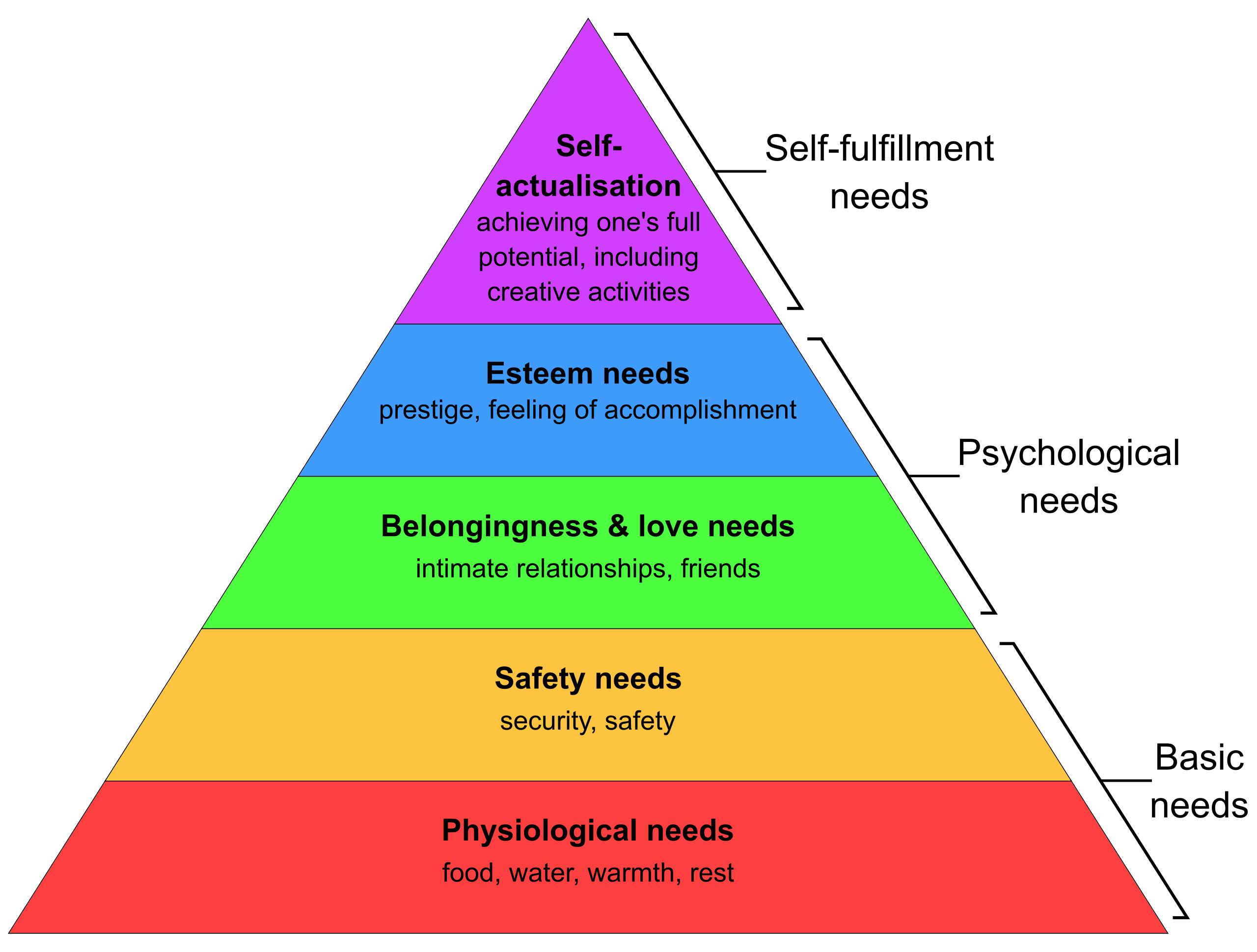
    In psychology, Maslow’s Hierarchy of Needs depicts a five-tiered model of human needs: physiological, safety, love/belonging, esteem, and self-actualization. It’s often depicted as a pyramid with the idea that lower-level needs must be satisfied before higher-order needs can be fulfilled.

    Source: https://en.wikipedia.org/wiki/Maslow%27s_hierarchy_of_needs

    Growing up, my physiological needs were largely met. I had food, drink, and shelter. I was clothed with the finest sneakers from the grocery store and mismatched Underoos from Goodwill.

    The next level, safety, is about order, predictability, and control. There wasn’t much of this in my childhood. I grew up in a different time, surrounded by a system that still believed in corporal punishment and people who were angry, frustrated, and mean. The lack of control, the fear of being punished, and the unpredictability of my environment made it impossible to feel safe.

    If I was sad or scared and expressed my needs through crying, I never knew if I would be comforted, ignored, or told, “I’ll give you something to cry about.” The people around me couldn’t handle their feelings; mine were often too much, inconvenient, or wrong.

    My safety level was never fully satisfied, so there was little hope for anything above that. My desire for love and belongingness conflicted with my need for safety, especially within my family. This is especially common with children and why people cling to abusive parents or partners. I had friends but never friendships, and giving and receiving love was confusing and dangerous.

    Esteem is about the desire to be accepted and valued by others. It’s hard to feel worthy when you don’t feel like you belong, and it’s impossible to achieve self-actualization, the top level of needs, when you don’t believe you have any potential to become anything of significance.

    Over the years, I tried many ways to make my needs important to have them met. I would put other’s needs above my own and do my best to satisfy them in hopes that they would do the same in return, but the people I surrounded myself with were only interested in having their needs met. If I did find someone willing to consider my needs, my programming reminded me that it was dangerous and that they wouldn’t be met anyway, so it would be better not to express them to avoid disappointment. I had a therapist who once told me that in a healthy relationship, there is room on the shelf for both persons’ needs, but I operated as if there was only room for one, and the needs on the shelf weren’t mine.

    I’ve seen more and more how I interact with the world determines how my son interacts with the world. Whether it’s his desire to show his mother he loves her by heading straight to the flower section when we go to the grocery store or his unfortunate habit of not knowing when to stop a joke, I see what I do in him. I also know how the things that I don’t do but should do are absent from his behaviors.

    I think about the example I am setting for my son. Even if he didn’t have special needs, I would want him to feel comfortable putting his needs out there and being surrounded by people who are willing and capable of meeting them. He deserves to know what a healthy relationship is and feel like an equal partner in these relationships rather than unworthy or afraid like I did. The reality is that he does have special needs, and he will be more dependent on others and will most likely be less able to navigate the world alone.

    Change is hard, but there are so many ways in which our journey has already made me a better husband, better father, and better role model for my son. He already has the biggest heart and is sensitive to the needs of the people around him. I want to ensure he knows his needs are just as important and that he is worthy of having them met, too.

  • And

    And

    “And? And is just one word. How is that helpful?”

    Monnerat, K. (2022). And. kettlepot press.

    I had to look up how to do a proper book citation for the quote above. You may notice that the author’s last name looks familiar. Hint: it’s also my last name. That’s because the author is my wife, Kerri.

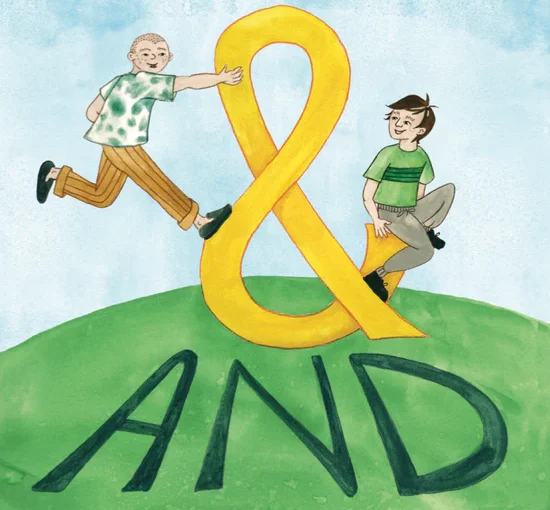
    A few years ago, she published And, a book about feelings, friendship, grace, and permission to feel multiple, conflicting feelings all at once. The book won a BookFest Award in 2023 and received positive reviews and comments about the impact of the story and the powerful three-letter word.

    As with many impactful books, And is drawn from the years of experience my wife had teaching children and her journey as the mother of a child with special needs. It’s also a word and idea we live by in our home that helps us navigate and have a common language for the complex and sometimes conflicting feelings we experience every day.

    A very common example in our house is when my son is doing something, whether a school performance or a baseball game, and he is feeling nervous and excited. This situation comes up so often that my son, who likes to make up words, created the portmanteau “nervou-cited,” and we use that as shorthand for talking about his feelings in those situations.

    We have had many conversations where someone will interject, “That’s an and.” We can be talking about a situation at work or the state of the world. The conversation can be about the dogs or our relationship with another person or family member. The reminder that we don’t need to force these experiences to have one emotion by dismissing the others is a truer representation of how we should be navigating the world and reduces the urge to focus only on the negative emotion or to try to force ourselves only to let ourselves feel the positive emotion.

    The reality is that being a father is stressful and joyous. Being a special needs dad is scary and rewarding. A project at work is challenging and impactful. An upcoming presentation brings nervousness and excitement… nervou-citement.

    By giving ourselves permission to feel multiple emotions at once, we can better navigate the complexities of life in a more honest, more effective way by dealing with everything we are feeling, not just the one emotion we think we should feel or the one that feels bigger.

    In recognition that 1 in 26 people will develop epilepsy in their lifetime, get 26% off your order with the code EPILEPSYDADBLOG when you order directly from kettlepot press.