Category: lifestyle

  • Imagine That

    Imagine That

    A few weeks ago, we went to three concerts in five days.

    The first concert was REO Speedwagon and Train. What might seem like an odd mix was incredibly entertaining. My wife also has connections with both bands. When she was little, her family stayed with the lead singer of REO for a few months in California. My mother-in-law and the lead singer’s wife were friends, and when my wife’s family needed a place to stay, they landed in the guest room of one of the hottest bands at the time. With Train, at a small show a few years ago, my wife found herself on stage singing with the band.

    Wild.

    The second concert was the following night. It was my wife’s band that she joined a few months back, and we’ve been lucky to see almost all of her shows. It’s an incredible feeling to see her back on stage where she belongs doing what she love and is so good at.

    The third concert was Imagine Dragons. Our son has wanted to see them for years, but we missed their last show in Pennsylvania. This year, they released a new album and, with that, began a new tour. This tour’s first stop was across the river in New Jersey, so we got tickets as soon as they went on sale.

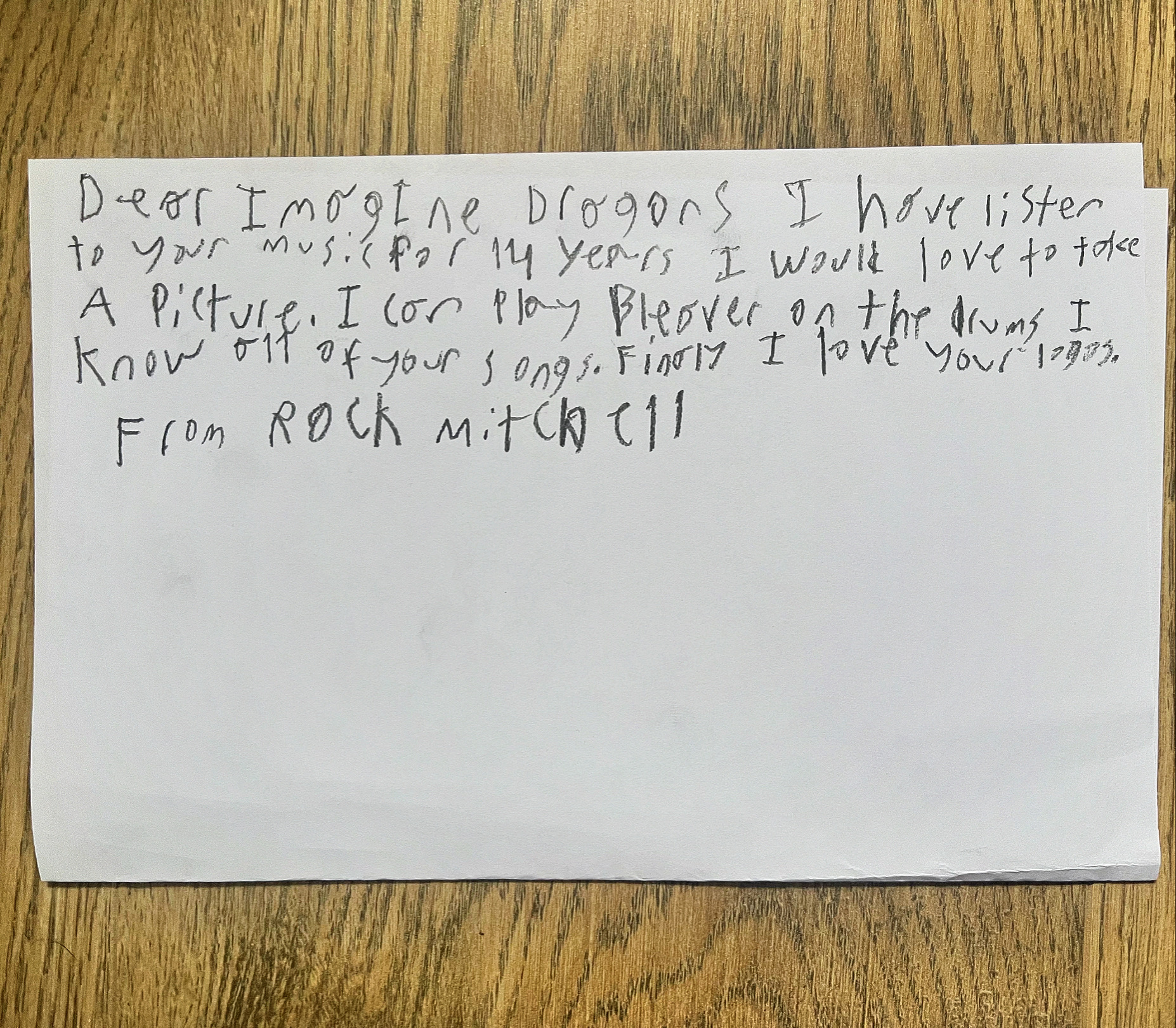
    My son counted down the months, then weeks, then days, and finally hours until the show. The day before, he wrote a letter to the band that he asked me to send to them.
    The day of the concert, we agreed to a game plan that would start as soon as we walked into the venue:

    1. Go to the merchandise table and get t-shirts.
    2. Put on t-shirts.
    3. Get food.
    4. Sit down.
    5. Eat.
    6. Rock out.

    We breezed through the first three steps and sat in our seats as the crew was changing over the stage after the opening band. The venue was packed with amazing energy, and every time one of the screens turned on, there was a surge of excitement until we collectively realized it was another commercial.

    Finally, the lights went down. The screens lit up with an image from the new album “Loom” and a recorded poem played over the speakers.

    Through distant lens, I see your shrouded form
    It carries there through some fervent storm
    Its promise neither wilt nor rapture bloom
    But only that it will not fade
    It looms…

    My son spent the first part of the show with his phone in his hand, trying to capture every moment as the band performed. I could see him taking in the experience as he sang at the top of his lungs. It was as if the band did the show just for our son, playing all of his favorite songs.
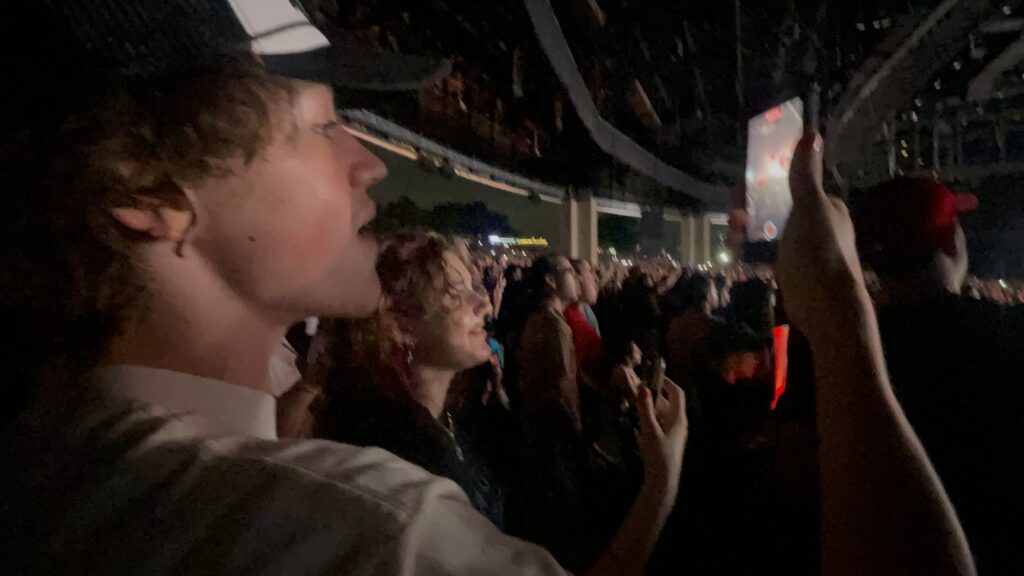
    I love watching him be so engaged and happy. With all his struggles, past and present, I am grateful that we can give him experiences like this. The looming surgery reminds me not to take the time we have for granted. As too many people know in this community, it can all end too soon.

    Of all the concerts I have seen, this was one of my favorites. Not just for the band and their performance but for the joy I saw on my son’s face. It was made even more special that we experienced it with our expanded family member, who was attending one of her first concerts. Watching the two of them sing and dance for the entire show was worth the price of admission.

  • And Then There Were Six

    And Then There Were Six

    I always imagined that I would have a bigger family. When my friends started having children, I saw the joy each baby brought into the world and wanted to fill our house with a family of our own.

    The birth of our son was one of the greatest moments in my life, even though it was also one of the scariest. A doctor’s visit turned into an emergency C-section later that day, and my first moment as a father was standing in the operating room in scrubs, clutching my camera, watching as they lifted my son from behind a privacy screen.

    That was during a SARS pandemic in the middle of a Colorado blizzard.

    Even with the dramatic start to our family, I was ready to do it again once we found our footing as new parents. But then came postpartum depression. Then came the stress and pressure placed on a new couple that barely had time being married before they became parents. Then came the seizures. Then, it was taken out of our hands with a partial hysterectomy to remove a mass.

    Everything about our plans for the future changed. Those were hard times, especially for my wife, both physically and emotionally. The idea of a big family was gone, but not having another child allowed us to focus on saving the one we did have. It also allowed us to work on healing ourselves and finding our way back to each other. The struggle and the journey led us to the amazing family we do have.

    We added our son’s service dog to our family a few years ago and another poodle to the unit last year. These additions did wonders for our son’s expressions of empathy and compassion as he learned to connect with other living creatures. Although not quite a sibling, our son still formed a close relationship with them that continues to deepen.

    This summer, we welcomed a new, if only temporary, member into our home. One of my wife’s former students, who has her own challenges, came to stay with us. While the change of environment, I think, has been beneficial for her, her presence has also had a noticeable difference for our son and our entire family.

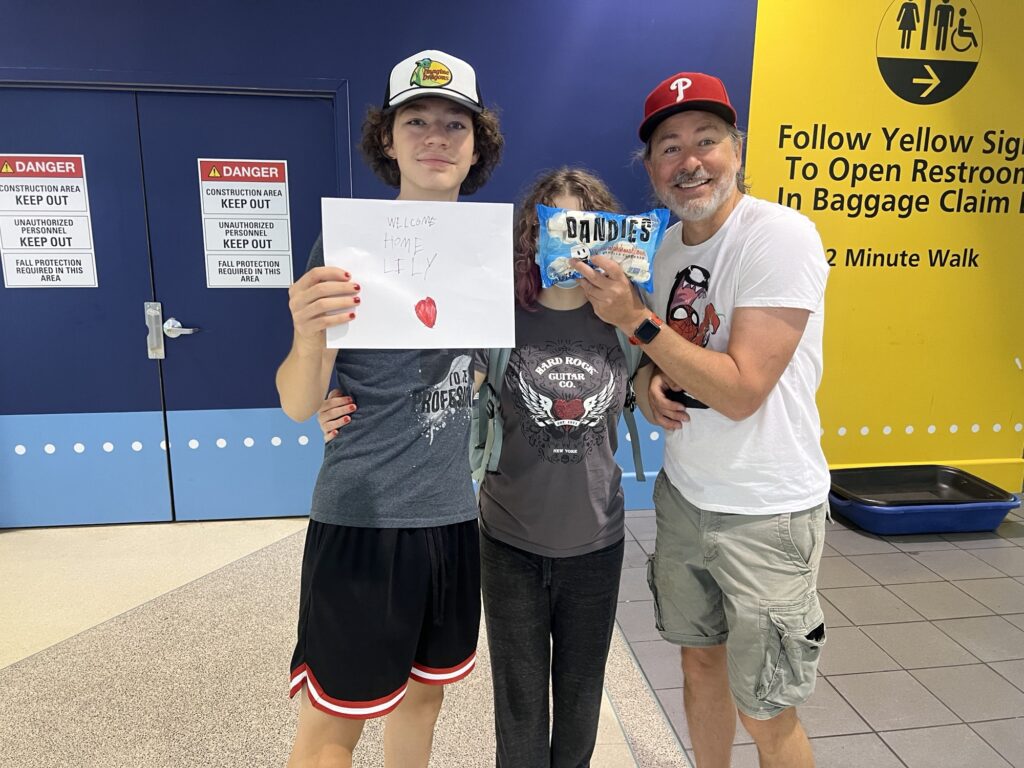
    Even before her arrival, my son was thinking of ways to make her feel at home. He helped get the house ready, created the “Welcome” sign we held when we picked her up from the airport and gave her space and attention as she adjusted to her new environment.

    She is a few years older than our son, but she understands him. They’ve found ways to interact, whether it’s playing Minecraft or chess together or her watching him play basketball or hockey in the driveway. She’s patient as he tries to explain how to shoot the ball or swing a hockey stick, giving him someone to interact with rather than being isolated on his electronics.

    Her presence was a catalyst for changes we struggled to make as a family stuck in our routines. We’re eating more meals together and having conversations at the dinner table. We’re experiencing the excitement of giving her a few firsts, or firsts in a while, going to baseball games and concerts, and including her in our family rituals.

    With the challenges our son and our family faced years ago, we couldn’t have done this then, or it would have been a much different experience. There is a reason this is happening now, both for us and for her. I’m grateful for the changes I see in our son and our expanded family.

    For however long it lasts.

  • Independence

    Independence

    Independence is happiness.

    Susan B. Anthony

    As my son has gotten older, he has been asking questions about what it means to be independent.

    My standard answer is that being independent means taking responsibility for your life and making decisions that affect you.

    Taking responsibility involves tasks such as chores, schoolwork, and personal care. It means managing time effectively and fulfilling commitments without relying too much on others.

    Decision-making means making choices about hobbies, friendships, daily schedules, and more. It’s also about understanding the consequences of your actions and making decisions that are right for you.

    Independence also involves speaking up for yourself and your needs, whether at school, home, or in social situations. It’s about expressing your opinions and standing up for your beliefs.

    As you age, your responsibility and number of decisions grow, as does your ability to cope with challenges and setbacks. This means learning from mistakes, handling stress, and bouncing back from difficulties until you can solve problems and handle situations on your own.

    We give our son opportunities as a teenager to be responsible for himself and to make decisions that affect him. But there is a limit, not only because of his age but also because of his circumstances.

    It’s not always clear what our expectations should be, now and in the future. He struggles with executive functioning and memory, both of which are important to making good decisions and remembering things like medications. His awareness, both of himself and of situations, is also a challenge. While we continue to try and improve these skills, likely, he will always need support.

    It’s important for us to normalize that being independent doesn’t mean he can’t ask for help when he needs it or that he is alone in his journey. It’s okay to need support. Being independent is about growing into his own person, making informed decisions, and taking responsibility for his life, whatever that will look like for him.

  • Executive (Dys)function

    Executive (Dys)function

    We’re probably those parents who have relied too much on technology while raising our son. Between the hospital stays, appointments, and sick days, we have spent a lot of time waiting. There have also been days where our son was too mentally or physically tired to do anything else, so we’d hand him one of our phones. Eventually, my wife and I also got bored sitting around with nothing to do. We also struggled with the reality and stresses of our complicated life and equally needed a way to escape, so we bought our son an iPad so we could disappear into our phones.

    In the beginning, leaning on technology served a purpose. It was a portable distraction that helped pass the time. By the time our son had fewer appointments and more good days, the habit of reaching for a device was automatic.

    The pandemic didn’t help. We played a lot of UNO and other board games, drawing, and finding ways to interact, but it felt like a lot of hours to fill, so we fell into our default of electronics.

    I’d often look up from my phone and see both my son and my wife firmly fixated on their devices. We were alone, together.

    As he got older, we would occasionally review his device usage to ensure he wasn’t doing anything inappropriate, but we didn’t use the parental controls or other settings to limit his access or screen time. Any time we would try, largely driven a realization that he was addicted to his devices, he would get sick or we’d find a reason why he needed his device, so we would remove the limits.

    When our son started puberty, we began to notice our son being more secretive about his device usage. When we investigated, we found that he was looking at inappropriate sites. As we looked into it, between his ADHD and issues with executive functioning, we also saw that he was having a hard time regulating and controlling his impulses.

    On more than one occasion, after we turned on parental controls, we would see a receipt for purchases he had made after disabling the “Ask to Purchase” feature. He would also bypass the content restrictions to download inappropriate apps and visit adult websites.

    Each time it happened, we’d sit down with him and have a conversation about rules and consequences. But, in many ways, it was like trying to rationalize with an addict. Worse, his struggles with attention and processing and our flexibility on the enforcement of the controls only set him up to fail. A few weeks ago, I saw another receipt for $200 worth of purchases in my inbox, including charges for apps that he knew were off-limits.

    This time, the conversation was different. We could see the struggle he was having to resist the urge to bypass the parental controls. It’s like when enough time passes and any previous consequences from the last incident has faded, his brain can’t make the right choice. The league of screen addiction, ADHD, and executive processing and decision making issues are simply too much to overcome.

    There are a number of studies detailing the impact of electronics on children, specifically as it relates to executive functioning and decision making, including “Less screen time, and more physical activity associated with executive function“, “Mobile Technology Use and Its Association With Executive Functioning in Healthy Young Adults” and “Addictive use of digital devices in young children: Associations with delay discounting, self-control and academic performance.” Many of the studies are on healthy children without the additional complexities that our son has, which can only exacerbate the impact on his developing brain.

    We tried to explain the situation to him in a way without shame by taking our responsibility for not providing more structure on his screen usage. We also let him know that these struggles are normal for children his age and that it’s our job as his parents to help him navigate this time in his life.

    Executive functioning, impulse control, and decision making are like muscles. A muscle doesn’t grow bigger unless you make it work hard, and you make this muscle work hard by having consequences, both good and bad. Historically, our negative consequences haven’t been very heavy, and that muscle hasn’t been strained. This time, we swapped in a heavy weight by taking away his devices completely for a few days. It was interesting to watch his attitude and awareness during that time, as both seemed to improve.

    When we gave him back his devices, we include time limits to help wean him off his dependence on them for entertainment and to pass time. Spending more time in the real world is where he can flex those muscles to help him continue to learn how to successfully live in the real world.

  • A Mindset Change

    A Mindset Change

    A few weeks ago, my tennis coach suggested that I switch to a two-handed backhand.

    Growing up in Florida, I have played tennis for most of my life. However, it was only a few years ago that I started taking lessons. Before that, like most kids, I just figured it out. There was no proper technique, and my swings developed organically to be serviceable enough to get the ball back over the net consistently. Even without a perfect swing, my speed allowed me to cover the court well, resulting in many years of enjoyable, semi-competitive tennis.

    My backhand was my weaker side, but my one-handed swing had a natural slice I could take advantage of by turning it into a drop shot with heavy backspin. It would be difficult for my opponent to react when I hit that shot, especially if they were further back on the court. The downside, however, was that I didn’t have a powerful, controlled backhand to push my opponent, meaning if I didn’t hit the drop shot, they could usually return it.

    After a few years of working on my one-handed backhand, I had improved the power and control and reduced the amount of slice, but the lifetime of muscle memory continued to creep into my swing. Rather than continue fighting against that programming, my coach suggested I try something completely different.

    Switching to the two-handed backhand was like starting from scratch. The grip on the racquet was completely different. My body position and the angle at which I approached the ball changed, and initially, I couldn’t hit the ball cleanly. I would be too close to or too far from the ball, and it would make contact with the frame or neck of the racquet. When I made contact, I launched it off the court or into the net. It felt as if I had never played tennis before.

    After a few minutes, the ball started to carry over the net and land in the court. At first, it seemed random, but then more and more balls landed in. Although not perfect, I had a usable new two-handed backhand by the end of that lesson.

    After years of working on my previous backhand, it seemed strange to make so much progress so quickly. It’s not that my old swing hadn’t improved with the effort, but progress was slow because so much energy was spent unlearning bad habits, which added friction to the process. But with a completely different swing, I had no bad habits to unlearn. I could focus on building something new rather than bending the old way of doing things.

    It is difficult to know when to try to improve what isn’t working or when to stop and try something new. The old way is familiar and comfortable, even if it’s not working. It often feels like an epiphany is right around the corner that will get you over the hump. The sense of progress and a breakthrough always around the corner can be a trap that keeps you on a slow backroad when there is a highway that can get you to your destination faster.

    Part of the mindset change is picking the right destination. When I started, my goal seemed to be improving my existing backhand, but that prescribes a specific solution and limits other possibilities. Instead, my goal should have been to become a better tennis player. That simple mindset change opened up other options to help me reach my goal, including the option to throw away my old backhand and learn a completely new one. That approach took me out of my comfort zone and off those familiar backroads, but I can still see my destination ahead of me, and I’m getting there much faster on the highway.

    The same mindset change works in other environments, too. At work, there are often solutions looking for problems or the wrong problems being chased. Especially when the solution is prescribed by a person of influence, it can be hard to get an organization to stop and consider a change in mindset. Successful companies can ask the right questions and adjust their course.

    The ability to adjust course is also important at home, especially with a child with special needs. Forcing my son to use traditional methods to improve his academics didn’t work, especially if the goal was to have him be successful in a traditional environment. Even if he was making incremental progress with those methods, it was a backroad to a destination we would likely never reach. Instead, exploring other approaches led us to find a school tailored to unique learners, and taking a different approach dramatically improved his reading, comprehension, and math.

    Of course, it’s not always that easy. My son loves hockey and has a personal goal to make it into the NHL, but his physical limitations make that an impossibility, at least as a player. It’s unlikely that any mindset change will give him the balance and stamina he needs to become a proficient skater and player. However, there are many ways to be involved in the NHL, such as as a trainer, coach, or other support staff. There are also ways to play hockey that don’t involve skating, such as ball hockey. In that case, a mindset change helps focus on an achievable destination and opens up a world of options to help reach it.

    If you change the way you look at things, the things you look at change.

    Wayne Dyer