Author: Dave

  • Neurodefender: Video Games and Epilepsy

    Neurodefender: Video Games and Epilepsy

    My first video game console was an Atari 2600 that my sister and I received for Christmas when I was eight.1 It was magical to toggle the switchbox and have an arcade on my television screen. Within a few months, I had a collection of cartridges. Pitfall, Pac-Man, Donkey Kong. I even had that horrible E.T. game. But Space Invaders was my favorite game, and my mother’s boss and I had a friendly competition every time we visited his family.

    I usually won.

    As I got older, I became very interested in computers. My first computer was a Mattel (yes, that Mattel) Aquarius, one of the shortest-lived computers ever to go to market. It had a Tron game that I played constantly, even though I had never seen the movie. But it was the ability to program on the Aquarius that got me hooked and, for a long time, my world revolved around computers and my gaming followed suit.

    My first online games were on a computer. That was back before there were high-powered consoles connected to the internet. I’m talking the days of dial-up modems. I would spend hours playing an air combat game with a classmate, but I was obsessed with the text-based fantasy role playing game Gemstone on GEnie, an early online service. It was a massively multiplayer online role-playing game (MMORPG) that connected people across the country in a virtual world. Eventually, I moved on to more graphical games like the World of Warcraft, but the ability to connect with other people in these worlds was life-changing and even turned into friendships in the real world. One of my groomsmen at my wedding was someone whom I had originally met in an online game.

    My son developed a love for video games at an early age. We had a Wii and loved to play baseball and, especially, bowling. I have videos of him running circles around the house after getting a strike, a huge smile on his face emitting an excited giggle.

    As he got older, we began to play video games together, especially sport games like hockey. We’d adjust the settings to give him an edge, and I’d occasionally have to pull my goalie and allow him to score to keep the game close, but it was a fun way to spend time together doing something that we both enjoyed.

    Eventually, of course, I stopped pulling my goalie and boosting his settings because he got better. Today, he wins more games than me. The grasshopper has become the teacher. And we’ve expanded to other games. We finished the Halo series, one of my all-time favorites. We played MarioKart every night during the pandemic to get three stars on every course. Today, we play Fortnite and Rocket League together, with an occasional session of Minecraft mixed in.

    But I’m not the only one he plays with. This era of powerful PCs and consoles with fast internet has opened up the world and allowed him to play with his friends. He has a friend in Connecticut who plays a baseball video game with him. And he hops on Fortnite after school to play with a few of his friends. Through them, he’s met other friends and he has a little network of gamers. Especially over the summer, it’s helped him stay connected as many families travel and it’s been harder to connect with summer schedules.

    In this world of gamers streaming on platforms like Twitch, he has decided that it is the career he wants to pursue. Whether or not that is a viable path for him, it has been a great way for him to explore many aspects of a traditional career: schedules, consistency, marketing, and engagement. He learns by watching other streamers and then practices engaging with his audience, describing his actions and thought process as he navigates a challenge. He loves to teach the “noobs”2 how to get started and basic tactics and tips.

    As a technologist and a gamer, it’s been fascinating to see how far gaming technology has come. For my son, it’s become a way to connect, express himself, and find his place in a world that hasn’t always made that easy. Watching him game, teach, laugh, and grow through this medium is beyond anything I could have imagined.

    If you want to see what he’s building—and maybe learn a thing or two yourself—you can check out his Twitch stream here: @neurodefender.

    Game on.

    1. Crazy side note, when the Atari 2600 was introduced, it cost $190, equivalent to paying $990 in 2024! ↩︎
    2. Slang for a newbie—someone who is inexperienced or new to a particular activity, especially in gaming or online communities. ↩︎
  • The Brave Face

    The Brave Face

    As caregivers, we become skilled at putting on a brave face.

    Every weekend, I play tennis at a club near our house. I’ve been playing there for a few years, and a group of us have become friendly. We ask about each other’s lives and families, even though many of us have never met their families. A few, though, met my wife and son when we first became members, including a few who happen to be doctors and know of my son’s epilepsy.

    After my goddaughter’s surgery, I reached out to one in particular—someone I’ve gotten to know better than the others—for advice. Even though it wasn’t her specialty, the good doctor took the time to provide recommendations. Now, when we see each other on the court, she asks how my goddaughter is doing, too.

    It’s weird trying to figure out how much information to share. With most of the group, a generic “doing well” is enough. For people who have met my family, I get a little more specific and use names. For the doctor, she knows milestones like recent surgeries or treatments.

    But no one knows everything.

    It’s the same at work. My core team knows about my son. I’m open about being a parent of a child with special needs, and it helps explain the time off I use to take him to appointments. A few also know that my goddaughter is living with us, and that I sometimes take her to appointments, as well.

    But they don’t know everything, either.

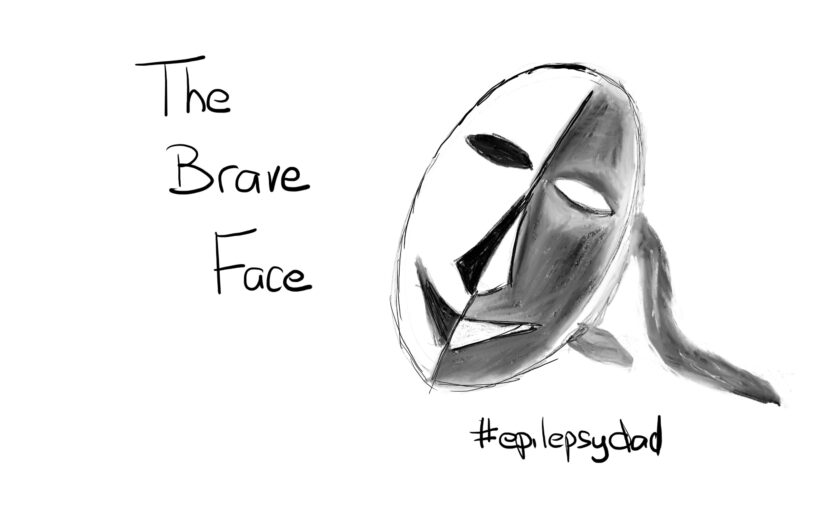
    I show up on the tennis court and at work with a brave face, a mask many of us use to avoid deeper questions. Some days, I wear the face to hide how hard it really is—because my reality might overwhelm most people, and I worry it would make things awkward. If this isn’t your world, what would you say or how would you respond if someone provided details of their challenges that represent the baseline they exist in every day?

    Well, my son had extra seizures this morning, so I didn’t sleep because, you know, SUDEP. And we’re waiting to hear if we can get assistance to send him to the only school we’ve found where he thrives, or if we have to send him to another school and hope for the best. He’s feeling alone and isolated over the summer, but it’s okay because we have our goddaughter here and they get along really well. Unfortunately, she has her medical challenges, so what they can do together is limited. And that’s only when we’re not helping with her challenges, or worried about her, or juggling appointments. My wife and I are managing, but it’s put a lot of strain on us, too. My job is going well, though. Thanks for asking, how are you?

    Even that only scratches the surface. Each of those threads is long, twisted, and knotted into a giant Gordian Knot with the other threads and it’s impossible to untie. Every day feels like we’re pulling at one of those threads, only to come to a spot where another thread blocks our progress.

    Another reason that I put on a brave face is because it gives me an opportunity to not focus on an impossible task for a few hours. I don’t have to field questions about why I look so tired, or to catch someone up on the state of my life. I can just show up and play tennis. Or I can just do my job.

    Because, eventually, the match ends. The meetings end. The mask comes off.

    I walk back to my car or close my laptop and return to the full weight of our life. To the unanswered questions, the unsolved problems, the countless needs that won’t wait. The brave face helps me move through the world, but it’s not who I am. It’s just what I wear to make it through the day.

    Underneath, I am tired. I am scared. I am trying.

    The brave face isn’t a lie—it’s just not the whole truth.

    And sometimes, putting it on is the bravest thing we can do.

  • Kintsugi Fatherhood

    Kintsugi Fatherhood

    I used to think that parenting meant protecting my child from cracks. It was my job to keep my son’s life smooth, whole, and unbroken. But when he started having seizures, everything fractured. Our assumptions. Our plans. Our son. Our lives.

    My son went from having no seizures to having epilepsy. He went from a typical, healthy child sleeping in his bed to a child confined to a hospital bed, doctors standing over him, trying to save his life. He went from running circles around the house to being unable to walk at all. He was broken, the imperfect pieces scattered in countless directions.

    I was broken, too, like the unspoken promises I had made to give him a life better than my own. I was helpless. Lost. Scared. Paralyzed. I didn’t know what to do. I couldn’t fix it. I wasn’t sure what would happen, but I knew every plan we had made before that hospital stay was also broken.

    I grieved for the version of parenthood I thought I’d live. I grieved for the ease I thought he’d have. I thought those pieces of my son, myself, and the life we had planned would never be whole again.

    But we didn’t stay broken.

    We made it out of that hospital room. And the next one. And the next one. We adapted. We healed—imperfectly, tenderly, and not all at once. Each new challenge left its mark, but those marks became part of the story. And somehow, over time, we became something stronger than before.

    It reminds me of kintsugi, the Japanese art of mending broken pottery with gold. The philosophy says that when something has suffered damage, it shouldn’t be hidden—it should be honored. The breaks don’t ruin the piece. They reveal its history. They add beauty.

    We can never return to the state of being unbroken. This life broke away from that possibility the moment my son had his first seizure. My son has lived through things most kids haven’t. And he carries those experiences with him, reflected brightly in the love, care, and attention that helped mend his broken pieces to make him whole.

    He is not whole despite what he’s been through.

    He’s whole because of it.

    Wholeness isn’t about perfection.

    It’s about loving what’s being transformed.

  • The Theater of Cowardice

    What unfolded in Congress last week wasn’t just political strategy — it was a performance. A performance where many were aware of the potential damage this bill could cause, and still chose to go along with it anyway.

    The new tax-and-spending bill is massive, packed with everything from tax breaks to military funding. But hidden inside are deep cuts to Medicaid — the very program that supports families like mine. It’s a lifeline for children with disabilities, for the elderly, for rural hospitals. And yet, that lifeline was negotiated away like a bargaining chip in the final hours before a holiday break.

    What struck me was how many others clearly wrestled with their conscience — and still voted yes. They voiced concerns in the press. They called the process rushed. They acknowledged the human cost. And then they folded. They let themselves be swayed by late-night tweaks, vague promises, or political loyalty. They did what was easiest, not what was right.

    This isn’t new. But it’s still devastating.

    When I read about lawmakers huddling under blankets in the Senate chamber at 3 a.m., fueled by carrot cake and caffeine, I couldn’t help but feel the disconnect. I know a different kind of 3 a.m. — one spent next to a hospital bed, watching your child attacked by seizures as doctors huddle over him trying to save his life.

    It’s easy to stand tall when the cameras are rolling, when your party is watching, when your vote aligns with power. It’s much harder to stand up when you’re standing alone — when your vote might cost you political capital, or a committee seat, or an invitation to the next fundraiser, or the favor of a narcissistic, fascist dictator.

    But that’s what courage demands.

    Senator Chuck Schumer said it plainly: “They didn’t have the courage, they didn’t have the backbone to vote with the people of their states.” Some senators voted in “obeisance to Donald Trump and his billionaire buddies,” even when their constituents — the ones in hospital beds, the ones relying on Medicaid for cancer treatment or seizure meds or speech therapy — were the ones who stood to lose the most.

    We’ve been in this fight too long to pretend this doesn’t hurt. I’ve filled out the Medicaid renewal forms while sitting on the floor of a hospital room. I’ve seen the costs of the pills, therapies, and surgeries that kept my son alive and have given him a life worth living. These programs, flawed as they may be, are holding up families like mine. If they cut it down, what’s left?

    This wasn’t just cowardice. It was a performance of leadership with no real cost to the performers. But for families like mine, the cost is very, very real.

  • There’s All Kinds of Success

    There’s All Kinds of Success

    I was listening to a recent episode of Adam Grant’s Work/Life podcast where he and author Susan Dominus discussed the psychology of achievement and success. There were a few quotes from the episode that stuck out to me as the parent of a child with special needs.

    I think this idea that parents are burned with, which is that if their child does not succeed in some socially conventional way, that they have not done their job.

    That idea used to live rent-free in my head.

    I thought my job as a parent was to prepare my son for the world—and by “the world,” I meant the conventional path: grade school, high school, college, career. That was the map I followed for the first five years of his life.

    Then he started having seizures. He was diagnosed with epilepsy. And still, I clung to that same definition of success. I believed I could outwork the diagnosis, push through the limitations, and keep him on the traditional track. But the more I pushed, the harder it became—on both of us.

    Eventually, I realized that holding on to that version of success was causing harm. Not just to his progress, but to his spirit—and to our relationship.

    My job is to prepare my son for the world. But first, I have to meet him where he is. Not where society expects him to be. Not where I once hoped he’d be.

    Right here, right now.

    Is it a parent’s job to measure their child’s utility and successfulness in life?

    It is a painful trap to judge our parenting by how well our kids reflect society’s idea of worth. We start to see them as mirrors of our own success or failure. We fear that they won’t measure up if they don’t fit in, if they are awkward, or if they don’t meet the normalized expectations of a traditional education, career, and life. It’s bad enough that, unless you have an extraordinary talent or athletic ability, fit unrealistic expectations of beauty, or have an idea that can make a fortune, you’re already excluded from those seen as the most valuable.

    And more dangerously, we risk not seeing our children at all.

    There’s all kinds of success.

    Success shouldn’t be a single destination. It should be a personal journey—based on who he is, what he loves, and what he’s capable of. My job is not to chart the course, but to walk beside him, to clear the obstacles, and to remind him that his path is valid—even if it doesn’t look like anyone else’s.

    That’s the shift I’ve had to make: from measuring success by milestones to celebrating presence, progress, and personhood. My son may not follow the path I once imagined, but every step he takes on his path is a triumph. And every time I choose to see him—not through the lens of expectation, but through the truth of who he is—I succeed, too.