Tag: childhood

  • Different Dreams

    Different Dreams

    I don’t remember ever having dreams of what I wanted to be when I grew up. I had friends who wanted to be cowboys, or baseball players, or astronauts when they were children. As they matured, they wanted to be doctors, or lawyers, or police officers. And I once knew a person who dreamed of being a circus performer, which might seem weird, but I knew him in a city that had a “clown college.” But I don’t remember having dreams of my own. I knew someday that I would be older, but I didn’t know what I wanted to be doing when that day arrived.

    After we moved to Florida in my mid-teens, I got it in my head that I wanted to be a marine biologist. It seemed like a good fit. I spent most of my summers when I was younger in the water, catching fish and crabs. I wasn’t afraid to pick up the random sea creatures that I’d come across. And, most importantly, a girl that I had a major crush on also wanted to be a marine biologist and she agreed to be my lab partner because of this newly developed common interest.

    I would have made an excellent marine biologist. Ignore the fact that I won’t go in water that is below 80 degrees. Ignore the fact that I’m more of a sinker than a swimmer. Ignore the fact that I don’t like being cold and wet. Ignore the fact that I get seasick. If you ignore all the things that are in the job description that involves being in or on the water, I would have been great.

    So, I signed up for a marine biology class in high school and sat across the room, watching my romantic interest instead of the fish. But she was watching the fish, but also started seeing one of the popular kids. As a result, my interest in her began to wane, and, coincidentally, so did my interest in becoming a marine biologist.

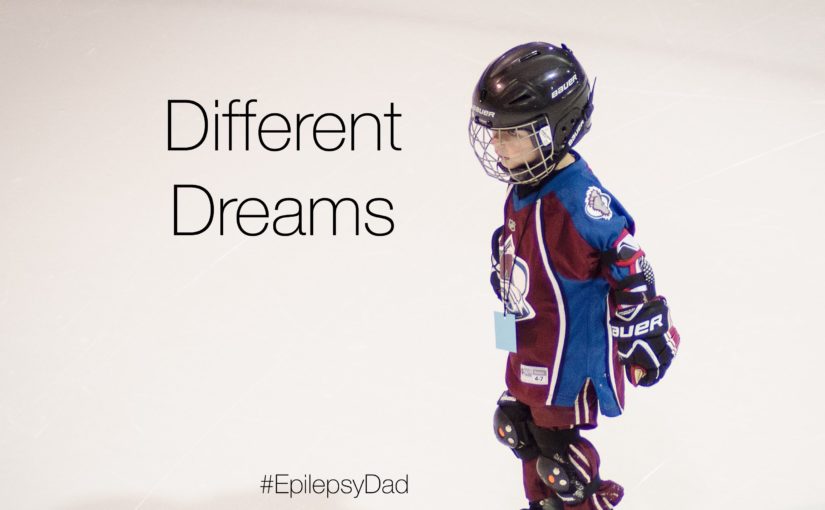
    My son, however, has known since he was born that he wanted to be a hockey player. He and I started playing hockey together before he could walk, and his love for the sport has only grown. Over the years, he’s added careers like a baseball player and professional video gamer. But they have been “in addition to” never “instead of.” Even now, at ten years old, he’s waiting for the call from the Colorado Avalanche or the Vegas Golden Knights to tell him they need him, and we’ll be on a plane.

    To help him pursue that dream, I took him to skating lessons starting when he was two. At four, we added the hockey classes. The look on his face when he got his first official jersey is etched in my mind.
    epilepsy dad different dreamsepilepsy dad different dreams


    But then, just before his fifth birthday, he had his first seizure.

    The first seizure didn’t adjust his course, but the second one did. And the third. And the three months in the hospital battling status. And the exhaustion and side effects of the medication. For more than two years, we struggled to get him back on the ice. We’d play hockey in the basement, but the level of exertion necessary to be on the ice and playing hockey was too much. We’d try a few classes, and his body would shut down for days. During one class, he had a seizure. The fighter that he is, he got right back up and tried to participate, but we needed to keep him off the ice for his safety until we could figure something out.

    We added tee-ball and baseball since those sports were easier to manage breaks and his level of effort. He is good at baseball, and he likes it, but he keeps asking about hockey. He has a friend who has been playing for a few years now, and I can hear it when he talks about his friend that he wishes it was him on the ice instead. But it isn’t. And the reality is that I don’t know if it ever will be.

    The reality is that my son’s seizures are still not under control. The reality is that the more he pushes himself, physically and mentally, the more exhausted he gets, and the more seizures he has, which perpetuates the cycle. No one can tell us if that will ever get any better, so we’ve tried to structure his life in a way where he gets the most out of it while minimizing the impact of his epilepsy. But the thing that he loves the most, the thing he’s dreamed about all his life, is the thing we haven’t figured out how to give back to him.

    I never had dreams when I was younger, so I don’t feel any remorse or regret for where I wound up. I think I am where I am supposed to be, with the family I love and a job in a field that I’m good at and find rewarding. Looking back, the choices that I made, even subconsciously, all aligned on a clear path to here.

    I believe the same will happen for my son. He will be where he is supposed to be. But I’ve always wanted to give him every opportunity to succeed, every opportunity to explore every possibility, and to feel supported every step of the way. Part of my purpose is giving that to him, and doing everything I can to help him achieve his dreams.

    It breaks my heart to think that I may need to tell him that he needs to have different dreams.
  • All The World’s A Stage

    All The World’s A Stage

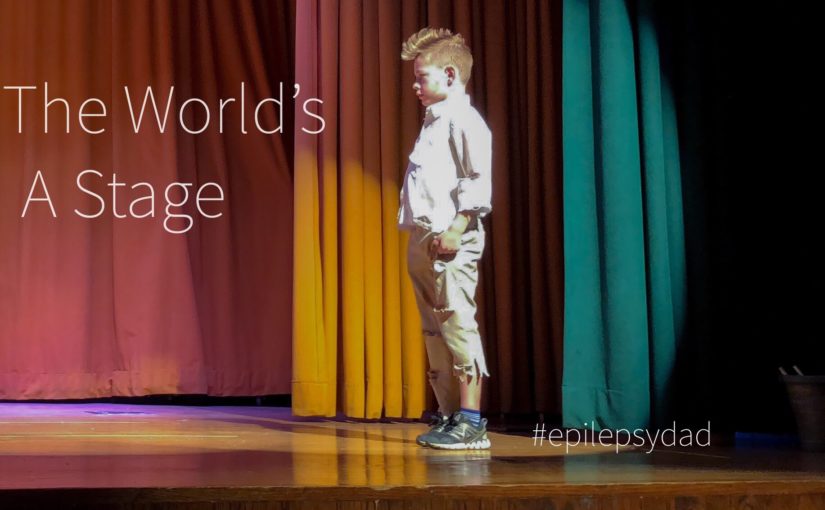
    Recently, my son performed in his first school play. School has been physically, mentally, and emotionally exhausting for him this year. He likes school, but it takes a huge toll on his body and mind doing full days. In an otherwise difficult year, the play was the thing he most looked forward to, so we adjusted his schedule to allow him to rehearse with his class and have a part in the show.

    He worked hard rehearsing for his role. Memorization is extremely difficult for him, but he practiced reciting his lines almost every day. We’d catch him at random times singing the songs from the show as he played with his toys or started to drift off to sleep. It was the first thing in a long time that he had that was his and that he was excited about.

    When the day of the show finally arrived, it started with six seizures before breakfast. He had big circles under his eyes as he slowly crawled out of bed. As it goes with epilepsy, we didn’t know why he had more seizure than normal. But we let him rest most of the day with our fingers crossed that he would feel well enough to go to the show. Even after an afternoon nap, he still seemed tired but, thankfully, his excitement and adrenaline gave him the boost he needed to make it out of the house.

    My wife and I sat in the audience anxiously waiting for the show to begin. I had a big smile on my face when I saw my son peak his head around the curtain. I heard the kids getting into position and felt my heart start to beat faster. Finally, the curtain opened, and I thought we made a terrible mistake letting him do the show that night.

    I could see by the look on his face that he wasn’t really present. The energy that got him out the door seemed gone. Most of the time, he looked lost on the stage, bouncing between children to try to find the spot where he should be. I felt helpless every time we made eye contact. I felt angry that they didn’t set it up better or give him a buddy to remind him where he should be. While these thoughts raced through my head, I tried to keep a smile and to be a friendly face in the audience for him.

    My wife and I struggle with finding the right place for my son. Not just with school, but finding environments that are safe for him and that try to understand what life is like for him. Watching him on the stage, unable to find his place, brought that fear of him never finding that place center stage. It acted out my anxiety of what life will look like for him as he gets older because the world doesn’t know him and doesn’t understand him. I saw on that stage a future for my son where he spends his life bouncing around, bouncing off people, endlessly lost.

    When the show was over, my son came running off the stage and into our arms. He was happy. He had just done something impossibly hard and felt good about himself. At that moment, everything I was feeling melted away and I held him and told him how proud of him I was.

    It’s hard to not get lost in those visions of what the future will look like for my son. There have been too many times where I get swept up in those feelings and miss what is happening right in front of me, in the present where my son needs me to be. It’s in those moments where he continues to show me what he is capable of and remind me that the future is unwritten and filled with as many possibilities as it will be limitations. The only thing that is certain is what we have at this moment. As I held my son and felt his joy, I didn’t want to miss it.

  • A Childhood In The Clouds

    A Childhood In The Clouds

    I wonder how my son is going to remember his childhood. Sometimes, I wonder if he is going to remember it.

    My son and I watched a Philadelphia Eagles game and we saw a player that my son had met at the hospital. I asked if he remembered meeting him and he said that he didn’t. We met the player almost two years, so at first, I chalked it up to my son being too young to remember. But he was also in the hospital because he was having more seizures and because we needed to adjust his medication.

    Like other medicines, epilepsy medications have a long list of side effects. But medicine that controls seizures targets the source of those seizures, the brain. As a result, the side effects show up in those areas that the brain controls, which is everywhere. We have sees these side effects alter his mood and behavior and impact his motor control. As he gets older, we’re also seeing how much they affect his ability to learn and his memory. Those side effects were likely there all along, hidden beneath the surface. But now that those skills are being tested, the latent effects are being revealed.

    We’ve passed the three year mark of my son taking medicine for his seizures. Three years of my son’s brain in a constant fog. Three years of struggling to form solid shapes around thoughts and ideas. Three years of a childhood spent in the clouds.

    Three years of exerting all his energy to focus on one task at a time. Three years of that focus sapping all his energy. Three years of wondering if there is enough energy or will left inside of him to enjoy an experience.

    The more we explore, the more gaps we find. Milestone events never happened. People erased from existence. It’s impossible to tell whether the failure is storing the memory or recalling it. The result is the same, though. A void where a childhood should be.

    My wife and I repeat stories of our adventures to him, and we show him the albums of pictures we’ve taken. I’m hoping by continuing to expose him to those memories that he will have something to remember. I don’t know if it will be because we’re unlocking old memories or creating new ones through our stories. I’m hoping his brain doesn’t know the difference. I’m hoping that when he looks back on this time in his life, he’ll have something to find.

  • To Be A Kid

    To Be A Kid

    We’ve seen many ups and downs over the last few weeks. An increase of dosage for one of my son’s new medications brought back unwelcome side effects. His seizures are only slightly more under control than they were before, but he’s exhausted and has a hard time sleeping through the night. His mood and behavior have been bouncing around from stable and happy to angry and defiant.

    When it’s at it’s worst, little incidents explode into big ones. The escalation is so fast that it’s jarring and catches us off-guard. It’s so fast and the situation is so frustrating that we don’t always respond in the best way. Then we find ourselves in the middle of the tornado. He’ll say mean things. He tells us he wants us to throw everything away and that he deserves it. I can sense the shame and guilt swell inside and overwhelm him. We hold him and tell him that we love him and wait for the storm to pass. When it does, there are usually tears and remorse and regret. As a father, these moments rip me apart.

    These side effects are cruel, especially for someone his age. Between the side effects, the diet, the appointments, and the seizures, he has little time to be a kid. There aren’t many chances for him to be free, to make a mess, and to not have the complications of his life burden him. There aren’t many chances for us to let our guard down, either. We’re always on the edge worrying about him, trying to keep him safe and regulate these side effects. We’re as confined as he is.

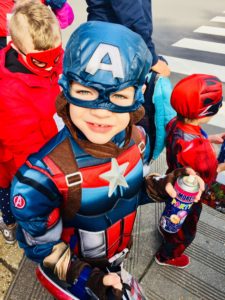
    But, sometimes, we find opportunities where we can all have fun and enjoy the moment. My son loves dressing up as Captain America, so my wife planned a Super Hero Scavenger Hunt for his birthday. He and his friends had to chase down the evil villain the Snake Robber, the role that I was taking on. The idea of running through the streets with a mask and stuffed snake around my neck made me anxious. I’m a shy, quiet, reserved individual that follows rules and avoids chaos. But I went into it with an open mind and the singular thought that it would make my son (and wife) happy.

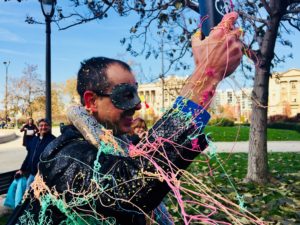
    I made my way to the location where the superhero party would encounter me for the first time. I waited nervously on a bench in the park while curious onlookers moved further away. Across the park, I saw one of the kids spot me and point in my direction. Then, they charged. Within a minute, they had covered me with Silly String and laughter. My son had a huge smile on his face as he and his friends chased me around the park. Then I used my freeze ray to, well, freeze them and escape to the next location.

    epilepsy dad kid childhood seizure

    I had a huge smile of my own on my face as I ran to set up the next battle. This time, the kids trapped me until I told them that I hid a dozen of their teddy bear friends in the park. While they looked for them, I escaped again. Eventually, they caught up with me and saw me entering my lair to assemble a machine to steal their powers.

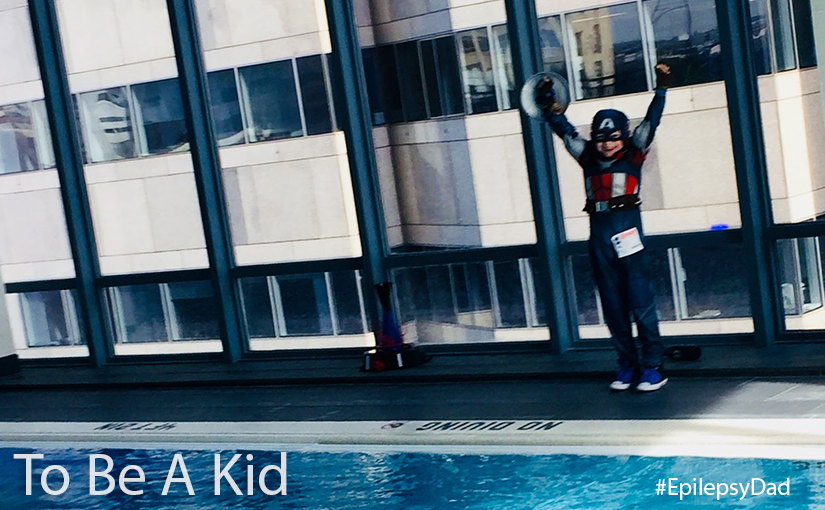
    In the final battle, the superheroes found me near the pool assembling my machine. I froze all the heroes again except for Captain America who used his shield to deflect the ray. He advanced on me while his friends watched and defeated me by pushing me into the pool.

    epilepsy dad kid childhood seizure

    As I laid in the pool, I looked up to see my son with the biggest smile on his face and his arms raised in victory. Behind us, I could hear his friends screaming and cheering him for him. Captain America had saved the day. At that moment, there were no side effects. No appointments. No seizures. There was just my son being happy. And being a kid.

    epilepsy dad kid childhood seizure

  • Leading With Love

    Leading With Love

    Sometimes I look at my son and I see a tall blade of grass, swaying in the breeze. His legs appears rooted on the ground, but his body moves and bends as if it is being pushed by an invisible force. Or a corn stalk that is too thin to support the ear that is is carrying, bobbing in no particular direction but down. It seems an exhausting tasks to constantly keep from falling over.

    When he moves, I see a puppet whose strings sometimes get twisted. The extension of his limbs or the gate of his stride are not quite right, and he sometimes tumbles to the ground. We do our best to pull him up and untangle his knotted strings, but each time he falls, my heart aches.

    I wonder if, when he does fall, when he’s lying on the ground, if that’s when he feels the most stable. Like in my younger days after I had too much to drink. When I wanted to lay on the bed and prayed for the world to stop spinning around me. My prayers were rarely answered, but at least I felt like there was nowhere further to fall. I could close my eyes and feel the world spread out below me and holding me so that my body could release all its tension. Only, he shouldn’t be old enough to know what that feels like.

    When he falls to the ground, I get angy and frustrated and sad. I look at him as that blade of grass, or stalk of corn, or sailor, or puppet. I can’t help myself but wonder if he wants to stay down for an extra second to let his body not worry about balance. But when I do, when he looks at me, I worry that he will see those expressions on my face directed at him. That he’ll think that I am angry and frustrated at him, or that he’ll see me sad and think that it is because of him. It’s a heavy burden to think that you are the cause of such powerful emotions in another person. Of course, he’s not. My anger, my frustration, and my sadness are not because of him, but because of what is happening to him. But what else could he think when I look at him the way I do? He shouldn’t be old enough to know what that feels like, either.

    The cruelest thing that epilepsy continues to do is to try to make my son feel less than he is. Less than an amazing boy. Less than the best son. Less than a gift. Less than a miracle. It feels as if it is using me to do its dirty work, to project those feelings on my son through my worry and frustration. I catch myself doing it, but usually after the message has been delivered. It’s a terrible feeling to worry about what your child thinks you think when you look at him. Because regardless of what is visible on the surface, hidden underneath is always love.

    I wish my instict was to lead with love. I want so much for that to be what he sees when I’m looking at him instead of the temporary emotions caused by a symptom of his condition. I don’t want him to have to remember that I also love him, I want that to be where he goes first. Because the pain and sadness at what his condition is doing to him is amplified by that love. Because loving him is where I am, first and always.