Tag: change

  • Catalysts of Change

    A couple we are friends with were pregnant right before the pandemic began. We were excited for them, and my wife was more excited about the opportunity to hold the baby. Then the pandemic happened, and it would be almost two before we saw their son other than at a distance or through a window.

    As the world has opened up a bit more, we were able to spend some time with them. Their son was already walking and saying words, and it was wonderful to see how happy he was. It was also wonderful to see how our friends had changed and opened up since their son arrived.

    It made me think of how much I had changed, not just when our son was born but also after he was diagnosed with epilepsy and all the challenges that presented.

    There are obvious reasons why having children changes us. They are completely dependent on us for everything, and that requires an instant upgrade of our maturity and level of responsibility. We lose some of our selfishness, and our choices become less about us. We start thinking more about the future. Having children takes us out of ourselves and expands the context in which we live.

    It’s hard to change patterns that have been with you since you were young. I think most people say they want to be better parents than the ones they had but then wind up doing a lot of the same things our parents did, anyway. Having a child may be an opportunity to do differently, but that doesn’t mean we can or do.

    When our son was born, I started on my journey of growth. I thought more about the example I would set for my son and the type of father I wanted to be. But I was a mess, and having him shone a big spotlight on how far I had to go both as a father and as a husband. I second-guessed everything because the weight of the responsibility was unlike anything I had experienced before. That insecurity caused me to go inward and protect myself, which pulled me further away from what I should have been doing for my family.

    Eventually, we found our groove, but it felt more like a plateau than a destination. I did change, but just enough to keep things together and to move forward. We did family things, and I was progressing at work and felt like I had figured some of it out, but life would throw in a twist and let me know that I had barely started.

    The first seizure was a wake-up call, like an alarm clock, but we were able to hit snooze. The second seizure, though, let us know that it was time to get up. The rapid deterioration of my son’s condition meant that I wouldn’t be able to sleep again.

    There were years when it felt like everything was hanging on by a thread, both my son’s health and our family. The challenges we faced were impossibly difficult and not something for which anyone could have been prepared. When things were good, I pretended like they were always good. When things were bad, I disappeared into myself or into work or a dark hole, anywhere to avoid the fear and pain and struggle.

    It took time, patience, therapy, and my son stabilizing before I could get out of that hole. I could have lost everything while I was in there. I almost did. But when I climbed out, my wife and my son were still there.

    In the past few years, I have done more to become the husband, father, and person that I want to be than I have at any other point in my life. Even going back through old posts, I remember those difficult times and can see a record of my progress. I can look around and see how much closer I am to my wife and how intentional and present I try to be with my son.

    But I’m not done. There is more to do. This is a lifelong journey of growth, with the course adjusted at each milestone. Milestones like having a child. Milestones like nearly losing a child. These events are opportunities to grow if we let them. And we should. The stakes are too high to ignore them. And the rewards are too great to ignore.

    Welcome the change.
  • Yes, And…

    Yes, And…

    We didn’t ask for this. One day, we woke up the same way we always did, and that night we were walking back to our hotel room from the hospital in a strange city after my son had his first seizure.

    That was six years ago.

    For many of those years, I fought what was happening. I didn’t want it, and I thought if I resisted it that it would go away. I looked at what was happening, and I led with “no.”

    That “no” manifested as resentment and anger. I wasn’t angry at my son. I was angry at epilepsy. I was angry at seizures. I was angry at the medication and the side effects. I was angry at the universe for doing this to my little boy. The seizures, the meds, the side effects. The impact on his future.

    Even though I wasn’t angry at my son, based on the way I was acting, to him, it probably felt like I was. I worried that he was internalizing what I was projecting. For years, he walked around saying, “I’m sorry” every time I corrected him or asked him to do something.

    I tried to change how I was showing up for him. Instead of fighting what was happening with a “no,” I moved on to a “yes, but…” I admitted that epilepsy was happening, but made excuses so that I wouldn’t have to give in to that reality fully. “Yes, this is happening, but someday it won’t.”

    The “but” in “yes, but…” wasn’t about giving up hope. It was about a lack of acceptance. There was still that resistance that got worse as things with my son got better. Instead of a bump in the road, every setback, every new symptom, every increase in seizures felt like falling off a cliff.

    That falling, too, surfaced as frustration and resentment. I had little tolerance when things weren’t right. I would snap when the smallest thing went wrong. I thought that I could correct our way out of this if I could get everything perfect. I kept trying to control and change the situation into something that it was never going to be.

    When we are no longer able to change a situation – we are challenged to change ourselves. ~Viktor E. Frankl

    In the world of improv comedy, there is a concept of “yes, and…” The idea is that a participant takes what is given and adds to and expands it. Instead of “no” (the brick wall) or “yes, but..” (the resistance ), the “yes” encourages acceptance and the “and” expands.

    Yes, my son has epilepsy, and he is amazing. Yes, he has seizures most days, and he also goes to school and plays baseball and loves Fortnite. Yes, we are on a different path than we thought we were going to be, and the future is full of new possibilities.

    I’m not going to lie, even as I typed the sentences above, I struggled to think of the “and…” My brain isn’t wired to find the positive in impossibly difficult situations. But the more I do it, the easier it will become. The more I practice, the more my brain will automatically find the possibility.  I can’t change the situation, but I can change how I approach it and how I engage with him. Because he truly is amazing, and he needs to feel that from me.

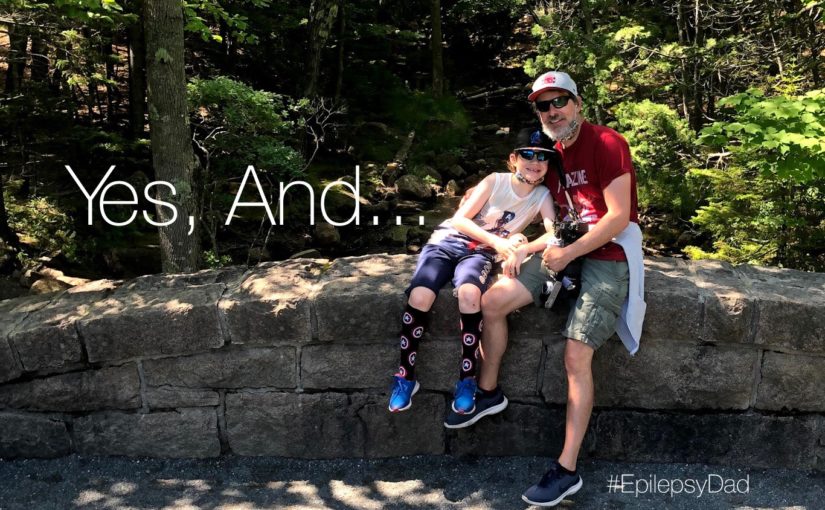
    Yes, my son has epilepsy, and I am the luckiest dad there ever was.

  • Unnatural Times

    Unnatural Times

    Every morning, I like to sit near the window of our condo and look out on to the streets of Philadelphia. I watch as the empty sidewalks start to fill with people. The roads fill up with cars. Food carts appear on street corners. Lights turn on in the office buildings. Mornings are when the city wakes up.

    Usually, on weekends, the process is a bit slower. It takes longer for the sidewalks and the street to fill. But eventually, they do, and the city finally comes to life. Not lately, though. There aren’t as many people. There are fewer cars. And not as many lights in the office buildings are turning on.  Now when I look out the window, the city hasn’t been waking up. It’s a perpetual Sunday morning that lasts all day, every day.

    Being stuck inside the house is unnatural. We aren’t used to the confinement. We are social creatures and miss those connections and contact with the outside world. Our bodies and our minds start to panic, which is only exacerbated by the fear and uncertainty of the spreading virus. It’s unnatural, but, for me, it also feels familiar.

    A few years ago, my son was in a bad state. He was still seizing a lot, and the angry side effects of the medicine he was on came out as rage. He was isolated at home without social contact; no school, no friends, no playdates. My wife stayed home with him, equally isolated. A similar fear and uncertainty blanketed our lives, not knowing how long these conditions would last or, worse, whether they would ever change. Maybe that was going to be our life now, forever.

    We couldn’t plan anything. We couldn’t really go anywhere. So we lived in a dark apartment, watching the city through our front window, hoping for something to change. That lasted for more than a year. Eventually, we found better medication and a nanny to help. We got therapy and found our way back to each other. But it was an agonizing and traumatic time, and our current isolation is triggering those painful memories.

    Before “social distancing”, things had been better. My son was going to school for half days, but every day this year, which he couldn’t do before. He made a few real friends. We were looking forward to baseball season, bike rides, and summer. But now we find ourselves, along with the rest of the world, wondering what comes next.

    It feels like another test of our strength and capacity to adapt to another “new normal.” Fortunately, we’re starting from a better place. My son is doing better. Our family is stronger. And we know that because we made it to the other side of those dark days years ago that we can make it through these challenges, too.

    These are unnatural times. But as parents of children with epilepsy, we are no strangers to unnatural times. Hang in there. Remember to be kind to each other. Remember to make room for yourself. And we will make it through together.

  • The More Things Stay The Same

    The More Things Stay The Same

    The only thing that is constant is change. ~Heraclitus of Ephesus

    In many ways, our life is constantly changing. We meet new people and have new experiences. There are new projects at work. The changing season is bringing cooler temperatures and color to the trees. Things look different than they did a few months ago.

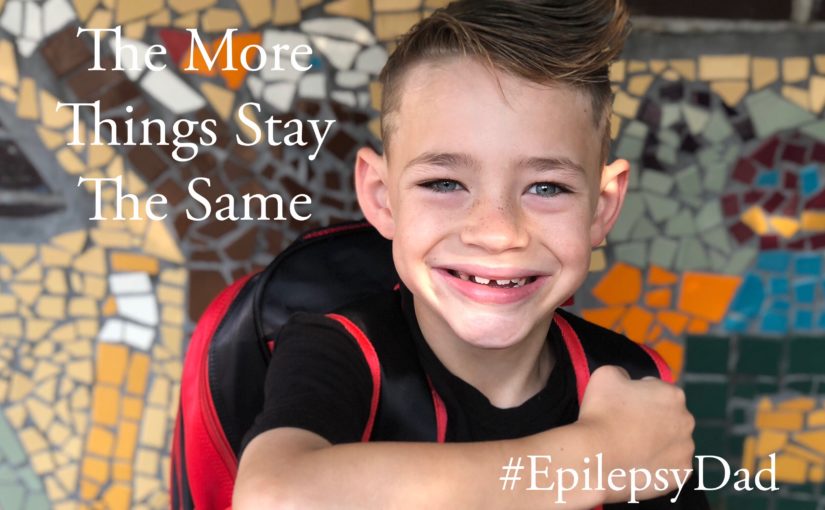
    My son started third grade and has a new teacher, a new aide, and is meeting new kids in his class. He’s in a different place than he was this time last year. He’s a year older. He’s on different medications with different benefits and side effects.

    The more things change, the more they stay the same. ~Jean-Baptiste Alphonse Karr

    But even with so many things changing, the world looks very much the same.

    In spite of the new medications, my son is still seizing. He still labors physically and mentally through the impact of those seizures and the many medications he takes to try to control them.

    In spite of the new grade, teacher and aide, the school is still not set up for him to succeed. He still cannot physically or mentally make it through the day. We’re having to explain and defend ourselves again this year, just like we do every year.

    In many ways, my son’s life changes so much that it’s unpredictable. But after a while, even that becomes expected. It becomes the same. A change for us would be stability. A change for us would be knowing what to expect from one moment to the next.

    But there is no way to control what that looks like. We could find ourselves stuck at the bottom instead of at the top. He could always be seizing. He could always be at the mercy of the cruel side effects of the medicine that keeps his brain from losing control. So, at least for today, I welcome change. Because, as long as things keep changing, there is always hope that things will change for the better.

  • In The Moment

    In The Moment

    I remember a few months ago sitting on the floor holding my son who was in the middle of an angry tantrum. I don’t recall what set it off but he had clearly lost control. His eyes were glazed over and he was saying hurtful, mean things while trying to hit me. It was an all too familiar Jekyll and Hyde moment when my son became someone else.

    I sat there, holding him, and tried to not get hurt or become angry by what he was saying and doing. I remember thinking “This is our life now.” Things were never going to change. Things were never going to get better. For the rest of my life, I would need to be there to shield the world from my son.

    Even when this episode passed, I felt like I would only be waiting for the next one. And there was a next one. And another after that. But with each of those episodes, I began to notice the moments in between. Those moments when we weren’t on high alert. The moments when we might have looked like a normal family. I tried to let myself believe those moments would become our new normal, but that didn’t happen, either.

    My mistake was treating these highs and lows and my feelings and reactions to them as a permanent thing. When I was sitting on the floor holding my son, those fears and emotions were very real and very consuming. They were all I could see. When we were happy and hopeful, I held on to those feelings tightly. They were all I wanted to see. But in both cases, the moments passed. Those feelings fell into the stream of time and it carried them away.

    The current of the stream is strong and unbiased. It takes away the good and the bad. When it takes away the good, it’s always faster than I want it to. Those precious moments sometimes disappear before I can appreciate them. When it takes away the bad, it’s never fast enough. The pain and heartache seem to consume me and linger longer than I think I can endure.

    I’ve tried to control the stream. I’ve tried to hold on to those good moments longer by slowing the flow. But I wind up focusing too hard on not letting go that I wind up not being present. While I struggle to hold on to that one moment, others are floating by without notice.

    I’ve tried to push away the bad moments. But the more attention I give them, the more they seem to stay with me. Instead of being pulled away by the current, they bob up and down in front of me, creating a compounding log jam of moments behind them.

    The hardest thing to do is to give up trying to control every moment and, instead, to be in the moment. To be aware of how the moment affects me and my reaction to it. To be present in each moment and to take what the moment offers but then to let it go.