Month: May 2017

  • It Looks Like Rain

    It Looks Like Rain

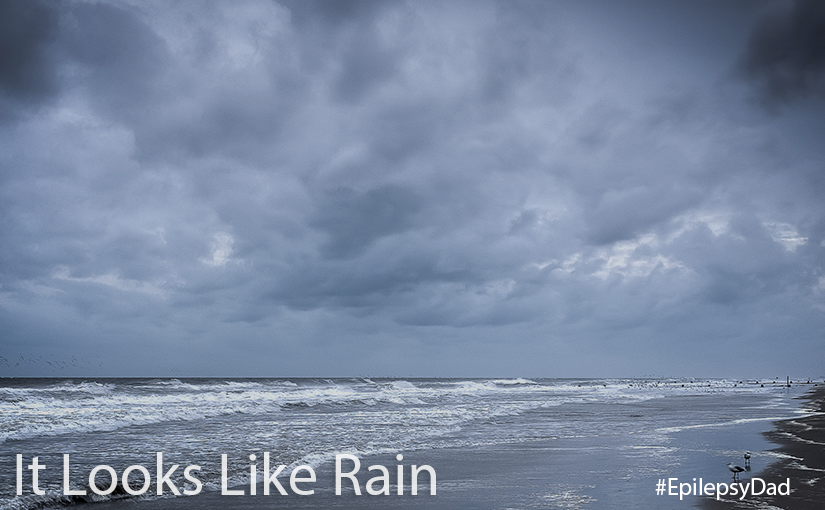
    When my son was at his worst, with relentless seizures and medicine flooding his body, he wasn’t our boy. He was uncontrollable and so, so angry. He would have fits for hours where he would try to hurt us and say terrible things. We’d spend those hours holding him, telling him that we love him, and waiting for the storm to pass.

    There were long stretches of weeks where we would only see glimmers of the boy that he was, like a break in the clouds. But, inevitably, the clouds would expand, find each other, and hide the light behind them.

    After too many months, the enormous storm that ravaged our lives started to break up. The seizures were more under control and we were able to reduce his medications to only a handful. We sought counseling for dealing with his condition and with each other. With a lot of hard work, we had more breaks in the clouds, more times where we saw the light from our boy shining on our lives.

    We spent a lot of time basking in that light. We were starved for it after so much time without it. There were still rumbles in the distance, a seizure or an outburst, that made the hair on our necks stand up. Occasionally, a storm would pop up, but it was usually brief and not as violent. Still, we remained on guard.

    Lately, the sound of thunder is getting louder.The hairs on my neck are standing up again. We’re seeing the tell-tale signs of a storm. There are times when he can’t control his body or regulate his emotions. There are days when he’s not there and when he’s not processing and not aware. There are more times when he gets angry and pushes everyone away. We’re adjusting his medicine again and these signs act as our barometer that tells us when the dose is too high.

    I know we have to adjust his medicine to keep the seizures in check, but I also know what that brings with it. I can see the clouds forming. It looks like rain.

  • Keeping The Door Open

    Keeping The Door Open

    If you believed the headlines, you might have thought that CBD was a miracle cure for epilepsy. After so many drugs failed to control my son’s seizures or burdened him with terrible side effects, I felt like we needed that miracle. But, in the end, CBD, like many other medicines, did not help to control his seizures.

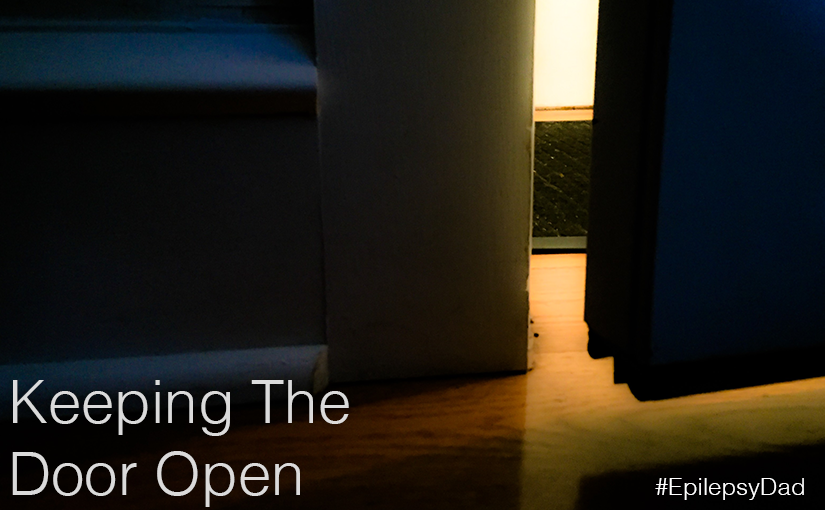
    This post isn’t about CBD. It isn’t about Keppra. It isn’t about dilantin, or topamax, or vimpat, or triliptol, or tegratol. It isn’t about any of them in particular but, in a way, it is about all of them. It’s about feeling like a door closes a bit more every time we stop another medication. There is still light on the other side because I can see it splashing through the opening onto the floor. But the beam is getting narrower. And no matter how I angle my head, I can’t actually see the source of the light. I have to trust that it is there.

    I’m frustrated that another thing that has worked for others didn’t work for us. I hoped it would live up to the hype and that we would be one of the success stories. I want desperately for something to work for my son. As hopeful as I am that he will wake up one day seizure-free, I’m not greedy. I’d settle for a magic pill that would allow us to stop his other medication and free him from their side effects. A pill that would let him stop the ketogenic diet so that he could have a slice of pizza or a piece of candy.

    The side effects. The ataxia. The attention. The unbalance. The learning difficulties. The feeling of being different. The loss of control of his mind and body. The lack of freedom. An uncertain future. I want that magic pill to take away these things, too.

    But there is no magic pill. As every parent of a child with epilepsy knows, some things work for some people but not for others. We happen to be in the unlucky camp of people for whom most things don’t work at all.

    The door hasn’t closed, though. I won’t let it. I jammed my foot between the door and the frame so that it can’t close. I’ve got one hand gripped on to the handle and the other with a firm grasp on the door, and I’m pulling as hard as I can.

    I won’t let that door close.

    There is too much at stake. When there is light, there is hope, and there is so much to be hopeful for.

    I won’t let that door close.

    If I have to, I’ll rip it right off its hinges.

  • Leading With Love

    Leading With Love

    Sometimes I look at my son and I see a tall blade of grass, swaying in the breeze. His legs appears rooted on the ground, but his body moves and bends as if it is being pushed by an invisible force. Or a corn stalk that is too thin to support the ear that is is carrying, bobbing in no particular direction but down. It seems an exhausting tasks to constantly keep from falling over.

    When he moves, I see a puppet whose strings sometimes get twisted. The extension of his limbs or the gate of his stride are not quite right, and he sometimes tumbles to the ground. We do our best to pull him up and untangle his knotted strings, but each time he falls, my heart aches.

    I wonder if, when he does fall, when he’s lying on the ground, if that’s when he feels the most stable. Like in my younger days after I had too much to drink. When I wanted to lay on the bed and prayed for the world to stop spinning around me. My prayers were rarely answered, but at least I felt like there was nowhere further to fall. I could close my eyes and feel the world spread out below me and holding me so that my body could release all its tension. Only, he shouldn’t be old enough to know what that feels like.

    When he falls to the ground, I get angy and frustrated and sad. I look at him as that blade of grass, or stalk of corn, or sailor, or puppet. I can’t help myself but wonder if he wants to stay down for an extra second to let his body not worry about balance. But when I do, when he looks at me, I worry that he will see those expressions on my face directed at him. That he’ll think that I am angry and frustrated at him, or that he’ll see me sad and think that it is because of him. It’s a heavy burden to think that you are the cause of such powerful emotions in another person. Of course, he’s not. My anger, my frustration, and my sadness are not because of him, but because of what is happening to him. But what else could he think when I look at him the way I do? He shouldn’t be old enough to know what that feels like, either.

    The cruelest thing that epilepsy continues to do is to try to make my son feel less than he is. Less than an amazing boy. Less than the best son. Less than a gift. Less than a miracle. It feels as if it is using me to do its dirty work, to project those feelings on my son through my worry and frustration. I catch myself doing it, but usually after the message has been delivered. It’s a terrible feeling to worry about what your child thinks you think when you look at him. Because regardless of what is visible on the surface, hidden underneath is always love.

    I wish my instict was to lead with love. I want so much for that to be what he sees when I’m looking at him instead of the temporary emotions caused by a symptom of his condition. I don’t want him to have to remember that I also love him, I want that to be where he goes first. Because the pain and sadness at what his condition is doing to him is amplified by that love. Because loving him is where I am, first and always.

  • Moving To Australia

    Moving To Australia

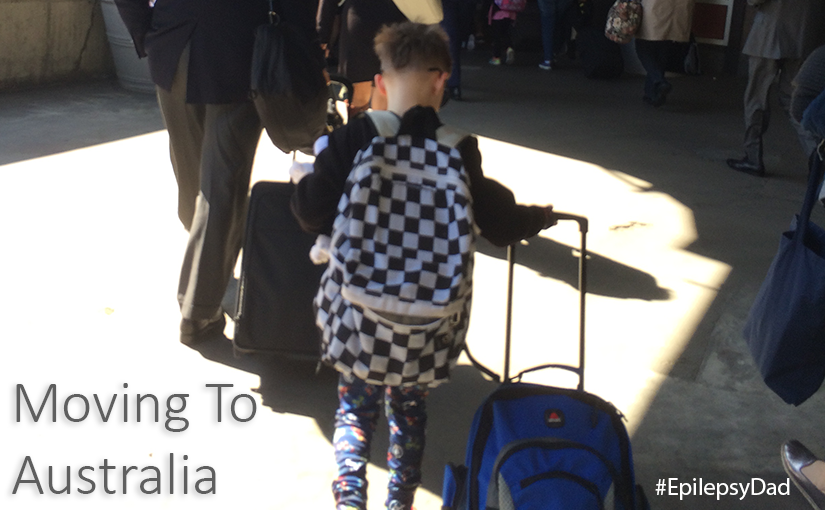
    Before my son was born, my wife and I talked about moving to Australia. It wasn’t because we were having a terrible, horrible, no good, very bad day. It was because we had been there on our honeymoon and we loved the experience. The idea of packing up and living on the other side of the world seemed like an amazing adventure.

    In a way, it’s the same reason we moved to Philadelphia. While it wasn’t on the other side of the world, it might as well have been. Moving from the suburbs to the city. From the Colorado laid-back mentality to the always-moving city. The people and culture are as different as if we had moved to another planet.

    At the time, the logistics of moving were easier. I already had a job, so we only needed to pack and find a place to live. Everything else we could figure out as we got more familiar with our surroundings. But we landed in Philadelphia right before my son’s seizures started. After that, the idea of moving became a lot more complicated.

    It’s no longer a simple matter of packing up and finding a place to live. “Everywhere” is no longer the list of possible destinations. Our mindset needed to shift from aspirational to practical. The nature and complexity of my son’s condition mandated more specific requirements.

    We would have to research the hospitals in the area to get a feel for their ability to support my son. How good is the medical care? Do they have the testing equipment on site, like a video EEG, or would we have to travel to another hospital? How easy is it to get in to see our neurologist?

    We also have to do more research on the schools. In the past, we would have asked about class sizes and the quality of the education. Now, we would need to ask more targeted questions. Can they accommodate my son’s special needs? Can he get a one-on-one aide? Is the nurse familiar with seizures and epilepsy? Will the integrate him or isolate him?

    Many of the answers to these questions would remove cities from our list of potential new homes. And there are many more questions to ask, each one shortening the list.

    In many ways, epilepsy has taken away choices. Where we can live is one area, but there are so many. It also forces restrictions on what job I can take, what activities my son can do, even what he can eat. I assumed that we could build our lives by picking pieces from an unlimited list of options. But instead of the full buffet, we’re limited to the salad bar.

    It would be easy to be resentful. It would be easy to see these limitations that epilepsy has imposed on us make and feel like victims. It would be easy to see only loss. Loss of freedom. Loss of choice. Loss of potential. But being where we’ve been, I’m grateful for where we are. I don’t resent what we don’t have or where we can’t go because I know how special what we do have is.

    I still like the idea of an adventure. I still think about moving to Australia. Maybe some day, if we can get my son’s epilepsy under control, we’ll be able to move to have that adventure. Until then, we are exactly where we need to be. The dream of living in another part of the world might seem far away. But the reality is that our journey so far has brought us closer together.

  • How People On Reddit Talk About Epilepsy

    How People On Reddit Talk About Epilepsy

    As a technologist, I’m fascinated about how people use social media. It’s such a vast space but people find places where they can make connections around any number of topics. Social media has fostered revolutions, saved lives, but also taken them. It enables freedom of expression but also allows an unprecedented level of hatred. Like a hammer, social media is a tool, and it’s up to humanity to use it to build or to destroy.

    I read an article that described a language analysis done on comments from Reddit. Reddit is a community website that aggregates content. It also allows members to share, rate, and discuss the content. I thought it would be interesting to see how people on Reddit talked about epilepsy.

    Why does it matter?

    If you’re reading this post, you may have been lead to it by Twitter, Facebook, or Medium. Maybe you subscribed to the blog. In any case, you are using technology and the Internet to consume information. And there is a lot of information out there…some good, some bad, some supportive, some not. These types of analyses aren’t perfect, but they can provide some interesting insights.

    I’m old enough to be able to navigate these platforms and decide what to take and what to leave. While my son is not of Internet age yet, he will be soon. And he’ll be more likely to look to social media for support. The more I know about the different systems, the abler I’ll be to guide him as he explores them.

    More generally, though, these types of analyses can be helpful to see what aspects of epilepsy people are talking about. Or, not talking enough about.

    What data did I look at?

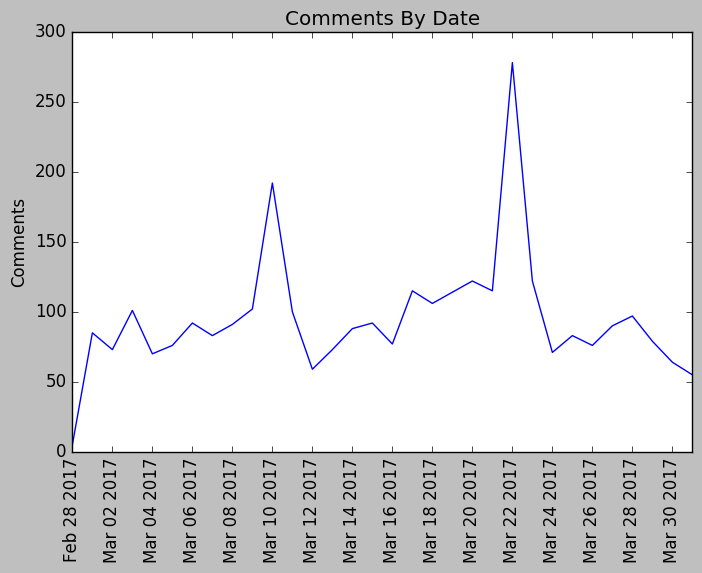
    For this project, I grabbed comments from March 2017 that contained the word “epilepsy“. That gave me 3,046 comments out of about 79 million (0.0038%). Literally, a drop in the bucket, but enough for a simple analysis.

    Number of comments by day in March 2017

    Here is how the epilepsy-related comments were distributed throughout March.
    epilepsy reddit nlp google sentiment

    The big spike on March 22 was partly due to a question in AskReddit. AskReddit is where posters ask and answer “questions that elicit thought-provoking discussions”. The spike was the result of responses to the question “What are you sick and tired of having to explain to people?.” I can imagine people living with epilepsy having an opinion on that question.

    Which subreddits are the most active?

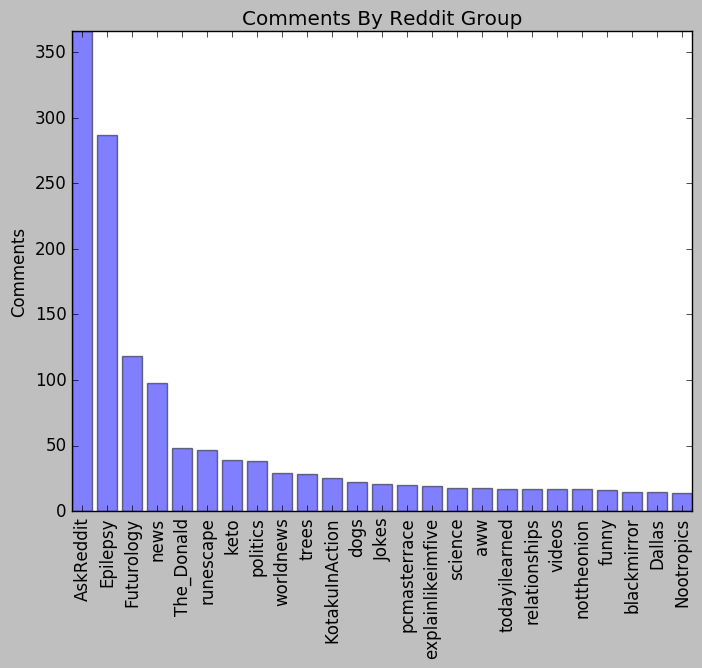
    Next, I wanted to break down the comments by the group they were posted in. On Reddit, the groups are called “subreddits”. Those discussions helped the AskReddit subreddit lead the comment count for epilepsy-related posts. The subreddit dedicated to discussions about epilepsy came in second.
    epilepsy reddit nlp google sentiment

    What adjectives do people use when they talk about epilepsy?

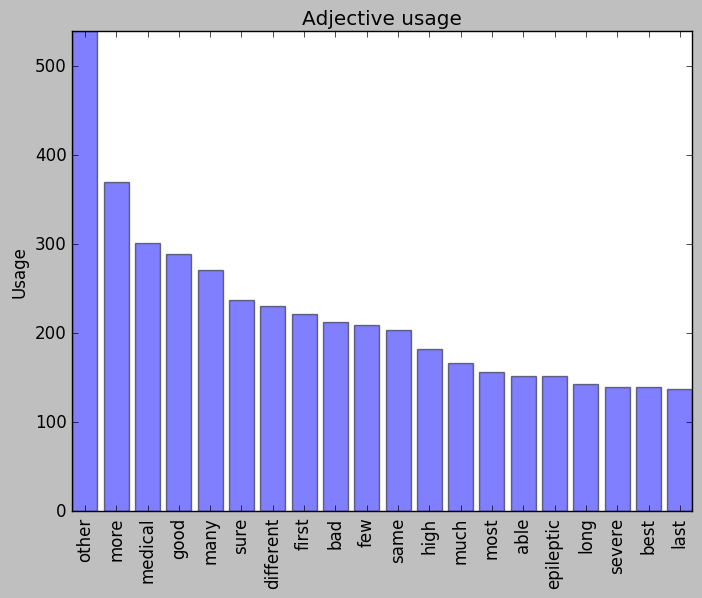
    Besides looking at simple numbers, I wanted to analyze the comments themselves. I ran them through Google’s Natural Language (NLP) API to see what I could learn. NLP takes a sample of text and breaks it down into parts of speech and sentiment.

    First, I looked at the parts of speech. Here are the top adjectives most used in conjunction with the word “epilepsy.”
    epilepsy reddit nlp google sentiment

    What is the sentiment of the comments about epilepsy?

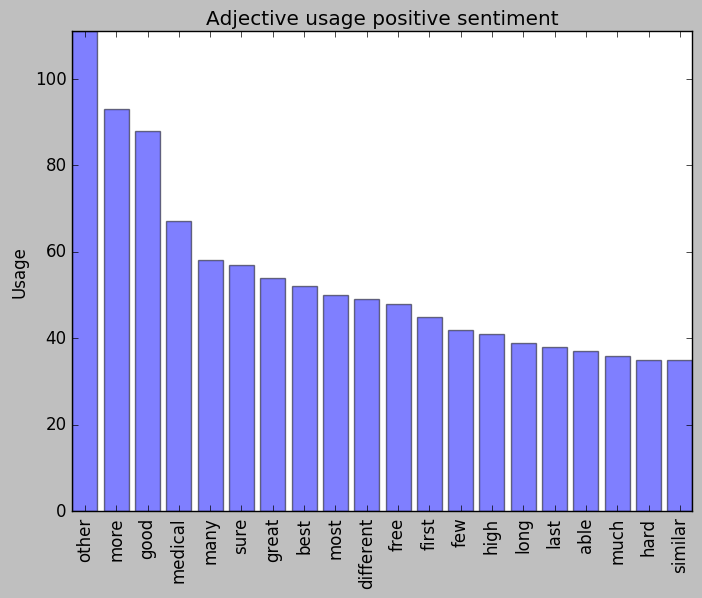
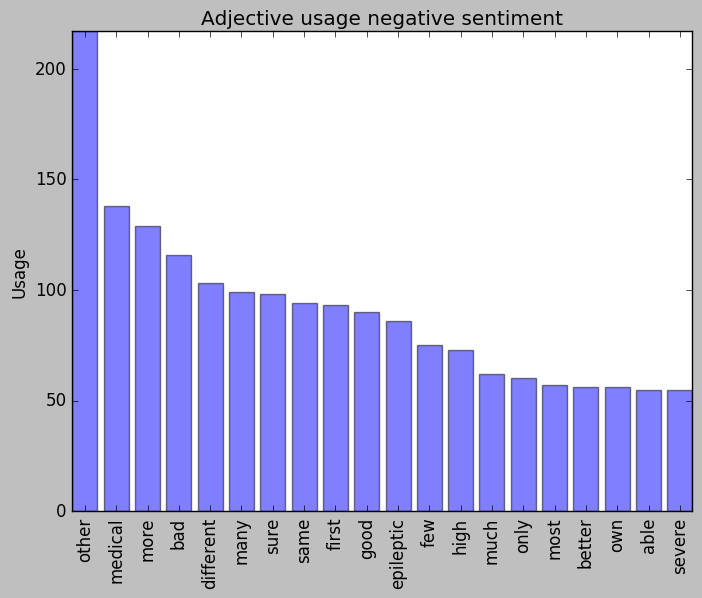
    Next, I wanted to add the sentiment piece. The NLP looked at each comment and to try to infer if it represented a positive or negative sentiment. “I won’t let epilepsy get me down” is an example of a positive sentiment. “I have epilepsy and am depressed” expresses a negative sentiment. I wondered if the adjectives used changed depending on the sentiment of the comment, and they did.

    For comments characterized as positive, words like “good”, “great”, and “best” were included.
    epilepsy reddit nlp google sentiment

    For negative comments, “bad”, different”, and “severe” made the list.
    epilepsy reddit nlp google sentiment

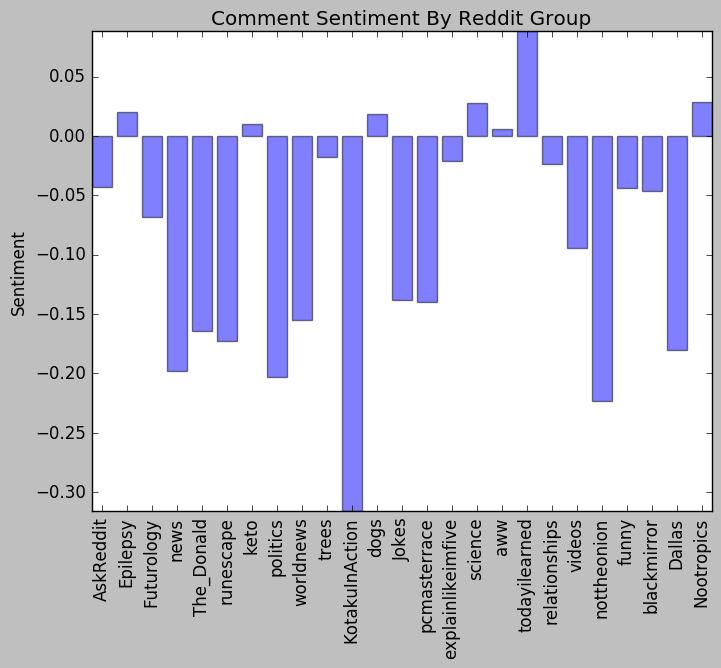
    I also wanted to look at the sentiment across the different groups. The chart below shows the average sentiment of the epilepsy-related comments by subreddit.
    epilepsy reddit nlp google sentiment

    Again, a positive score reflects an overall positive sentiment of the comments. Interestingly, the big negative score on the chart is for the subreddit “KotakuInAction.” The group relates to the “GamerGate” controversy and other gaming and Internet issues. The thread that contained the epilepsy comments related to the Eichenwald case. That was where a journalist with epilepsy was sent a seizure-inducing twitter message.

    What else do people talk about when they talk about epilepsy?

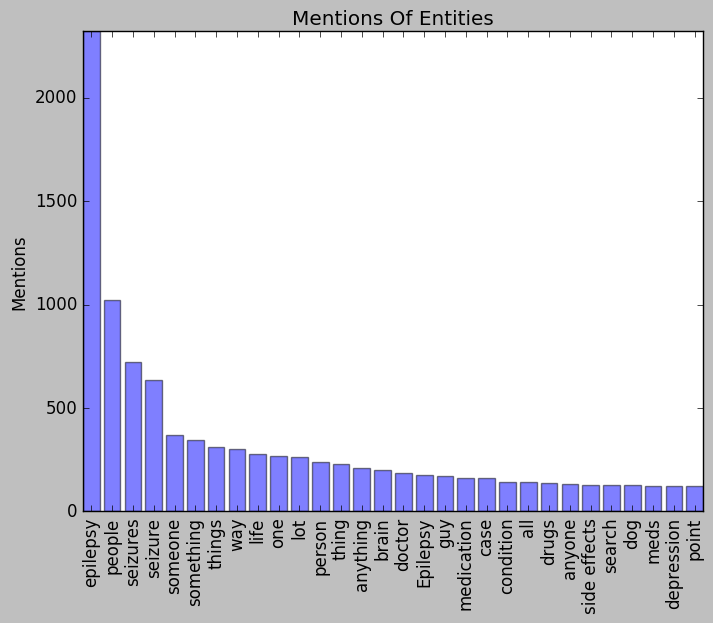
    Finally, Google’s algorithm also provides other topics (entities) that are discussed in text. Here are the most common entities mentioned in conjunction with epilepsy on Reddit.
    epilepsy reddit nlp google sentiment

    Let’s look at January through March…

    Since the data was available, I ran a few of the reports for the first three months of 2017, as well, to see if anything changed.

    First, here are the number of comments for January through March.
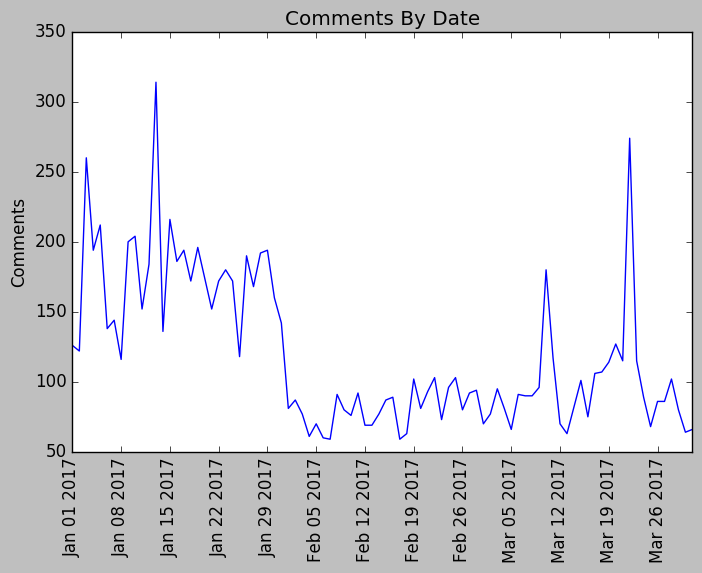
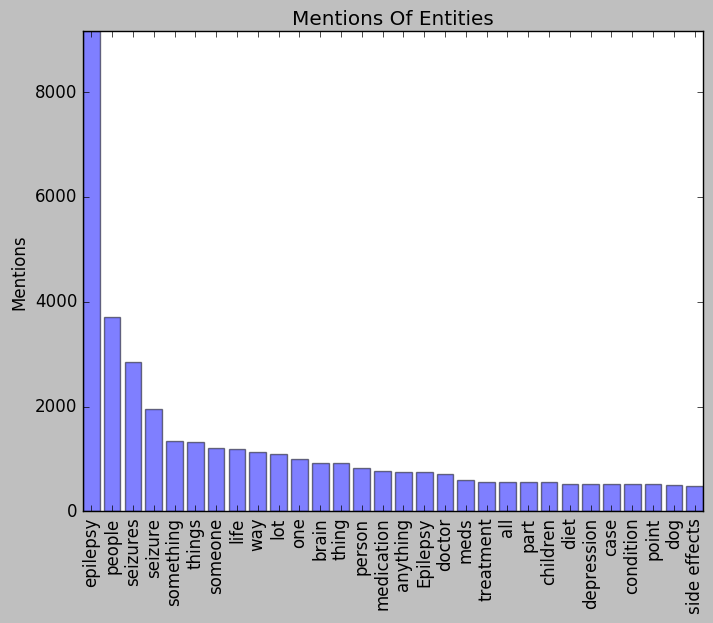
    I also wanted to see how different the entities report was over the three months. There was a lot of overlap from the March chart, showing that conversations about those entities are likely normal.
    Finally, I also looked at the occurrences of specific references to a handful of positive and negative terms that often come up when speaking about epilepsy.
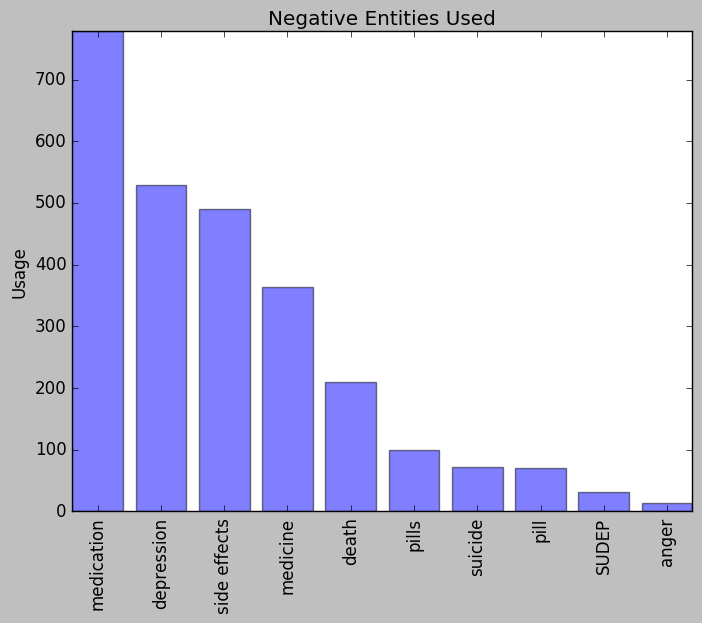
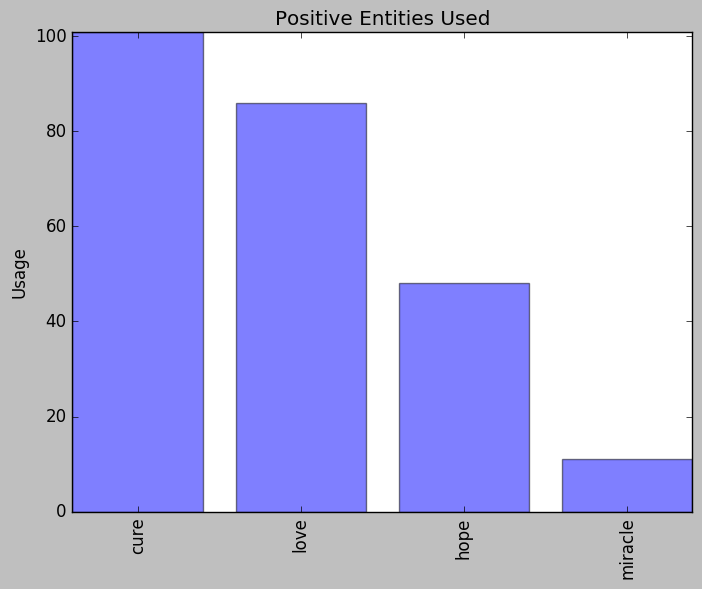
    Looking at the two charts, clearly, references to medication, side effects, and depression were often discussed in the comments on Reddit.

    What’s next?

    This project was a first look at using natural language processing techniques to analyze social media posts about epilepsy. There are a number of applications for such technology, and it will be interesting to explore more sites and using different algorithms and techniques. If you have any thoughts or suggestions on other ways to look at the data, please leave a comment below.

    If you’re interested in doing your own analysis, you can find the source code and other information on my GitHub page. A shout-out to Sara Robinson for her article, which was a guide and huge inspiration.